HomeBlogPage 421

Bangladeahi Theater Activist Ehsanul Aziz Babu Taken Away by DB

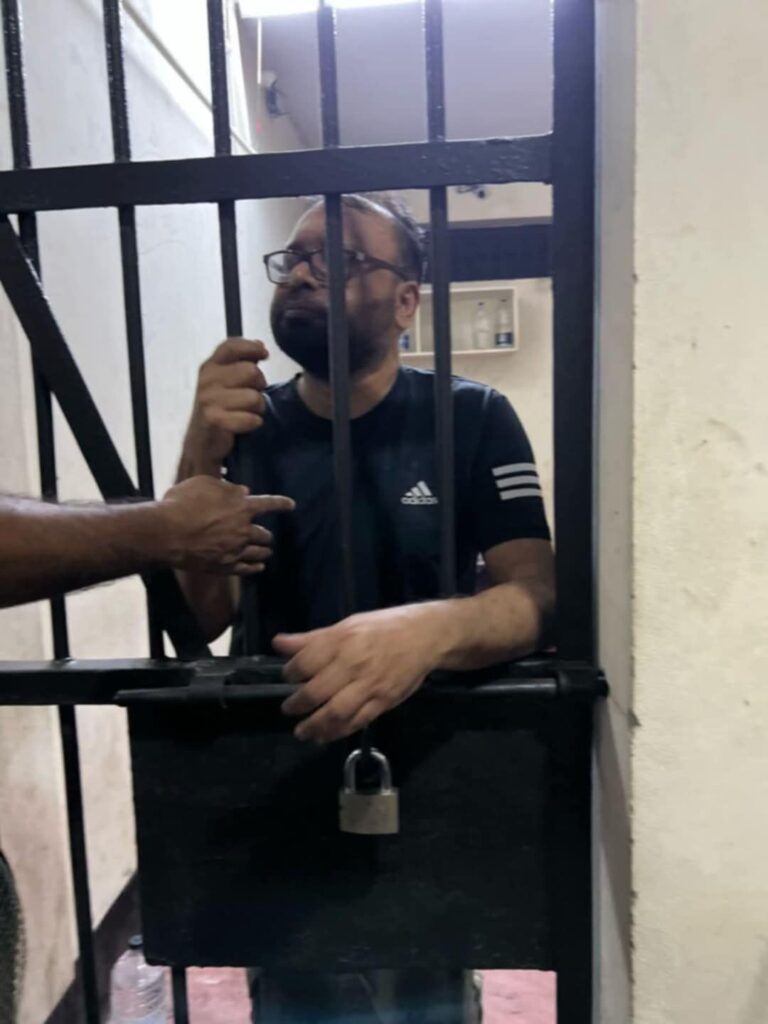
Ehsanul Aziz Babu, a member of the stage drama group Desh Natok, has been taken away by individuals identifying themselves as members of the Detective Branch (DB). The incident occurred on Tuesday night (March 18) at around 10:30 PM. Reports indicate that he is currently being held at Mirpur Model Police Station.

According to Babu’s family, a group of people arrived at Mohammadpur in Dhaka around 10:15 PM and took him away, claiming to be DB police officers.

Reliable sources confirm that the Detective Branch of Gazipur Metropolitan Police conducted the operation and arrested Ehsanul Aziz Babu. He is currently being held at Mirpur Model Police Station and will be transferred to Gazipur Police Station after other operations are completed. He is expected to be presented in court tomorrow.

Both Mirpur and Gazipur police have refused to provide details regarding Babu’s arrest. However, sources claim that he was detained in connection with an online-related complaint.

Ehsanul Aziz Babu is an active member of Desh Natok. Since the beginning, he has been vocal on Facebook, labeling the July Revolution as an anti-state conspiracy. Following the fall of Sheikh Hasina’s government on August 5, he has consistently criticized the interim government led by Dr. Muhammad Yunus.

On October 17, Babu gained attention after making a controversial Facebook post. In the post, he wrote, “Let us all save this country. Say ‘Joy Bangla’ and stand against these anti-Bangladesh, anti-independence collaborators.” He also shared an edited image portraying the interim government’s chief advisor and other advisors wearing Muhammad Ali Jinnah’s signature cap, symbolically portraying them as pro-Pakistan collaborators.

Following this post, on November 3, Babu faced resistance while working on a play at the Bangladesh Shilpakala Academy. Amid protests, the scheduled performance of the play Nityapuran was canceled.

This incident sparked widespread debate on social media. Theater artists took to the streets, protesting the cancellation of the play. Now, news of Babu’s detention has caused panic within the theater community. Fellow artists have demanded his immediate release and safe return to his family.

Bangladesh: Under Pressure from Jamaat, Yunus Government Protests Tulsi Gabbard’s Remarks

The government of Bangladesh, led by MD Yunus, has strongly protested the remarks made by US intelligence chief Tulsi Gabbard regarding the country’s situation. Late on Monday night, the Chief Advisor’s Press Wing issued a statement condemning Gabbard’s comments as “misleading.”

During her visit to India, Gabbard, in an interview in New Delhi, raised concerns about alleged persecution of minorities in Bangladesh. She also claimed that efforts were being made to establish an Islamic caliphate in the country and expressed concerns over Islamic extremism and terrorism. According to her, US President Donald Trump was deeply concerned about the issue, and Indian Prime Minister Narendra Modi also supported Trump’s stance on Bangladesh’s situation.

Gabbard’s remarks sparked strong reactions in Bangladesh, while India welcomed them. Senior officials in New Delhi suggested that her statement reinforced India’s position on Bangladesh.

Facing mounting pressure both domestically and internationally, the Yunus government initially sought to avoid a direct confrontation with the Trump administration. However, hardline Islamic groups, including Bangladesh Jamaat-e-Islami, exerted significant pressure on the government, demanding an official response. Sources suggest that fears of potential US sanctions on Bangladesh for allegedly failing to take adequate measures against terrorism influenced the government’s initial cautious stance. Intelligence agencies also warned that a lack of response could trigger violent protests by extremist groups.

As a result, late on Monday night, the Chief Advisor’s Press Wing issued an official statement addressing Gabbard’s remarks. However, the Ministry of Foreign Affairs was not directly involved in the response.

In its statement, the Bangladesh government expressed “deep concern and disappointment” over Gabbard’s comments. The government rejected her claims of religious persecution and denied any efforts to establish an Islamic caliphate in the country. It emphasized that Bangladesh is historically committed to peaceful and inclusive Islamic practices and has played a crucial role in combating extremism and terrorism.

The government asserted that Gabbard’s portrayal of Bangladesh was “unjust and exaggerated,” urging the international community not to form opinions based on misconceptions. However, the statement did not address specific incidents of minority persecution or counterterrorism measures taken since August 5 of the previous year.

The developments have raised questions about the future trajectory of US-Bangladesh relations in light of the controversy.

TIB Criticizes DMP Commissioner for His Remarks on Avoiding the Word ‘Rape’

Transparency International Bangladesh (TIB) has strongly criticized Dhaka Metropolitan Police (DMP) Commissioner Sheikh Md. Sajjat Ali for requesting the media not to use the word “rape.” According to TIB’s Executive Director, Iftekharuzzaman, this stance indirectly supports perpetrators of sexual violence and is entirely unacceptable. He demanded that the commissioner retract his statement.

Speaking at a human chain protest titled “Stop Violence Against Women and Children, Now!” in front of the National Parliament on Sunday (March 16), Iftekharuzzaman expressed outrage over the commissioner’s remarks.

TIB’s Reaction
Iftekharuzzaman stated, “The police are supposed to ensure women’s safety, yet a senior officer discourages using the term ‘rape’ in media reports. This is shocking and deserves condemnation. His stance appears to protect rapists rather than victims.”

He also criticized the overall approach of state officials toward gender issues, saying, “Our leadership does not demonstrate a pro-women attitude in their words or actions. The presence of such police officials at senior levels reflects a culture that has not changed despite movements for a discrimination-free Bangladesh.”

Media Should Report More on Rape Cases
TIB called for increased media coverage of rape cases instead of reducing their visibility. Iftekharuzzaman urged journalists to reject the commissioner’s appeal and continue reporting on sexual violence forcefully.

Context of the Controversy
On Saturday (March 15), during an event, DMP Commissioner Sheikh Md. Sajjat Ali requested journalists to avoid using the word “rape” because it “sounds unpleasant.” He suggested using terms like “violence against women” instead.

TIB’s Executive Director dismissed this reasoning, emphasizing that softening language could lead to suppressing discussions about sexual violence. He also urged the government to include women’s rights activists in drafting laws for rape prevention to ensure meaningful reforms.

The protest was led by TIB’s Assistant Coordinator for Outreach and Communication, Saimum Mausumi, alongside various human rights activists, including Shamsul Huda, Executive Director of the Association for Land Reform in Bangladesh.

Dr Younu’s Rohingya Gambit: A dangerous game of false promises Aminul Hoque

The Great Repatriation Mirage: Dr Yunus’s Eid-Day Fairytale

For over five decades, the Rohingya people have been fleeing persecution in Myanmar, seeking refuge in Bangladesh. Their numbers have swelled, but a solution remains as elusive as ever. The world knows about this crisis, countless high-level discussions have been held, yet not a single meaningful step has been taken toward their safe and dignified return. The reason? Global politics, backroom deals, and strategic indifference.Now, amidst dwindling international aid and rising desperation, Dr. Muhammad Yunus has entered the scene with a dramatic, headline-grabbing promise. Standing beside UN Secretary-General António Guterres, he addressed the Rohingya in their own language, boldly declaring that they would be sent back to their homeland before next year’s Eid. A problem that has defied resolution for over 50 years—he now claims he will fix in just one.

Who Holds the Strings? The Real Power Players Stay Silent

Repatriation isn’t Bangladesh’s burden alone, yet the nation finds itself at the centre of an issue global powers are happy to ignore. The UN, despite its lofty statements, lacks the teeth to enforce solutions. Meanwhile, the real kingmakers—India, China, and Myanmar’s junta—remain conspicuously uninvolved. Without their buy-in, Dr Yunus’s repatriation pledge has no more weight than a campaign slogan. If Myanmar isn’t the intended destination, then where exactly is this ‘home’ he envisions?

A Dangerous Proposition: A New State on Bangladesh’s Border?

Whispers of an independent Rakhine state led by armed groups like the Arakan Army have surfaced. If such a state emerges, Bangladesh may be pressured into recognizing it and relocating the Rohingya there. But at what cost? The creation of a volatile, unstable neighbor would have catastrophic geopolitical implications for Bangladesh. Border disputes could erupt, territorial integrity could be threatened, and a fragile state could spiral into perpetual conflict. And even if such a state were formed, why would the Rohingya agree to return to a war zone instead of cementing their presence in Bangladesh?

Safe Passage or Diplomatic Trap?

The UN’s suggestion of ‘safe passage’ through Bangladesh for Rohingya refugees adds yet another layer of danger. Framed as a humanitarian effort, it could in reality transform Bangladesh into a transit hub for geopolitical maneuvers, pulling the country deeper into an international quagmire. Instead of easing the crisis, it could further entangle Bangladesh in an unwinnable game.

The Press Gag: Silence in the Face of Hard Questions

Transparency? A foreign concept in this narrative. During the UN Secretary-General’s final press conference, most diplomatic journalists were left out. Instead, a select few—handpicked by Dr Yunus’s administration—were allowed to participate, ensuring that no difficult questions on human rights abuses, extremism, or state failures could be raised. This was not an open dialogue—it was a scripted performance.

A History of Smoke and Mirrors

This is not Dr Yunus’s first foray into political showmanship. His administration has a track record of grand claims—billions in flood relief that never materialized, foreign investments that vanished into thin air, and now, a Rohingya repatriation promise that seems destined to share the same fate. The UN Secretary-General’s visit, rather than being a meaningful step forward, appears to be yet another chapter in a long history of media-driven deception.

What’s the Real Game Here?

Dr. Yunus isn’t naive. He knows his promise is impossible. But then why say it?The timing is suspicious. The UN recently slashed food aid for Rohingya refugees, fueling anger and unrest in the camps. Did Yunus simply throw them a false promise to defuse tensions? Or is this part of a larger political maneuver—a carefully crafted distraction to shift focus away from his own controversies?Either way, the damage is done. By playing to the media, Dr. Yunus may have just pushed Bangladesh further into an inescapable geopolitical trap. And the worst part? Bythe time his promised deadline arrives, he may not even be around to face the consequences.

(Writer: Former Bangldeshi Diplomat and Security Analyst)

Bangladesh’s Descent into Anarchy under Yunus The World’s Silence Is Painful To the Conscience of Humanity

Harun Al Rashid

Bangladesh writhes under the savagery unleashed by Nobel laureate Dr. Muhammad Yunus. Millions face an impossible choice: death, exile, or submission to radical extremism.

On August 5, 2024, the nation experienced one of its darkest hours—a meticulously coordinated terrorist onslaught that shattered its foundations by overthrowing the legitimate government of Prime Minister Sheikh Hasina. As the country burned and order collapsed, Muhammad Yunus emerged as the usurper.

How will it go down in history? Perhaps the most devastatingly successful act of terror—one that reshaped an entire nation overnight.

The Rise of a Terrorist Movement: A Calculated Plan

For years, digital terrorists such as Pinaki Bhattacharya and Elias Hossain have exploited Western countries as platforms for radicalization and manipulation. They have waged an online war against Bangladesh’s government, spreading disinformation and inciting unrest. Just look at how Pinaki, from France, and Elias, from the U.S., orchestrated the destruction of the Bangabandhu Memorial Museum online—an act of sheer brutality and criminality.

Meanwhile, jihadists like Farhad Mazhar and Zahedur Rahman have thrived inside Bangladesh, abusing Sheikh Hasina’s commitment to free speech. Their propaganda fuels extremist hatred against Hindus and India, simply because Hindus feel safe under her rule.

Their fabrications have transformed anti-India sentiment into a psychological disorder among Muslims in Bangladesh who are susceptible to radicalization.

Under Muhammad Yunus’s regime, the media has been both servile and silenced. Brutalities have unfolded daily—hidden from the world. The extremists have convinced Bangladeshis that the West no longer takes Islamic terrorism seriously—giving radicals free rein. And so far, they have been proven correct.

The Destruction of Bangladesh’s Identity

These jihadists have already uprooted Bangladesh’s secular and cultural identity, erasing its history and traditions—under Yunus’s direct supervision.

They haven’t just destroyed museums, murals, sculptures and cultural symbols; they’ve razed hundreds of Sufi shrines and Hindu temples. Under Yunus’s rule, few countries oppress women more. Minorities and secularists live in constant fear, while Hizb ut-Tahrir, IS, and Al-Qaeda flaunt their red and black flags, openly demanding Islamic theocracy. The July–August terrorists came straight from their ranks.

But Yunus didn’t just shield them—he empowered them. His government includes terrorists as ministers, and those he couldn’t install, he patronized—allowing them to form a political party.

As Bangladesh’s Ambassador to Morocco, I was singled out. My ‘crime’? Writing a Bengali novel about Bongobondhu’s early years (1920–1942)—entirely unrelated to later events. Yunus’s hatred for our history isn’t mere contempt. It’s a deliberate, calculated attempt to erase Bangladesh’s very foundation.

Since Its Birth: Secularism vs. Persistent Extremism

Bangladesh was born secular, but from its first breath, Islamists and jihadists conspired to tear it apart. The country’s founding father, Bongobondhu Sheikh Mujibur Rahman, believed in reconciliation, hoping they would embrace the ideals of the Liberation War. They did not. Instead, they murdered him in cold blood.

Decades later, his daughter, Prime Minister Sheikh Hasina, took a similarly tolerant approach. But in the end, she too fell—to the same extremists who had spent years weaving deception into the nation’s fabric, only to strike with barbaric force.

If human rights violations were truly examined, an independent, impartial investigation would reveal a horrifying truth: the atrocities committed in just 15 days after her ouster—under Yunus’s protection—far exceeded those of her entire tenure.

In those two weeks, Bangladesh descended into terror. Mobs lynched hundreds of police personnel—pregnant women begged for mercy, only to be slaughtered. Hundreds of Awami League supporters were beaten to death, their bodies left as warnings. Such barbarity, on such a massive scale, has not been seen in centuries.

This exposes a hard truth: while Bangladeshi secularists repeatedly sought compromise, jihadists never wavered in their mission to annihilate them. Under Muhammad Yunus, that mission accelerated.

The brutality under Yunus makes one truth inescapable: Only Sheikh Hasina stands between Bangladesh and complete theocratic rule.

Sheikh Hasina vs. Yunus

When Prime Minister Sheikh Hasina’s government prosecuted Yunus for corruption, he painted himself as a victim—and the world believed him.

But make no mistake: none of these charges were false. One could argue that others committing similar offenses went unpunished, but that does not absolve Yunus of his crimes.

His greed knew no bounds. Once in power, he wiped his slate clean—escaping justice and dodging 6630 million Bangladeshi Taka in just one case.

The Unquestioned Shield of Muhammad Yunus

Yunus’s goons rampage across Bangladesh, taunting its forsaken people. ‘You can’t picture Yunus as a terrorist—the world won’t buy it. Everyone who matters knows him.’ So far, they’ve been right, and that only deepens the cruelty. They burn, lynch, and brutalize—while we, the victims, remain voiceless, invisible.

Since seizing control, Yunus has torn off his mask—revealing not a reformer, but a tyrant cloaked in deception. His latest deception? Claiming Sheikh Hasina left Bangladesh “like Gaza”—a calculated, insidious lie to inflame his radical Islamist base.

While Sheikh Hasina painstakingly built Bangladesh, Yunus has waged war against it. He has sabotaged its economy, incited riots, and empowered extremists, dragging the nation toward civil war.

Yunus’s Endorsement of Terrorism

But the betrayal runs deeper.

Yunus himself introduced one of the terrorists, Mahfuj Alam, in New York—standing in the presence of former U.S. President Bill Clinton—and presented him as the mastermind of the July-August terrorist attacks.

This demands an answer from the free world:
How would the French react if someone openly celebrated a terrorist responsible for the Charlie Hebdo massacre? How would Americans react if the mastermind of 9/11 were honored in New York, just as Yunus did? Bangladesh felt the same outrage, the same deep sense of injury and humiliation. This was not just an insult to our nation but an affront to justice itself.

The Enigma of Yunus: Garment Workers vs. Grameen Bank Borrowers

When a garment worker in Bangladesh faces poor working conditions, the West erupts in outrage.

But Yunus’s Grameen Bank—built on an even more exploitative model—is hailed as a savior.

Consider this: A garment worker toils in hardship, but she does not carry the weight of debt.

A Grameen borrower, however, takes a loan—then another, and another—trapped in an endless cycle of repayment. She must work harder than any factory laborer, not just to survive, but to outrun a debt disguised as empowerment.

Yet, the West glorifies Yunus while scrutinizing every garment factory mishap.

A Final Appeal

I could cite hundreds of examples of the terrors Yunus unleashed. Yet, this is no rhetoric—every claim here is public and provable. Ignoring the truth won’t erase it.

The West bears a double responsibility in restraining Yunus—he rose to prominence as their protégé. Has a Nobel laureate ever presided over such barbarity in history?

History will remember Yunus, but not as a hero—only as a swindler who deceived the world and descended into terror. In betraying his own nation, he also disgraced those in the West who still champion him.

Yet, this is not a diplomatic note. It is the raw, urgent cry of a man whose country has been stolen, whose life has been shattered—punished by Yunus’s regime for the simple act of writing, for daring to remember history, for remaining loyal to the truth. Today, I am voiceless, a persecuted diplomat, an exiled novelist pleading from the wilderness. But tomorrow, it may be your silence, your apathy, that history condemns. Listen now—not just to me, but to the silenced millions whose cries Muhammad Yunus has drowned in blood and lies.


Harun Al Rashid
A Persecuted Bangladeshi Diplomat and Secular Citizen

Political Tensions in Bangladesh: BCL Leader Minhaz ul Islam Arrested Amid Controversy

Gazipur, Bangladesh – March 13, 2025 – Minhaz ul Islam, Vice-President of the Bangladesh Chhatra League (BCL) Gazipur, Pubail Unit, was arrested on Wednesday at 10 AM, sparking political controversy and raising concerns about the state of democracy in Bangladesh.

Minhaz, a close associate of former BCL Secretary General Golam Rabbani, had supported Independent Candidate Akher Uz Zaman Akhter in the January 24, 2024, election, where Akhter defeated Awami League candidate Meher Afroz Chumki. His arrest has led to speculation about political motivations behind the charges.

According to the Officer-in-Charge of Pubail Police Station, Minhaz was arrested in connection with an arson attack and violence, based on a complaint filed by a BNP activist. However, this statement has raised questions, as critics argue that an arrest before proper investigation suggests political targeting.

One of Minhaz’s close associates dismissed the allegations, claiming, “It is impossible that Minhaz was involved in any arson attack or vandalism. He was working for an independent candidate and had no animosity with other party workers. BNP leaders demanded a huge ransom from him to avoid prison.”

BCL Condemns Arrest, Calls Interim Government “Fascist”

The Bangladesh Chhatra League General Secretary, Sheikh Wali Asif Enan, strongly criticized the arrest, accusing the interim government of targeting BCL activists.

“This illegitimate and fascist interim government is riding a steamroller over BCL activists. Thousands have been arrested on false charges, and many have died in custody. Bangladesh’s prisons are overcrowded, with over 70,000 detainees in facilities meant for 42,000. We call this government inhumane,” Enan said.

Minhaz, a Business Administration graduate, was known for his active political involvement. His family remains distressed, with a relative stating, “This is a political case. We ask for prayers in the month of Ramadan and prefer not to comment further.”

Growing Political Tensions in Bangladesh

The arrest underscores growing political tensions in Bangladesh, with accusations of false arrests and human rights violations under the interim government. BCL leaders argue that their members are being unjustly targeted, while law enforcement maintains that arrests are based on legitimate complaints.

As the legal proceedings against Minhaz ul Islam continue, his case has become a focal point in discussions about political freedom, student activism, and the integrity of Bangladesh’s justice system. Many will be watching closely to see how this case unfolds and what it means for the future of political activism in the country.

Bangladeshi American Diaspora Demands UN Probe into Volker Türk

New York, March 10, 2025 – A coalition of Bangladeshi American community leaders has formally urged the United Nations to investigate and suspend UN High Commissioner for Human Rights Volker Türk, accusing him of exceeding his authority and interfering in Bangladesh’s internal affairs.

In a letter addressed to UN Secretary-General António Guterres, the group alleged that Türk made politically motivated statements regarding Bangladesh’s military and its role in the country’s political transition. Specifically, they cited his BBC HARDtalk interview, where he reportedly warned the Bangladesh Army about potential consequences, including exclusion from UN peacekeeping missions, if it engaged in violence against protesters during the July-August 2024 unrest.

The letter, signed by several prominent figures from the Bangladeshi American community, argued that Türk’s remarks constituted a violation of Article 2(7) of the UN Charter, which prohibits the UN from intervening in matters within a nation’s domestic jurisdiction. The signatories emphasized that only the UN Security Council or the Department of Peace Operations has the authority to make decisions about peacekeeping participation, not the High Commissioner for Human Rights.

Allegations of Bias and Political Influence

The group also criticized an OHCHR report on the Bangladesh protests, claiming it was biased against the former Awami League-led government while downplaying violence committed by opposition groups, Islamist militants, and criminal factions. They argued that the report failed to acknowledge a series of violent incidents, including mob attacks, targeted assassinations, and arson against government supporters.

Additionally, the letter raised concerns about Türk’s alleged connections with Nobel laureate Dr. Muhammad Yunus, who was named as a key figure in Bangladesh’s political transition. The signatories questioned whether Türk’s actions were influenced by personal or political motivations, calling for an inquiry into his relationship with Yunus and his role in the resignation of former Prime Minister Sheikh Hasina.

Demands for UN Action

The signatories urged the UN to take the following steps:
1. Conduct a thorough investigation into Türk’s alleged involvement in Bangladesh’s political transition and any conflicts of interest.
2. Suspend Türk from his position pending the outcome of the inquiry.
3. Examine potential bias in Türk’s actions and whether he held any personal animosity against the former government.
4. Ensure future UN reports on Bangladesh are balanced and reflective of all sides of the conflict.

The letter warned that failure to address these concerns could damage the credibility of the United Nations and its commitment to neutrality in global affairs.

As of now, neither Volker Türk nor the UN has publicly responded to the allegations.

Historical March 7th Speech: The Formation of Bangladesh

Engineer M. Hossain
Fellow of the Institution of Engineers, Bangladesh

On March 2, 1971, the flag of Bangladesh was raised by students at Dhaka University, a moment that echoed the courage and determination of the Bengali people in their demand for independence and their assertion of Bengali identity against an oppressive regime. Despite the imposition of a curfew later that evening, the undeterred populace faced violent suppression from security forces. As hospital injuries increased, Sheikh Mujibur Rahman cautioned, “Do not ignite fires in Bangladesh. You will not be spared from the blaze if you do,” and urged, “Be careful; do not confront the people with force.” This was a testament to the unwavering courage and determination of the Bengali people, a source of inspiration and pride for generations to come.

On March 3, a commemorative procession was conducted to honor the victims of the previous night’s violence. In Palton, Sheikh Mujib proclaimed, “If you do not want a constitution enacted through democratic means, then you can all write your constitution. We will write the constitution for Bangladesh.”

Dr. Kamal Hossain noted that on March 6, the Awami League’s executive committee convened to strategize Sheikh Mujib’s forthcoming address on March 7. Given the prevailing national sentiment, there was a pervasive expectation that he would declare independence, particularly among the youth and student factions, who had been fervent advocates for the cause. The political landscape indicated that refraining from a declaration of complete independence would not meet the aspirations of an increasingly politically conscious populace.

As the leading political party, the Awami League was entrusted with the dual responsibility of maintaining momentum within the movement and ensuring the safety of the people. Any misstep or misstatement could potentially justify Pakistani military action against the largely unarmed civilians. Sheikh Mujib’s position within Pakistan’s broader political framework further complicated this delicate balance, as he was the majority party’s leader in Parliament. This position generated considerable pressure from the youth, who had already signified their commitment by raising the Bangladeshi flag.

March 7, 1971, is pivotal in Bangladesh’s liberation struggle narrative. During a monumental gathering at Racecourse Ground in Ramna, Sheikh Mujibur Rahman articulated the fundamental underpinnings for the liberation of Bengalis from Pakistani oppression. This address not only galvanized the populace of East Pakistan but also inspired a collective movement toward independence. Notably, poet Nirmalendu Goon has characterized this speech as an epic, while Newsweek magazine highlighted Sheikh Mujib as “A Poet of Politics.”
On March 6, 1971, the pressure on Sheikh Mujibur Rahman to declare independence reached a critical point. That day, he engaged in an extensive discussion with President Yahya Khan, during which the President urged him to refrain from taking any actions that would preclude the possibility of negotiation. The intense debate lasted several hours, with both leaders presenting their arguments and concerns. Later that same day, President Yahya announced that a National Assembly session would occur in Dhaka on March 25. However, the implicit threats conveyed in the President’s remarks contributed to escalating tensions among the populace of East Pakistan. In this climate, the Awami League and the student league intensified their calls for Sheikh Mujibur to declare the independence of Bangladesh. The following day, preparations were underway at Bangabandhu’s residence in Dhanmondi in anticipation of a significant public gathering scheduled for March 7.

Joseph Farland, the U.S. Ambassador to Pakistan, warned Sheikh Mujib that the U.S. would not support Pakistan’s disintegration, complicating international backing for Bangladesh’s independence. This position highlighted Bangladesh’s geopolitical challenges in its struggle for freedom and added complexity to the situation.

Amid this atmosphere of uncertainty, Sheikh Mujib delivered his historic address on March 7 at 2:30 PM before a massive assembly at Racecourse Ground. Clad in traditional attire—white pajamas, panjabi, and a black Mujib coat—he placed his heavy-framed black glasses on the table and calmly addressed the audience with gravity. The choice of his traditional attire and the setting of the Racecourse Ground added a visual element to the narrative, helping the audience better imagine the scene.

“My brothers, today I stand before you with a heavy heart. You all know and understand that we have tried with our very lives.”

In his address, Bangabandhu Sheikh Mujibur Rahman highlighted the gravity of the historical struggles faced by the people of Bengal, “It is with sorrow that I must speak of the painful issue today: the tragic history of 23 years, the history of the oppression of Bengal, the blood of the people of Bengal, the history of the cries of dying men and women for 23 years, and the history of this land stained with the blood of its people.” This poignant invocation of historical trauma served to contextualize the current political landscape.

Bangabandhu notably distanced himself from personal ambition, emphasizing, “I do not seek the position of Prime Minister. We want the rights of the people of this country.” His speeches were not just eloquent oratory but also a strategic mobilization of support, a testament to his unwavering commitment and astute leadership. His proclamation highlighted this: “As I have given blood, I will give more blood to free the people of this country, God willing. This time’s struggle is the struggle for our liberation; this time’s struggle is the struggle for independence. Joy Bangla.” This statement effectively encapsulated the multifaceted nature of the Bengali struggle, focusing on themes of liberation and independence.

Although the speech was delivered without a script, Bangabandhu’s composure and emotional resonance displayed a masterful command of rhetoric. His effective use of regional vernacular played a significant role in bridging the gap between him and the grassroots audience, ensuring that his message was heard and felt. By incorporating local dialects, he invigorated his discourse’s emotional and cultural undertones, prompting a robust collective response from those in attendance. The emotional resonance of his words made the audience feel a deep connection and empathy with the struggles he described, fostering a sense of unity and shared purpose.

Bangabandhu’s command of the Bengali language is evident in phrases such as “23 years of history, a history of the cries of dying men and women” or “The history of Bengal is the history of staining the roads with the blood of the people of this country,” which raises questions about the preparatory processes behind the speech. Having drafted his address that day, he may have mentally composed his speech from Dhanmondi Number 32 to Ramna Race Course (Suhrawardy Udyan), succinctly outlining the historical context, ongoing struggles, necessary actions for the populace, and a bold declaration for independence.

Bangabandhu was fluent in English but intentionally avoided using unnecessary English words in his March 7 speech. He used terms such as “President,” “National Assembly,” “Secretariat,” and “Supreme Court,” which are familiar in Bengali, and pronounced them in English. However, for words like “economical,” “culture,” “independence,” and “leaders,” he chose to use the Bengali pronunciation instead of the English versions. This decision made his address accessible to uneducated villagers and educated urban dwellers, fostering inclusion and respect for all audiences. This choice made his address accessible to uneducated villagers and educated urban dwellers, promoting inclusion and respect for all audiences.

The speech, delivered on March 7, 1971, resonated emphatically with attendees at Race Course. Subsequent radio broadcasts ensured that its powerful message reached a nationwide audience. The clarity and urgency of his words continue to reverberate, facilitating understanding among listeners globally.

Some commentators have likened Bangabandhu’s speech to poetry, particularly noting the potency of his concluding remarks: “This time the struggle is our liberation struggle; this struggle is for independence.” This statement introduces a nuanced distinction between the concepts of liberation and independence. While independence connotes political and territorial sovereignty, liberation encompasses economic, cultural, and psychological dimensions. A nation cannot claim freedom solely based on political independence; true liberation involves a multifaceted reclamation of identity and autonomy. Bangabandhu envisioned a comprehensive liberation that imbued independence with profound significance, countering the compromises of identity endured by citizens in Pakistan.

In his address, Bangabandhu Sheikh Mujibur Rahman presented his remarks to Yahya Khan and Zulfikar Ali Bhutto with a mix of sarcasm and respect, notably referring to them as “Mr. Yahya” and “Mr. Bhutto.” He asserted, “We will kill you by stopping the rice; we will kill you by stopping the water.” Furthermore, he stated, “You are my brothers. Remain in the barracks; no one will comment on your presence.” This expression of civility was unprecedented among the leaders in Pakistan.

In his speech delivered on March 7, Bangabandhu skillfully guided the audience toward a resolution. He began by expressing sorrow and addressing the historical deceit the central Pakistani government practiced. He asked the crowd a critical rhetorical question: “What wrong did we do?” This question effectively stirred the audience’s awareness of their circumstances. As discontent regarding the manipulative actions of the Pakistani authorities began to emerge, he followed this with another thought-provoking question: “What have we truly gained from this?” This further encouraged profound reflection among the attendees. He emphasized a significant irony: the arms procured for national defense were used against the Bengali populace. This contradiction served as a clear reflection of the escalating public dissatisfaction.

Bangabandhu shifted his attention from the specific challenges faced by the Bengali people to the broader political landscape involving Yahya Khan. He recounted a significant five-hour confidential meeting concluding with Yahya Khan attributing blame for the prevailing tensions between Bangabandhu and the Bengali populace. This account clarifies for the audience the distinction between adversaries and allies.

He reiterated, “The brothers belong to me,” emphasizing that he could not join the legislative assembly “at the cost of sacrificing that martyr.” This statement marked the beginning of the most passionate segment of his speech. He called for a strike and issued directives to ensure that the poorest members of society would not suffer during this unrest. He advocated for a non-cooperation movement, urged everyone to build fortifications in their homes, and encouraged them to use “whatever means necessary” to resist oppression. This bold proclamation energized the populace and laid the groundwork for the Liberation War.

We were living within the framework of Pakistan at that time. We cannot be separatists. The majority can never be separatists. There is an international community. They do not readily accept separatists. Therefore, in narrating the history of his own country’s people, he wanted to send this message to the international community: Bengalis are always in favor of peace. West Pakistan and the central government are in favor of unrest and are not only depriving the Bengalis of their rightful rights but are also trying to suppress them with gunfire.

This foresight of Bangabandhu was instrumental in shaping the quest for independence. The government of Bangladesh later framed its struggle within the context of being war victims, asserting their experience of a ‘due process of law’ that the Pakistani authorities systematically disregarded. This legal narrative garnered significant international support, spotlighting the plight of Bengalis. The Bangladeshi government-in-exile drew upon the core values articulated during the March 7 speech, with the Proclamation of Bangladeshi Independence issued from Mujibnagar on April 10, reflecting its inspiration.

Given Bangabandhu’s keen awareness of the delicate circumstances surrounding him, it is reasonable to suggest that he foresaw the potential repercussions of his actions. He implemented two strategic initiatives: first, to demonstrate to the international community the steadfast commitment of the Bengali people to a peaceful and nonviolent resistance movement; second, to prepare the populace for the possible eventuality of his arrest or assassination, thereby equipping them to manage such challenges effectively.

On March 7, 1971, Bangabandhu issued a directive on how to respond in case he was unavailable or if the authorities disregarded his request: “If, after this, the salary is not paid, if a single shot is fired, and if my people are killed, I have one request: Build a fortress in every home. Confront the enemy with all your strength. Even if I cannot give the command, you must block the roads permanently and resist the enemy with everything you have for the sake of life.”

Sheikh Mujibur Rahman delivered a pivotal address that encapsulated the urgency of the political situation in Bangladesh. He declared an indefinite closure of courts, offices, and educational institutions, urging citizens to collect their salaries on the 28th while underscoring the importance of solidarity among workers. His speech showcased meticulous attention to detail, a rarity in extemporaneous addresses, and addressed potential discord due to external influences, stating, “In this land, Hindus and Muslims, Bengalis and non-Bengalis are all our brothers.” He emphasized mutual protection to avoid damaging reputations amidst rising tensions.

A balanced yet emotionally impactful speech during a crisis is rare, and it is surprising how he delivered one today. Pakistani Major Siddique Salik noted, “Towards the end of the speech, he advised the crowd to remain calm and nonviolent. Initially surging with great emotion like ocean waves, the crowd returned home like a receding tide. They resembled a group coming back from a religious gathering—a mosque or a church—carrying a sense of satisfaction and a divine message in their hearts. It was as if the fire within them had been extinguished. If they had chosen, that fire could have been unleashed in an attack on the cantonment, which many feared. This speech brought relief to the Martial Law Headquarters. During a phone call from the headquarters, a high-ranking official remarked that the martial law administrator stated it was the best speech under the circumstances.”

Dr. Kissinger reported that an immediate conflict between East and West Pakistan was avoided, but the situation remained unchanged, viewing the speech as a temporary fix to the political crisis.

The founder of the BNP, Ziaur Rahman, wrote, “Bangabandhu’s historic announcement at the Race Course Maidan on March 7 felt like a ‘green signal’ for us. We finalized our plan but did not inform anyone else about it. Tensions between Bengalis and Pakistani soldiers were gradually reaching a peak.”

Maidul Hasan explained, “Perhaps, following the non-cooperation movement that lasted more than three weeks, there was a radical transformation in the political consciousness of the common people of Bengal. With the onset of the brutal genocide by the Pakistanis, the independence of Bengal became their common and singular goal. Sheikh Mujib’s announcement on March 7 became a guiding beacon for most people.”

Many people compare Bangabandhu’s March 7 speech to Abraham Lincoln’s Gettysburg Address, but the two speeches serve different purposes and come from other contexts. Lincoln was the President of the United States, and his goal was to abolish slavery in America, which led to the Civil War in 1861. On one side were the Confederates, who supported slavery, and on the other were the Unionists, who opposed it. A fierce battle occurred in Gettysburg, Pennsylvania, where many soldiers lost their lives, and ultimately, the Unionists emerged victorious. Lincoln visited Gettysburg to pay his respects, and during this visit, he delivered a three-minute speech emphasizing the protection of democracy.

Unlike Lincoln, Bangabandhu had the critical responsibility of uniting a nation for independence within the framework of an existing state. He had to prepare his people for the fight for freedom while ensuring that his call did not appear separatist. His March 7 speech served as a declaration of liberation for the Bengali people and holds far greater significance in that context.

After Sheikh Mujibur Rahman’s seminal address on March 7, 1971, East Pakistan experienced a profound transformation that catalyzed a robust national liberation movement. The non-cooperation movement rapidly gained traction, with Sheikh Mujib’s directives perceived as imperative, garnering support even among government officials. This marked a critical juncture in the region’s political landscape, as calls for autonomy and self-determination intensified, setting the stage for the eventual struggle for independence.

Dr. Borhanuddin Khan Jahangir articulated that the groundwork for Bangladesh was laid through the non-cooperation movement initiated in March 1971, which aimed to reject the institutional framework of Pakistan. Sheikh Mujibur Rahman’s role was critical in converting this resistance into a structured political campaign for state formation. His communication of a vision for an independent state was bolstered by a set of 35 directives that established the foundational principles for Bangladesh’s emergence and outlined prospective state policies ahead of the liberation war. This emphasized that the sovereignty of Bangladesh rests with its populace, which encompasses civil authority, law enforcement, and military command. In this context, Sheikh Mujibur Rahman is venerated as the Father of the Nation, a testament to his accountability and leadership.

Bengalis were intensely anticipating Bangabandhu’s speech on March 7. Shaheed Janani Jahanara Imam noted in her diary her eagerness to hear the speech from home despite being unable to attend the meeting. She expressed annoyance at delays caused by Subhan in the kitchen. In another household, Panna Kaisar’s family felt the historical significance of the speech, with Shahid Shahidullah Kaisar asserting that his unborn son would hear the Declaration of Independence.

Bangabandhu’s invigorating address on March 7 catalyzed the liberation war, rallying around seventy million Bengalis against the Pakistani military. The weeks between March 7 and March 25, 1971, became crucial for Bengalis, akin to the October Revolution for Russia. On March 26, following a brutal Pakistani military operation on March 25, Bangabandhu proclaimed independence. While the March 26 Declaration is recognized as a significant milestone, the foundation of Bangladesh was established on March 7. The momentum of the non-cooperation movement in Bangladesh gained rapid traction, surpassing Mahatma Gandhi’s campaigns.

Even as Bangabandhu languished in a distant prison in Pakistan—a fate uncertain for many—his words, disseminated via the Shadhin Bengal Radio Center, sustained hope among the oppressed populace. Freedom fighters eagerly awaited the radio program “Bajrakantha,” while Bangabandhu’s phrases became synonymous with the liberation effort, with “Joy Bangla” emerging as the movement’s rallying cry.

The nation achieved a monumental victory on December 16, 1971, albeit at an exorbitant cost—enduring the sacrifice of three million martyrs, the victimization of over two hundred thousand women, and the displacement of nearly ten million people. The nine months of the liberation war were marked by profound sacrifices, ultimately culminating in the hard-won independence of Bangladesh.

Bangabandhu poignantly encapsulated this historic juncture in his address on March 7, when he powerfully declared:

“This time’s struggle is the struggle for our liberation,
This time’s struggle is the struggle for our independence.”

The speech highlights UNESCO’s Memory of the World Register, which recognizes essential documentary heritage. This announcement marks Bangladesh’s first Memory of the World Programme entry. On October 30, 2017, in Paris, Irina Bokova, the Director-General of UNESCO, made this decision public. This achievement is now a source of pride for Bangladeshis and a valuable global asset.

Violence Against Women is Increasing in Bangladesh

Engineer M. Hossain
Fellow of the Institution of Engineers, Bangladesh

The rising prevalence of gender-based violence in Bangladesh underscores an urgent need for comprehensive interventions and strong policy frameworks that tackle the complex societal, economic, and cultural factors driving this issue. During the significant student movement in July and August, women and female students emerged as vital advocates for systemic change. However, in the wake of this mobilization, there has been a concerning increase in violent incidents, including rape, physical assaults, harassment, and various forms of sexual violence against women. Notably, reports show a significant rise in harassment cases following Sheikh Hasina’s departure from leadership, raising serious concerns about the implications for women’s participation in public and social spheres. This trend calls for a thorough analysis of the contributing factors and a concerted effort to design effective strategies to mitigate gender-based violence and promote women’s rights and safety in Bangladesh.
A notable incident in Cox’s Bazar beach involved an individual named Farukul, who was filmed compelling a woman to perform degrading actions while threatening her with a wooden stick. Additional footage captured him harassing a woman seated on a beach chair at night. Another clip depicts a woman requesting her mobile phone from a group of policemen, with Farukul present. He has shared these incidents on his Facebook account, describing them as efforts against indecency, stating, “I will conclude my office hours today and commence my efforts against indecency, InshaAllah.”
On September 11, several harassment incidents involving women at Cox’s Bazar beach gained media attention, highlighting public safety issues for women in recreational environments. An escalation occurred on September 21 when mountaineer Shayla Bithi was physically assaulted while crossing a bridge in Dhanmondi, Dhaka. While many of these incidents receive limited mainstream media coverage, an increasing number of women are sharing their experiences on social media, indicating a rise in reported feelings of fear and vulnerability.
There have been alarming reports of harassment, abuse, rape, lynching, and cyberbullying against women in Bangladesh, affecting individuals from all backgrounds. These incidents reflect a broader trend of violence and intimidation toward women. Violence against women, especially rape, is a significant and ongoing issue in our country. A recent case involved a vulnerable woman with mental health challenges who was gang-raped during the floods in Titas Upazila, Comilla, while seeking humanitarian aid (Prothom Alo, August 31, 2024). On September 24, a teenage girl who lost her way was gang-raped twice in Chittagong (Samakal, September 25, 2024). On September 14, a seven-year-old child was raped in Pabna’s Santhia (Jugantar, September 15, 2024). On September 6, a female driver and assistant were raped in a moving bus in Chittagong around 9 pm (Prothom Alo, September 11, 2024). An American woman was a victim of indecency in broad daylight in Cox’s Bazar city on March 10 in a public place. Recently, a woman was gang-raped while on a moving bus in the Tangail area. An attack on two students in Lalmatia, the harassment of a student by library staff at Dhaka University, attacks on the hijra community in Cox’s Bazar, assaults on young girls in football fields in Rangpur and Joypurhat, and the increasing oppression faced by Indigenous women.
Violence against marginalized groups, particularly women, is rising in Bangladesh. Women face severe threats of gender-based violence, including high rates of rape. The ineffective prosecution of offenders exacerbates the issue. The March 1 attack in Lalmatia, where two women were assaulted for smoking, led to public outrage. Instead of condemning the perpetrators, the Home Affairs Adviser blamed the victims, increasing public unrest. On March 3, protesters demanded accountability and the resignation of Md Jahangir Alam Chowdhury for his remarks. This ongoing violence causes significant harm to victims and their families.
In the first two months of 2025, nearly 400 women and children have fallen victim to rape and harassment, including 157 young girls. In January 2025, a total of 85 girls and 120 women were subjected to torture. This information comes from Mahila Parishad’s monthly report on the torture of women and girls for January. Among these victims, 67 were raped. Within this group, 20 individuals, including 14 girls, were gang-raped, and two people, including one girl, were killed after being raped.
In February, alarming statistics emerged regarding gender-based violence, with 189 reported cases nationwide, including 48 incidents of rape, two attempted rapes, and eleven cases of gang rape. Additionally, the data revealed that 46 individuals, including 10 daughters, were murdered for various reasons. The following month saw a significant increase in violence against women, and the actual incidence is likely underreported, primarily according to media sources.
In addition to the violence targeting women, there has been a noticeable rise in assaults on various religious and ethnic minority groups, including Hindus, Christians, and the Ahmadiyya community. The Bangladesh Christian Association documented several attacks on places of worship, such as the Church of Bangladesh in Naogaon and the Evangelical Holiness Church in Dinajpur, as well as assaults on Christian homes in multiple locations, including Gouranadi, Barisal, Khulna City, Haluaghat in Mymensingh, and Parbatipur (Prothom Alo, August 12, 2024).
The shifting political landscape poses risks to societal stability, particularly as individuals experience violence based on gender, ethnicity, or faith. The hope for meaningful state reform in Bangladesh has sparked a mass student movement, reflecting a strong desire to address and heal the gender-religious divide. However, the past seven months have shown a concerning rise in violence, especially against women, necessitating a critical analysis that goes beyond simplistic labels like ‘mob violence.’
A thorough examination of the political economy surrounding these events is essential. The concept of “toxic masculinity” significantly influences criminological discourse; societal norms that glorify aggression and dominance among men play a crucial role in perpetuating misogyny. Clinical psychologist Nicholas Groth clarified in 1977 that power dynamics, anger, and sexuality are central to violence against women. The long-term consequences of these deeply ingrained beliefs remain poorly understood and could present significant obstacles to societal progress for an extended period.
In Bangladesh, the relationship between men and women is heavily influenced by entrenched patriarchal norms, resulting in a widespread culture of sexual violence that poses significant challenges to the interim government’s goal of fostering an “anti-discriminatory society.” The prevalence of sexual violence has reached alarming levels, threatening social stability and developmental progress. Despite having had female political leadership over the years, practical measures to address and prevent sexual violence remain inadequate.
Currently, the rise of religious extremism has led to an increase in violence against women, with concerns that there is indirect support from groups closely tied to Dr. Yunus’s government. This situation is deeply troubling. Without substantial government intervention and societal pushback, the oppression of women is likely to persist, undermining national progress. Women, who make up half the population, often experience insecurity even within their own homes. A safe environment is crucial for individual families and the cohesion of society.
While incidents of violence often occur in public spaces, many go unreported, contributing to a culture of impunity where perpetrators frequently evade justice and victims risk retaliation. Offenders come from a broad range of socio-economic backgrounds, which intensifies the climate of fear and silence. To combat this pervasive issue, disclosing the identities of offenders could raise public awareness and encourage communities to remain vigilant against such acts. Private entities, educational institutions, and human rights organizations need to collaborate on publications addressing sexual violence in Bangladesh.
Despite widespread condemnation of these atrocities, fear and a sense of powerlessness often silence public outcry. The intersection of sexual violence and women’s oppression stifles both social development and the potential of men, as women constrained by fear cannot participate fully in education, work, and civic life, thus hindering national progress. To build a prosperous Bangladesh, eradicating sexual violence must be a priority. Establishing a safe environment for all citizens requires collective action from all stakeholders to confront this urgent crisis.
Improving the status of women necessitates both ideological shifts and practical reforms, particularly the implementation of stricter legal frameworks. The interim government, which arose from mass protests, has a responsibility to address violence against women decisively. Current governmental shortcomings in responding to ongoing violence and ensuring accountability for offenders send a damaging message that such acts are tolerated. Moreover, government representatives often downplay the severity of the issue and fail to protect at-risk women adequately.
Acknowledging the diversity of women’s interests and backgrounds in this discourse is crucial. Immediate and robust action against offenders, along with responsible media coverage of protests against violence, is essential. Misrepresentation in the media can exacerbate insecurity; thus, maintaining journalistic integrity and providing accurate narratives is vital for effectively shaping public perception.

We reject the normalization of violence against women and assert that all women should be able to exercise their rights without fear. Calls to remove home adviser Jahangir Alam Chowdhury highlight the urgent need to restore safety and institutional trust. We stand firm against silence and will mobilize until we can live freely and with dignity.
The troubling lack of accountability in cases of rape and harassment is compounded by a societal tendency to redirect blame towards women who allegedly fail to conform to conservative standards. This double standard reinforces victim-blaming, which undermines the pursuit of justice. A notable incident involving the harassment of a female student by a staff member at Dhaka University exemplifies the entrenched misogyny within our legal frameworks. Provisions like Section 509 of the Penal Code and Section 10 of the Nari-O-Shishu Nirjaton Domon Ain emphasize female “modesty” and undermine women’s rights and autonomy. Misinterpretations of religious values further restrict women’s agency.
A profound commitment to women’s rights is essential for fostering genuine equality, as it contrasts sharply with control and subjugation. The glorification of abusers in various contexts entrenches a culture of impunity, perpetuating cycles of violence and oppression. Addressing victim-blaming and the systemic silence surrounding gender-based violence is crucial for achieving meaningful justice.
The ongoing protest serves as a manifestation of resistance against gender-based violence and systemic oppression in Bangladesh, demanding accountability and an unequivocal end to violence against women. Misinterpretations of religious doctrines can significantly undermine women’s autonomy, limiting their contributions to societal development. It is vital to recognize that acknowledging women’s rights is not merely a moral obligation but a prerequisite for holistic societal progress.
Continued victim-blaming and pervasive silence remain significant obstacles in the pursuit of justice, reinforcing a status quo that is detrimental to social cohesion. This protest is part of a broader movement that aims to dismantle the structures enabling gender-based violence and systemic oppression in Bangladesh, emphasizing the urgent need for accountability mechanisms and the cessation of violence against women.
Furthermore, the overall development trajectory of any society faces substantial challenges when a significant portion of the population experiences oppression and fear. The potential for societal advancement is severely limited when a considerable demographic lives in doubt and insecurity. This idea is echoed in the words of national poet Kazi Nazrul Islam, who stated, “Whatever great creation exists in the world is eternally beneficial; women and men together make up half of it.”
Finally, it is crucial to examine the recent incidents that illustrate how gender discrimination and sexual violence not only violate human rights but also negatively impact a nation’s economy and stability.

Sajeeb Wazed Joy Denounces ‘Purbachal Plot Scam’ as Political Smokescreen

Dhaka, March 11, 2025 – Sajeeb Wazed Joy has strongly condemned the allegations surrounding the so-called “Purbachal Plot Scam,” calling it a politically motivated distraction orchestrated by the #Yunus regime to shift public focus from the country’s deteriorating law and order situation.

In a statement, Joy asserted that the charges against him, his mother, and other family members were fabricated to tarnish their reputation. “Whenever the illegal #Yunus regime faces governance failures, they resort to making baseless accusations against my family through foreign media,” he stated.

The allegations involve corruption in the allocation of residential plots in the Purbachal Project, a claim Joy vehemently denied. “The entire process followed legal procedures, and there was no wrongdoing. Yet, they continue to make baseless allegations without providing any evidence,” he said.

Joy further accused the Anti-Corruption Commission (ACC) of being politically compromised after its recent reconstitution in December 2024. He pointed out that the new ACC Chairman, Dr. Mohammad Abdul Momen, had previous ties to BNP, having served as Khaleda Zia’s private secretary. He also claimed that Momen had been forced into retirement by the Awami League government over corruption allegations during his tenure as Biman MD and CEO.

“This is nothing but a smear campaign led by a biased and compromised official. No credible investigation can be expected from such a politically influenced ACC,” Joy concluded.

The allegations have sparked fresh political tensions as Bangladesh continues to grapple with rising violent crimes, including rape, extortion, and robbery. Meanwhile, the government has yet to respond to Joy’s accusations regarding the motives behind the charges.