
Missile Chemicals, Millions of SIM Cards, Regional Security and Government Silence: Who Was Behind the MV Star Line Shipment?

PARVEZ HASHEM
(405 tonnes of strategic chemicals, millions of blank SIM cards, questionable shipping documents and an unidentified destination raise serious questions about Bangladesh’s national security.)
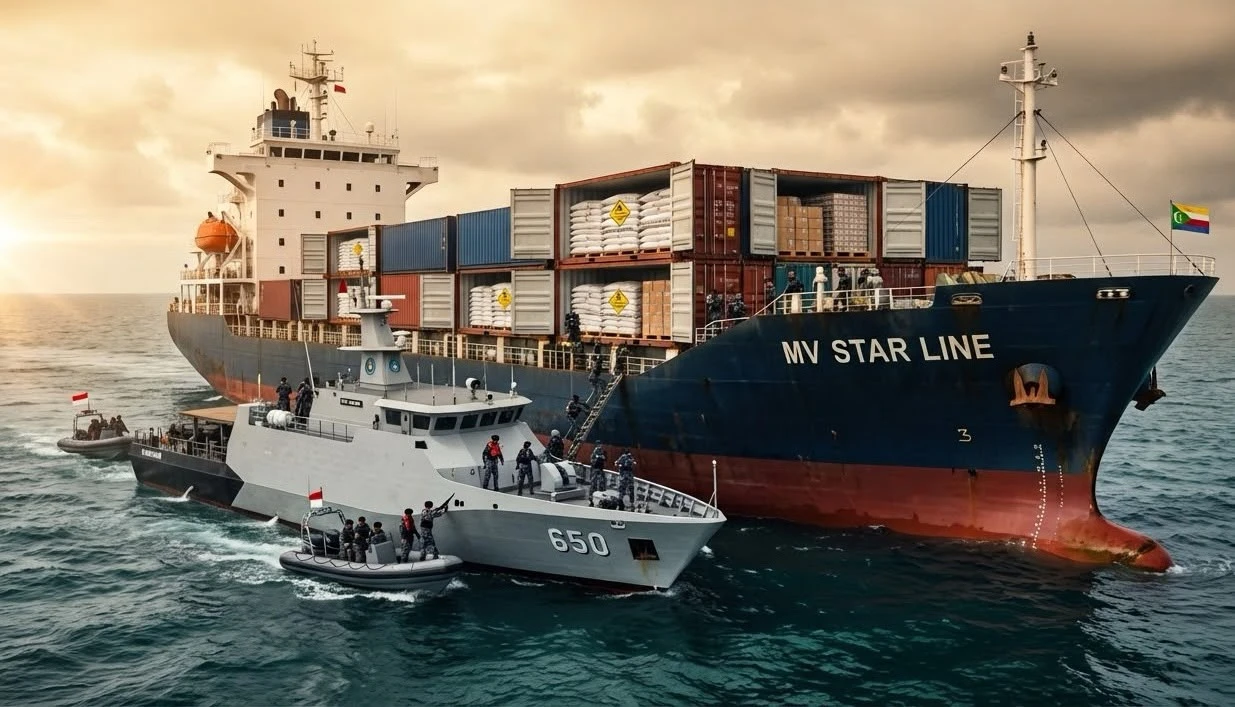
The seizure of the Comoros-flagged cargo vessel MV Star Line by the Indonesian Navy has raised serious questions about an unexplained shipment reportedly bound for Bangladesh from China. The vessel was intercepted on November 7, 2026, in waters off Belawan, North Sumatra, carrying 405 tonnes of sodium perchlorate and millions of blank 4G LTE SIM cards.
According to the Indonesian Navy’s November 20 announcement, the vessel was found carrying the chemical in 15 of its 36 containers, alongside SIM cards stored on 54 pallets. The ship was reportedly travelling from China’s Lianyungang Port to Mongla Port in Bangladesh. Its registration status was reportedly suspended, and investigators identified irregularities in its shipping documents.
The Indonesian authorities have launched an investigation. However, the circumstances surrounding the shipment raise questions that extend beyond maritime smuggling. They concern Bangladesh’s customs oversight, national security, regional stability and possible links to transnational criminal networks.
Who Was Supposed to Receive the Shipment?
One of the most concerning aspects of this incident is the lack of publicly available information about the importer, consignee, cargo owner, and intended end-user.
Who ordered 405 tonnes of sodium perchlorate? Which Bangladeshi company was supposed to receive it? Who financed the purchase? Was the shipment intended for a legitimate industrial purpose, or was it destined for another party?
According to reporting by The Daily Star on November 24, Mongla Customs officials said they had no information about the vessel. No Import General Manifest (IGM) had been filed on the National Board of Revenue’s system, and customs officials could not identify a local shipping agent.
Bangladesh’s customs framework requires shipping agents to submit import manifest information electronically. Section 43 of the Customs Act, 1969, and subsequent electronic manifest procedures establish the reporting requirements. The absence of an IGM is particularly concerning if the vessel was genuinely scheduled to deliver the cargo to Bangladesh.
This raises a fundamental question: How could a shipment of such a large quantity of strategic chemicals reportedly be travelling to a Bangladeshi port without an identifiable importer or corresponding customs declaration?
The absence of publicly available receiver information does not, by itself, establish an international law violation. However, the reported documentation irregularities warrant investigation under applicable customs, maritime and dangerous-goods regulations.
A Potential Threat to Bangladesh and South Asian Security
Sodium perchlorate is an oxidizing chemical used in industrial applications. It also has strategic applications in rocket and missile propellants.
According to Indonesian naval officials, the seized quantity could potentially supply propellant production for approximately 100 missiles.
Thousands Protest Against Proposed Division of Sindh, Chant ‘Free Sindhudesh’ Slogans
The chemical itself is not a missile or ammunition. Its potential use depends on its intended application, the presence of other materials and the technical capacity of the recipient.
Nevertheless, 405 tonnes is a substantial quantity. Its movement through questionable shipping arrangements raises serious concerns about diversion, unauthorized transfer and possible proliferation.
If such material were diverted into the hands of an illicit weapons network, extremist organization or unauthorized military supplier, the consequences could extend beyond Bangladesh.
South Asia already faces complex security challenges involving cross-border militancy, illegal arms trafficking and organized criminal networks. The authorities must establish whether this shipment was part of legitimate commercial trade or an attempt to move strategically sensitive material through an opaque supply chain.
Bangladesh cannot treat this merely as a foreign maritime incident.
Millions of Blank SIM Cards: Another Unanswered Question
The discovery of millions of blank 4G LTE SIM cards alongside the chemical cargo makes the incident even more unusual.
SIM cards are ordinary telecommunications products, but their illegal distribution can facilitate anonymous communications, identity fraud, organised crime and coordination among criminal networks.
In a country where authorities have repeatedly raised concerns about extremist networks and digital communications, the potential misuse of large quantities of unregistered SIM cards deserves serious attention.
Were these cards intended for legitimate telecommunications companies? Who ordered them? Were they properly declared for import? Were they intended for distribution through authorized operators?
The Indonesian investigation should establish whether the chemical cargo and SIM cards had a common owner, financial sponsor or intended recipient.
Their presence on the same vessel does not establish a common criminal purpose, but the combination demands a thorough explanation.
Why Is the Bangladesh Government Silent?
Perhaps the most important question concerns the response from Bangladesh’s authorities.
As of November 24, no comprehensive public explanation has been provided by the Bangladesh government regarding the reported destination of the vessel, the identity of the importer or the possible purpose of the cargo.
Why have the Ministry of Foreign Affairs, Ministry of Home Affairs, Ministry of Commerce, National Board of Revenue and relevant security agencies not provided a coordinated explanation?
Has Bangladesh formally contacted Indonesia to obtain the investigation findings? Has the government requested information about the cargo owner, shipping company, crew and intended receiver?
Most importantly, have Bangladeshi intelligence and law enforcement agencies begun investigating the possible domestic connections?
Government silence does not establish government involvement. There is currently no verified evidence that Bangladeshi officials participated in arranging or facilitating this shipment.
However, the absence of a clear public response creates an accountability problem. If the shipment was intended for Bangladesh, citizens have a legitimate right to know what the government is doing to identify the parties responsible.
Pakistan Connection and Possible Militant Networks: Evidence Must Be Examined
Another sensitive issue has emerged through claims circulating on social media. According to these claims, contact information associated with an official of the Pakistan High Commission in Dhaka, reportedly from its cultural section, was found on a crew member’s mobile phone.
This allegation requires independent verification. It is important to establish whose contact information was found, whether the number genuinely belonged to a serving diplomatic official, why it was stored on the crew member’s phone and whether any communication took place.
Nevertheless, given Bangladesh’s security concerns, the matter should not be dismissed without investigation.
Bangladesh has experienced extremist violence and militant recruitment in the past. Concerns about the reorganization of extremist groups and the activities of transnational networks make the investigation particularly relevant.
Authorities should examine whether the shipment had any connection to extremist financing, illegal weapons procurement, covert communications or networks operating across South Asia.
Investigators should also examine the crew’s financial transactions, communications, travel records, shipping instructions and relationships with cargo owners and intermediaries.
Any potential connection to militant organizations must be established through evidence, not political speculation or religious identity.
An Independent Investigation Is Essential
The Indonesian Navy’s official announcement confirms the seizure of MV Star Line, the 405 tonnes of sodium perchlorate and millions of blank SIM cards. The vessel was taken for further investigation involving Indonesian law enforcement and other agencies.
Bangladesh should urgently seek access to the investigation findings and cooperate with Indonesian authorities.
The government should disclose what it knows about the vessel’s intended destination, investigate possible importers and financial intermediaries, and establish whether any Bangladeshi individual or organization was involved.
The international community should also examine the vessel’s ownership, registration history, cargo declarations and the legality of transporting such strategic chemicals.
Bangladesh Deserves Answers
The MV Star Line incident is not simply a story about a foreign ship detained in Indonesian waters. It raises serious questions about the movement of strategic chemicals, the control of telecommunications equipment, maritime transparency and the possibility of transnational criminal activity.
There is no established evidence at present that the cargo was intended for militant organizations or that the Bangladesh government was involved. Those questions require investigation, not assumptions.
But one question cannot be avoided: If 405 tonnes of a chemical with potential missile applications and millions of blank SIM cards were reportedly heading for Bangladesh, who was supposed to receive them, and for what purpose?
The Bangladesh government must answer that question.
National security cannot depend on silence. The public deserves transparency, accountability and a credible investigation.
Parvez Hashem, Lawyer and Human Rights Defender






COMMENTS