
By Shayla Ahmed Lopa
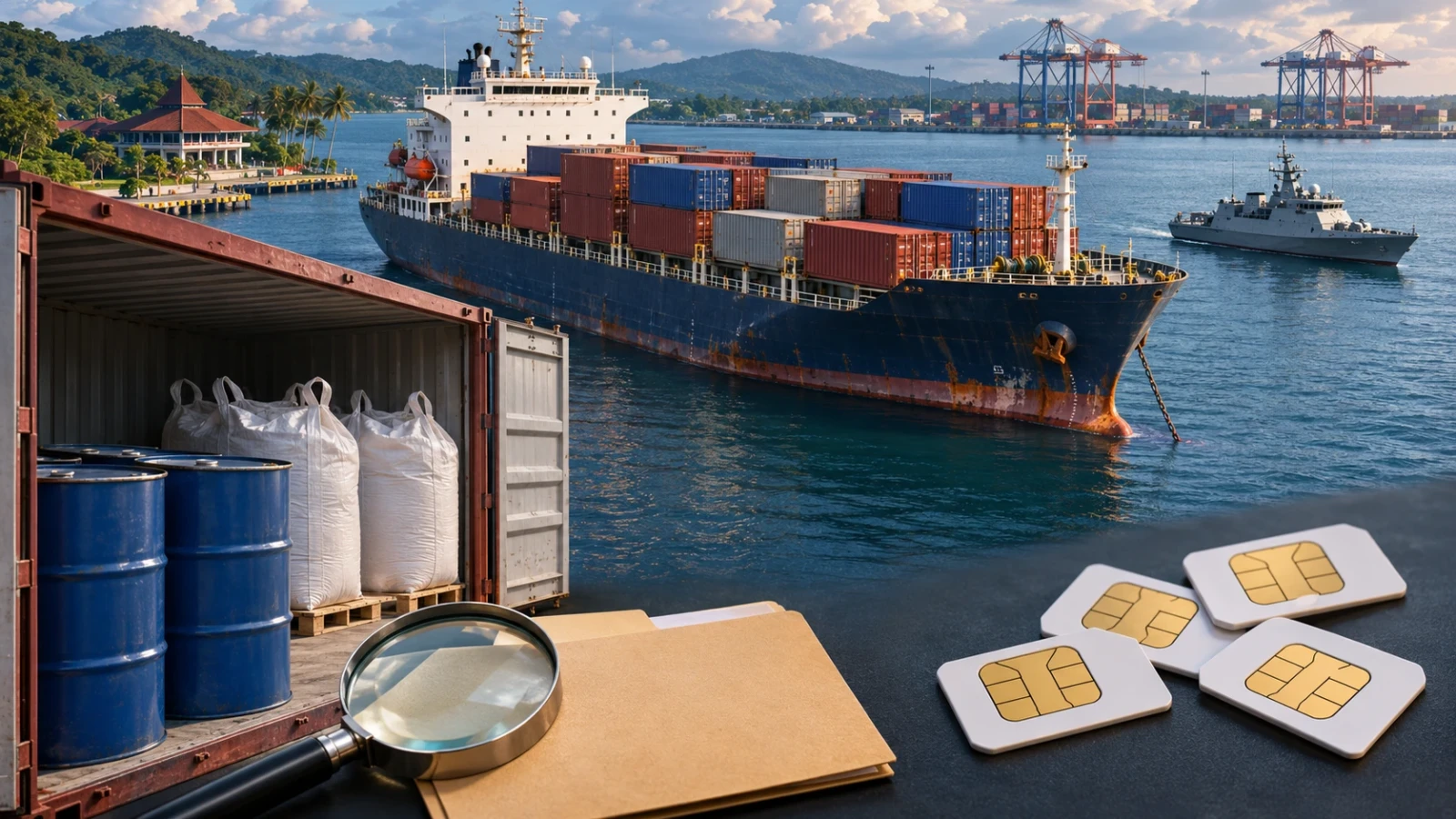
The incident surrounding the MV Star Line has raised fresh concerns about Bangladesh’s national security. A vessel was reportedly found carrying 405 tonnes of sodium perchlorate and a massive quantity of blank SIM cards. The origin of these goods, who dispatched them, where they were headed, and what their ultimate purpose was remain unclear. Although several international ship-tracking platforms listed Mongla Port as the vessel’s destination, the shipment’s actual connection to Bangladesh has not yet been officially confirmed.
Nevertheless, the presence of such a massive quantity of chemicals and SIM cards aboard the same vessel cannot simply be dismissed as an ordinary commercial shipment. A comprehensive investigation is essential.
405 Tonnes of Sodium Perchlorate: Why Such an Enormous Quantity?
First, it is important to understand what sodium perchlorate is and what it is used for.
Sodium perchlorate is a powerful oxidising chemical. In simple terms, it is not a fuel itself, nor is it an explosive in the conventional sense. However, it can intensify the combustion of other substances. It has legitimate applications in chemical research, laboratories, certain pharmaceutical processes, and industrial operations. It can also be used to produce compounds such as ammonium perchlorate and potassium perchlorate, which are used in rocket and missile propellants, military equipment, pyrotechnics, and industries associated with explosives.
In other words, the chemical has legitimate applications as well as military and strategic uses. This dual-use nature makes it particularly significant from a security perspective.
But the question is: Why would Bangladesh require 405 tonnes of sodium perchlorate?
According to a report published by The Daily Star on November 23, 2026, National Board of Revenue data show that Bangladesh imported only 685 kilograms of sodium perchlorate through a total of 50 consignments between January 2010 and November 22, 2026. Most of these consignments contained less than 15 kilograms. In 30 of the 50 consignments, the quantity was 2 kilograms or less. The largest recorded shipment was 99 kilograms.
Yet the vessel detained in Indonesia was carrying 405 tonnes, equivalent to 405,000 kilograms, of sodium perchlorate. That single shipment is approximately 591 times the total documented quantity imported by Bangladesh over nearly 17 years!
Professor Md. Shafiqul Islam of the Department of Chemistry at the University of Dhaka told the newspaper that Bangladesh’s annual requirement for this chemical should not exceed 30 to 40 kilograms. Although this is an expert estimate provided by him, when compared with the national import statistics, it becomes clear that 405 tonnes represents an extraordinarily unusual quantity.
So, what could have been the possible destination and purpose of these 405 tonnes of chemicals?
It would be inappropriate to reach a definitive conclusion about the purpose before an investigation is completed. However, considering the chemical’s applications, the quantity involved, and the unusual nature of the shipment, several possibilities need to be examined.
First possibility: Legitimate industrial or commercial use.
The chemical may have been imported for an industrial company or an international buyer. In that case, there should be documentation identifying the importing company, purchase orders, licences, intended applications, storage arrangements, and transportation records. However, given Bangladesh’s historically low import volume of this chemical, strong evidence would be necessary before treating a 405-tonne shipment as normal industrial demand.
Second possibility: The chemical was being transported for use in military or aerospace supply chains.
Certain perchlorate compounds derived from sodium perchlorate are used in manufacturing rocket and missile propellants. Therefore, whether this shipment was part of a military or defence-related supply chain is an important question that must be investigated.
Sheikh Hasina seeks to return to Bangladesh on December 16 on state carrier
Third possibility: An attempt to use Bangladesh as a transit point or intermediate destination.
Although Mongla Port was listed as the vessel’s destination, it is necessary to investigate whether the actual plan was to transport the goods to another country or deliver them to another party. The absence of any import declaration for this shipment in Bangladesh makes this question even more significant.
Fourth possibility: Supply to illegal networks or conflict zones.
International media reports have raised the possibility that the chemical was intended for a Myanmar-linked insurgent group. Citing its own investigation, Northeast News reported that the shipment, including approximately four million SIM cards and the chemicals, was allegedly destined for an insurgent group in Myanmar. However, comprehensive evidence supporting this claim or official confirmation from Indonesian authorities has not yet been made public. Therefore, this should be treated not as an established fact but as a serious allegation requiring investigation.
Determining which of these possibilities is accurate requires identifying the actual owner of the shipment, the buyer, the source of financing, the vessel’s operator, and its final destination.
Why Is There Concern About the Chemical’s Potential Military Use?
This is not merely a theoretical concern. There are documented international precedents involving the military use of perchlorate-based chemicals.
In November 2022, the United States Navy announced that it had seized more than 70 tonnes of ammonium perchlorate from a vessel in the Gulf of Oman. The same shipment also contained more than 100 tonnes of urea fertiliser. According to the US military authorities, the quantity of ammonium perchlorate seized could have been sufficient to produce propellant for several medium-range ballistic missiles. The same maritime route has also been associated with the smuggling of weapons and military equipment to Yemen’s Houthi rebels.
There is no evidence that this incident is directly connected to the shipment aboard the MV Star Line. However, it demonstrates how sensitive such chemicals can be in the context of international security and weapons supply networks.
Therefore, identifying the actual ownership and destination of the 405 tonnes of sodium perchlorate is extremely important for Bangladesh as well.
Now, Let Us Turn to the Massive Quantity of Blank SIM Cards
Of the vessel’s 36 containers, 15 reportedly contained 405 tonnes of sodium perchlorate. In addition, a massive quantity of blank 4G LTE SIM cards was found on 54 pallets.
Different media reports have provided different figures regarding the exact number of SIM cards. The Daily Star reported that several hundred thousand blank SIM cards were found. On the other hand, reports by The Business Standard and Northeast News referred to several million SIM cards, particularly approximately four million. The final number needs to be confirmed through the investigation by Indonesian authorities.
The question is: Why were so many blank SIM cards being transported aboard a single vessel?
Blank SIM cards are not illegal in themselves. Legitimate telecommunications businesses require SIM cards to provide new connections to customers. However, if a massive quantity of SIM cards remains outside proper registration, identity verification, and regulatory oversight, they can become powerful tools in the hands of criminal networks.
Such SIM cards can be used to obtain mobile connections under false identities, create social media and messaging accounts, communicate while concealing identities, commit fraud, and operate organised criminal networks. Extremist or armed groups can also misuse such SIM cards to establish their own communication systems.
In 2018, a man named Robb Mala was sentenced to eight years in prison in the United Kingdom over allegations that he used 360 SIM cards to help create social media and encrypted messaging accounts for ISIS supporters. This case demonstrates how large numbers of SIM cards can be used to support the communication and organisational activities of terrorist networks.
There is another important issue that needs consideration. On the same vessel, there was an enormous quantity of a chemical that could be used in the supply chain for manufacturing rocket and missile propellants, alongside several hundred thousand to approximately four million blank SIM cards.
Why were these two different categories of goods being transported together? Is there any connection between them? Were they being sent for an organised network?
We do not yet know the answers to these questions. However, investigators should not examine these as entirely separate commodities. They must also consider them as components of the same shipment.
Should Bangladesh’s Past Not Make Us More Cautious?
Bangladesh has a history of alarming incidents involving the smuggling of weapons and illegal military equipment.
On April 1 and 2, 2004, a shipment of ten truckloads of weapons was intercepted at the jetty of Chittagong Urea Fertilizer Limited, beside the Karnaphuli River in Chattogram. Subsequent investigations revealed a massive quantity of firearms, rocket launchers, grenades, and other military equipment. Significant developments also took place in the judicial proceedings many years later, including changes through higher court rulings.
This incident reminds us how illegal weapons and military supply networks can affect a country’s security and political stability.
In 2015, the seizure of ammonium nitrate in Cyprus also attracted international security attention. One individual was convicted for offences connected to activities associated with Hezbollah. The chemical involved was not the same as the sodium perchlorate found aboard the MV Star Line. Nevertheless, the incident serves as an international example of the risks associated with the misuse of dangerous chemicals concealed behind legitimate commercial goods.
Why Was Mongla Port Listed as the Destination? Why Do Customs Authorities Have No Information?
One of the most important questions surrounding this incident is how Mongla Port came to be listed as the vessel’s destination.
According to The Daily Star, Mongla Customs authorities stated that they had no information about the vessel. No Import General Manifest (IGM) for this shipment had been submitted to the National Board of Revenue’s server either. They were also unable to confirm the identity of any local shipping agent.
On the other hand, several media outlets, including The Business Standard, reported that the vessel was travelling from China towards Mongla Port. However, the statement released by the Indonesian Navy did not confirm Bangladesh’s involvement or the vessel’s final destination. The appearance of a particular port as a destination on a ship-tracking platform does not, by itself, constitute conclusive evidence.
These circumstances make the following questions even more important:
1. What was the vessel’s actual destination?
2. Who entered or provided Mongla Port as the destination on the tracking platforms?
3. Who was the actual owner or importer of the 405 tonnes of chemicals?
4. Was there any valid import permit or government clearance for such a massive quantity of chemicals?
5. Who owned the SIM cards stored on the 54 pallets? Which company or individual was supposed to receive them?
6. Where did the shipment’s financing originate? What was the relationship between the vessel’s owner, operator, commercial manager, and the actual owner of the cargo?
7. Was any individual, company, or network in Bangladesh connected to this shipment?
8. Has the Bangladesh government formally contacted the Indonesian authorities? Why has the public not been informed about the progress of the investigation?
Where Does the Concern About Bangladesh’s National Security Lie?
Given Bangladesh’s political and social realities, the possibility of militancy, extremism, and armed networks cannot be ignored. We have seen in the past how devastating the consequences can be when extremist groups are given the opportunity to organise themselves.
There is no publicly available evidence yet proving that the MV Star Line shipment was intended for militant activities. The claim made by a media outlet about a possible connection with an insurgent group in Myanmar has also not been independently verified. However, the enormous quantity of chemicals, the number of SIM cards, irregularities in the vessel’s documentation, and uncertainty surrounding its destination make this a matter that must be investigated seriously from the perspective of national security.
Is Bangladesh at risk of being used as a transit route for a new regional conflict or an illegal supply network involving weapons and chemicals? Are any extremist or militant networks inside the country attempting to reorganise themselves? Have weaknesses emerged in administrative and intelligence monitoring? These questions must be answered through evidence-based investigations.
I do not wish to jump to conclusions before the facts are established. However, raising questions and demanding answers are civic responsibilities. This incident is not about the interests of any particular political party, government, or individual. It concerns Bangladesh’s sovereignty, national security, and the safety of future generations.
My demand to the government is therefore clear: Bangladesh must coordinate with the Indonesian investigating authorities to identify the actual owner of the shipment, its source of financing, its destination, and its intended end users. If any individual or organisation in Bangladesh is involved, their identities should be disclosed and appropriate legal action should be taken. And if the shipment has no connection to Bangladesh, that too should be communicated to the public with supporting evidence.
The security of nearly 200 million people in our country cannot be compromised through negligence, secrecy, or irresponsibility.
Is Bangladesh moving towards the risk of a renewed rise in militancy? Is the state prepared to confront that threat?
These questions require answers now. Because negligence or delay in matters of national security can come at a devastating cost to a country, an entire generation, and even the nation as a whole.


COMMENTS