
Parvez Hashem
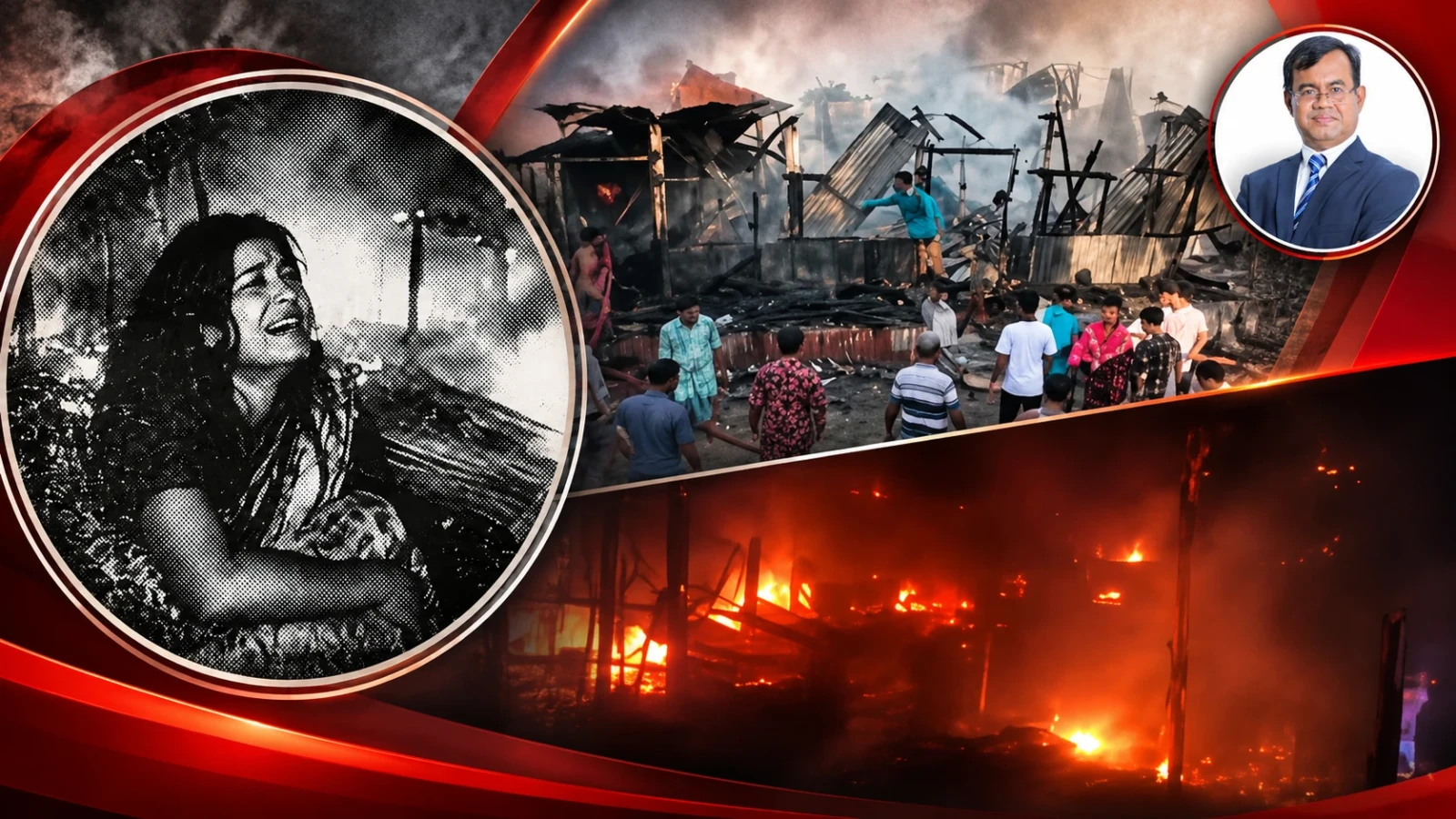
Some tragedies announce themselves loudly. Others unfold in the dark, literally. In Kalia, Narail, residents say the electricity went off before the attack began. What followed, they allege, was a night of torching, vandalism and looting, with Hindu families bearing the brunt. The Narail violence must not be taken lightly, and it must not be buried under political convenience.
Let us begin with what is beyond dispute. Two BNP supporters were killed in Kalia, and their families deserve justice. A killing is a killing, whoever the victim and whatever the flag. But justice for one set of victims can never become license for collective punishment of another. The moment a grieving community turns into a mob, the rule of law is the first casualty.
What happened next, according to villagers, is deeply shocking. Fearing arrests after the killings, many men had reportedly fled, leaving the village largely without adult males. Into this vacuum, outsiders allegedly walked in, breaking into homes, looting and setting them ablaze. Women and girls, with no one to shield them, were left to face the night alone. Anyone who has studied communal violence in South Asia knows what this pattern means. Attackers choose their moment carefully. They strike where resistance is weakest and where fear will do half the work.
The questions are simple, and the answers owed to the public are overdue.
Who ordered the electricity shutdown? Power cuts do not happen by themselves in the middle of a crisis. If it was a technical fault, the utility should say so with records. If it was deliberate, someone must answer for providing cover to arsonists.
Why were residents left unprotected? Tension had been building since the killings. The administration knew the village was on edge. Where were the patrols, the extra deployment, the early warnings? A state that cannot protect a frightened village for a single night has failed at its most basic duty.
Why do the numbers differ so wildly? Victims speak of more than 150 homes attacked. Media reports put it at around 60. Police acknowledge only about 20. Such a gap is not a rounding error. It reflects either a failure to document the damage or a reluctance to admit it. Police and the ruling party have in fact rejected claims of attacks on Hindu homes, and the BNP has called such reports false and baseless. Police have described the online claims about Hindu homes as false. If that is so, an open, verifiable inquiry should settle it quickly. Nobody with a clear conscience should fear one.
Why are victims being mocked instead of heard? Survivors who describe their ordeal should be met with a notebook and a medical team, not skepticism and ridicule. When those who have lost their homes are treated as liars, the message to every other citizen is plain: do not complain.
Now consider the larger picture. For decades, Hindus in Bangladesh have lived with a particular anxiety. Their homes, temples and shops have been targeted in spasms of violence, often after political upheaval, and the pattern of impunity has been depressingly consistent. A few arrests are made, a few statements issued, and then the story fades until the next time. This is how a minority learns that it lives on sufferance, not by right.
Violence against women deserves its own mention. In every communal flare up, women are targeted not only as members of a community but as symbols of it. Their bodies become battlegrounds. Even where no assault is proven, the fear itself is a form of torture. Girls who watched their homes burn, mothers who hid children in the dark, families who now sleep in relatives’ courtyards: these are people carrying trauma that will outlast any news cycle. A credible inquiry must include trained women officers, psychological support and protection for witnesses.
Let it also be said plainly that this is not a matter of party colors. Reports suggest that homes linked to Awami League leaders and activists were among those burned, and some of them belonged to Hindu families. Whether the target was religion, politics or a personal feud, the answer is the same. Nobody may burn another person’s house and walk free. Political rivalry is not a defense. Revenge is not a legal category.
BNP leaders, from the central to the local level, reportedly issued direct threats before the Narail attack. Were these threats a signal to grassroots supporters to carry out the attack? What should be done? First, an independent and impartial investigation, led by people with no stake in either camp, with a fixed timeline and a public report. Second, immediate relief and rehabilitation for those who lost their homes, with transparent damage assessment so that the “20 versus 150” question is answered once and for all. Third, protection for witnesses, because intimidation after an attack is as damaging as the attack itself. Fourth, accountability across the chain, from those who struck the match to those who looked away or gave the order. And fifth, a visible, credible effort to restore trust, with the government meeting the families, not just issuing press notes. The burning question remains whether a free and fair investigation is even possible when those allegedly implicated in the attack belong to the party in power.
South Asia and the wider region watch such events with concern, but this is not about neighbors scoring points. It is about a basic principle. A state earns legitimacy by protecting those who are most vulnerable, especially when it is politically inconvenient to do so.
No democracy can survive if mobs decide whose home stands and whose burns. No government can claim moral authority while its citizens question whether the lights will stay on when trouble comes. The families of Kalia are not asking for favors. They are asking for what every citizen is owed: safety, truth and justice.
Silence today is not neutrality. It is an invitation. If Narail is allowed to fade without answers, the next village will learn the lesson the wrong way round. The government still has a chance to show that the law applies to everyone. It should take it, and quickly.
Parvez Hashem, Lawyer and Human Rights Defender

COMMENTS