
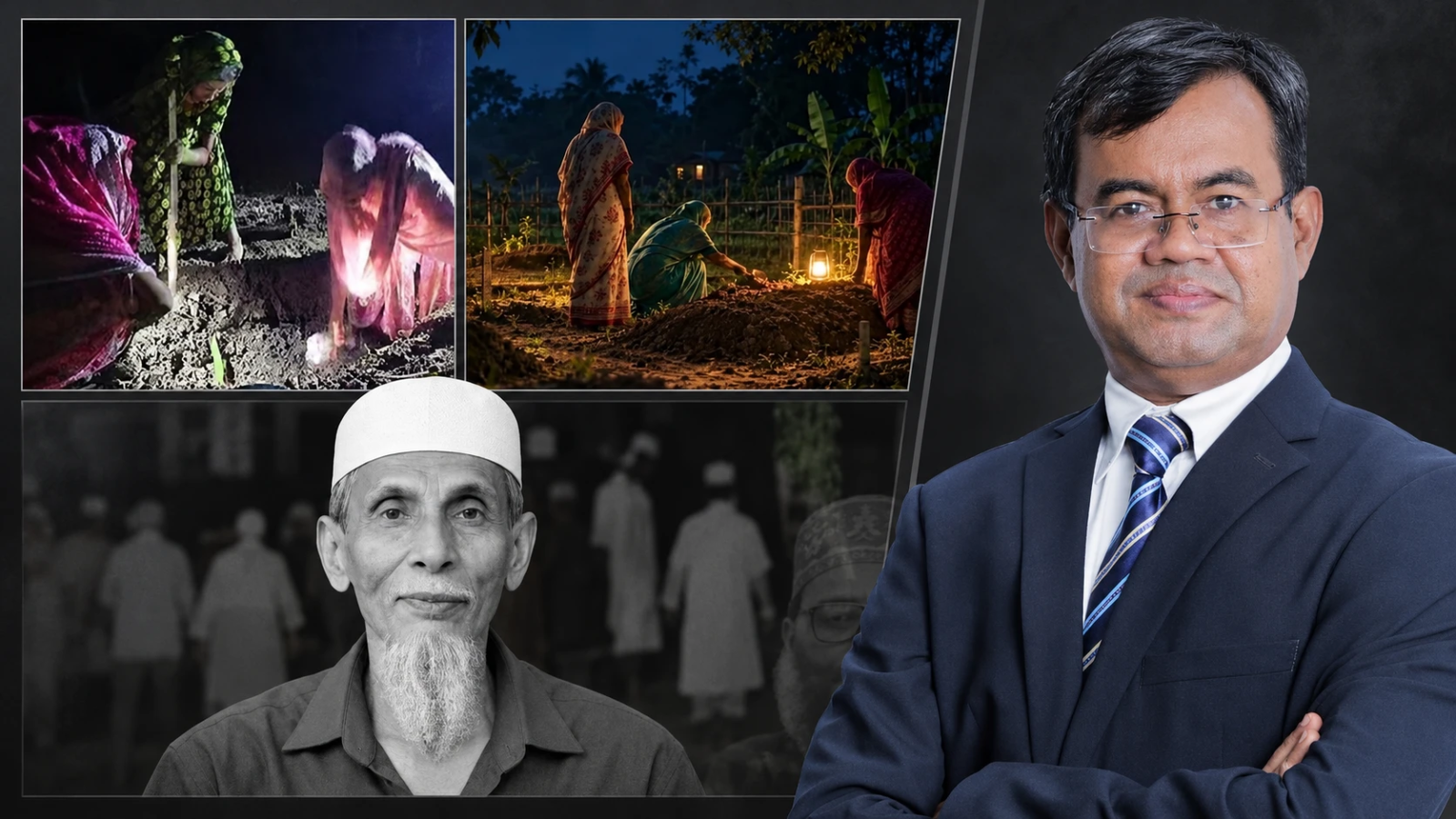
Manik Pasari, an 87 year old freedom fighter from Chitholia village in Pirojpur Sadar upazila, died on October 24, 2026, after a prolonged illness. His final journey should have been an occasion to honor his contribution to Bangladesh’s independence. Instead, his death was marked by political hostility, obstruction, and humiliation.
According to reports, local Jamaat e Islami leaders and activists opposed the state Guard of Honour for Pasari, disputing his status as a freedom fighter. His burial also faced obstruction when a group reportedly filled in the grave prepared for him. He was finally laid to rest in his village in the early hours of October 25 under heavy police protection.
A man who had fought for his country was denied the peace and dignity every human being deserves in death.
Remembering the Crimes of 1971
During Bangladesh’s Liberation War, the Pakistani military and its local collaborators committed mass killings, rape, arson, and other atrocities. Jamaat e Islami opposed Bangladesh’s independence, and members of its student wing and associated forces, including Al Badr and Al Shams, were implicated in atrocities against civilians, intellectuals, and supporters of independence.
These events are part of Bangladesh’s documented history. The victims and their families deserve recognition, and allegations of war crimes must be addressed through evidence and fair judicial proceedings. Attempts to intimidate witnesses or discredit those who seek accountability undermine the pursuit of justice.
Manik Pasari and the Case Against Delwar Hossain Sayeedi
Pasari became known for his role in the case against Delwar Hossain Sayeedi, a prominent Jamaat e Islami leader prosecuted by Bangladesh’s International Crimes Tribunal for crimes committed during the 1971 Liberation War.
On August 11, 2009, Pasari filed a complaint against Sayeedi and four others in the Pirojpur court. The allegations included murder, rape, arson, and persecution during the war. His role as complainant helped bring the allegations before the judicial system.
Sayeedi was convicted by the tribunal in 2013 and sentenced to death. The Supreme Court subsequently reduced his sentence to imprisonment until death. He died in custody in August 2023.
Pasari’s pursuit of accountability placed him among those who sought justice for the atrocities of 1971. His contribution should be remembered in the context of Bangladesh’s struggle to establish responsibility for wartime crimes.
A Home Burned and a Life Displaced
Pasari’s suffering reportedly continued long after the war crimes case. Following the fall of the Awami League government on August 5, 2024, his home in Chitholia was attacked and set on fire. Having previously received police protection, he fled his village and took shelter at his son in law’s home in Tungipara, Gopalganj.
The reported attack raises serious concerns about the safety of elderly freedom fighters, witnesses, and people associated with politically sensitive cases. No one should be driven from home or threatened because of their political history or their pursuit of justice.
A state that fails to protect such citizens risks allowing political retaliation and mob violence to replace the rule of law.
Obstructing a State Honour
The reported opposition to Pasari’s Guard of Honour was deeply troubling. Such an honor recognizes a freedom fighter’s service to the country. If questions arise about a person’s official status, the appropriate response is to examine the relevant records through lawful administrative procedures.
Political activists should not be allowed to determine a person’s entitlement to state recognition through intimidation or street pressure. Reports indicated that security concerns led authorities to move Pasari’s body to the Pirojpur Police Lines, where the Guard of Honour was eventually administered after a delay. His family also reportedly criticized the local administration over delays and inadequate arrangements for preserving the body.
The authorities should explain what happened and investigate whether established procedures were followed.
Every Person Deserves a Safe Grave
The reported interference with Pasari’s grave was particularly disturbing. According to local reports, the grave prepared in his family graveyard was filled in before the burial, forcing the family and authorities to reopen it. Local Jamaat activists reportedly opposed the burial and state honors.
Regardless of political affiliation, no group has the right to intimidate a grieving family or unlawfully obstruct a burial.
Every person has the right to a safe and dignified burial, irrespective of religion, political ideology, race, color, creed, caste, sex, gender, or nationality. Muslims, Hindus, Buddhists, Christians, Indigenous peoples, atheists, and people of every other belief deserve equal respect in death.
A grave is not a political reward. It is a place where the dead should rest in peace and the living should be free to mourn.
Denied a Grave: Bangladesh’s Betrayal of Its Liberation Values
Jamaat-e-Islami opposed Bangladesh’s Liberation War in 1971, and members of the party collaborated with the Pakistani military in atrocities against unarmed Bengalis. Its political legacy continues to raise serious questions about democracy, tolerance, and freedom of expression.
Bangladesh was born from a struggle for freedom, dignity, and equal rights. Yet the obstruction of freedom fighter Manik Pasari’s burial exposes a disturbing contradiction. His service to the country deserved respect, his family deserved to mourn in peace, and he deserved a dignified burial.
The government failed to protect democratic freedoms and hold accountable those who obstructed fundamental rights. Justice means respecting the dead, protecting the living, and upholding the values for which Bangladesh fought in 1971.
Parvez Hashem, Lawyer and Human Rights Defender

COMMENTS