
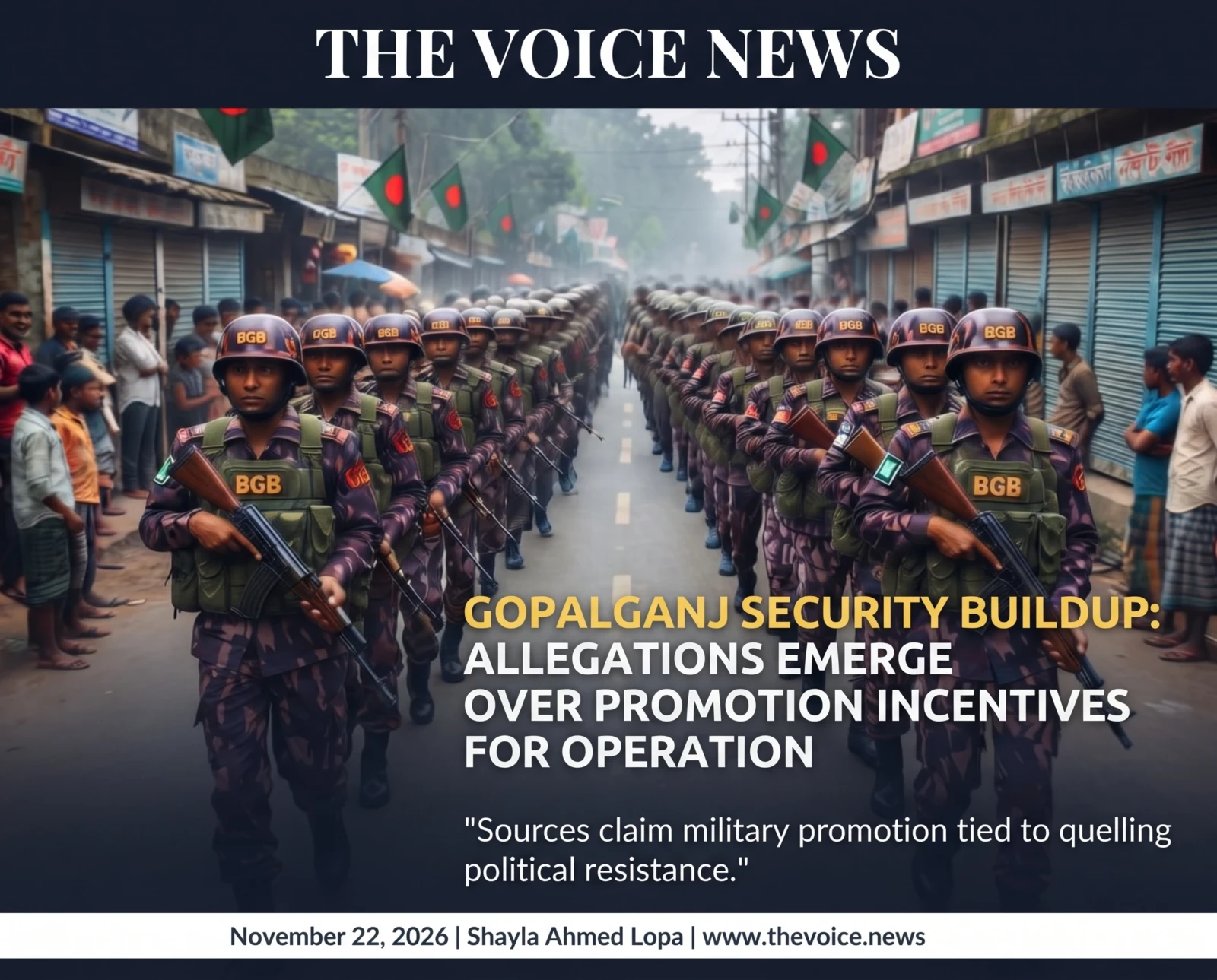
Special Operation to Crush Political Resistance in Gopalganj? Serious Allegations of Promotion and Special Privileges as Incentives
By Shayla Ahmed Lopa
The Voice News | November 22, 2026
DHAKA — Serious allegations have emerged questioning whether Gopalganj is once again becoming a testing ground for state power, amid reports that security forces are preparing for an intensified operation to suppress local Awami League protests and resistance. According to sources cited in the allegations, promises of military promotion and special privileges have been offered to the top official overseeing the deployment—claims that have not been independently verified by the government.
The reported preparations follow Prime Minister Tarique Rahman’s November 18 remarks in Parliament, where he labeled the Awami League a “terrorist group” and vowed to “crush” the organization before it could rise again. Against this backdrop, allegations suggest that Major General Mohammad Ashrafuzzaman Siddiqui, Director General of the Border Guard Bangladesh (BGB), has been assigned a special role in the district, with sources claiming successful execution of the operation would bring him a promotion to Lieutenant General and additional personal benefits.
These claims raise fundamental questions regarding the neutrality of state institutions, the professional independence of the armed forces, and the protection of citizens’ constitutional rights.
Background: How Tensions in Gopalganj Escalated
To understand the current standoff in Gopalganj, observers point back to the events of July 16, 2025. On that day, central leaders of the National Citizen Party (NCP) arrived in the district town as part of their “March to Gopalganj” programme. Slogans of “Down with Mujibism” and speeches delivered at a rally in the Municipal Park sparked immediate backlash among local residents.
Simultaneously, rumors circulated regarding an alleged plot to attack and demolish Bangabandhu’s mausoleum in Tungipara—drawing comparisons to the earlier demolition of the historic residence at Dhanmondi 32 and further inflaming local sentiment. The situation rapidly deteriorated into clashes. Following vandalism at the rally venue, the NCP leaders’ motorcade was attacked, forcing them to take shelter at the Superintendent of Police’s office before being escorted out of the district in armored vehicles by army and police personnel. Five people were reportedly killed in joint-force gunfire that day, leaving deep-seated grievances in the area.
Renewed Unrest and Heavy Security Deployment
Tensions reignited in mid-November 2026 amid local complaints of arbitrary arrests and police harassment. On November 17, local residents gathered outside Tungipara Police Station demanding the release of detainees. The protest spiraled into violence, resulting in attacks, vandalism, and arson at the police station, as well as the forcible release of detainees.
While local residents described the incident as an eruption of frustration over indiscriminate arrests, authorities and ruling coalition leaders framed the unrest—alongside subsequent arson attacks on Muksudpur Police Station and the residence of BNP MP Selimuzzaman Molla—as coordinated sabotage by Awami League activists. Political parties, including the BNP, Jamaat-e-Islami, and the NCP, subsequently called for decisive action.
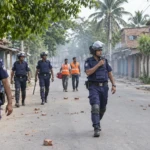
In response, the administration replaced Gopalganj’s Deputy Commissioner and Superintendent of Police and initiated a massive security buildup. According to official BGB press releases issued on November 22, two full BGB battalions—comprising 55 platoons—have been deployed across Gopalganj as part of a broader 95-platoon nationwide deployment across seven districts. The BGB stated that its personnel are working alongside local administrations using round-the-clock drone surveillance and body-worn cameras strictly to “maintain law and order, ensure public security, and prevent untoward incidents”.
Allegations of Incentives and a Hard-Line Strategy
Despite official assurances that the deployment is a routine measure to protect lives and property, sources reportedly linked to the Ministry of Home Affairs allege a different objective.
According to these sources:
-
The BGB Director General was allegedly summoned and tasked with breaking political resistance in Gopalganj, with a promotion to Lieutenant General—a rank that places an officer in contention for the position of Chief of Army Staff—offered as an incentive.
-
The alleged operational blueprint involves conducting actions outside public and media scrutiny and employing harsh measures if deemed necessary.
-
Field-level junior officers are reportedly being encouraged to adopt a hard-line stance, described by critics as a “scorched-earth” approach.
Government and BGB officials have not publicly commented on these specific allegations regarding promotions or off-record operational directives.
High-Level Security Visit to Gopalganj
Adding to the scrutiny was a high-profile visit to Gopalganj on Friday, November 20, by BGB Director General Major General Mohammad Ashrafuzzaman Siddiqui, Inspector General of Police (IGP) Mohammad Ali Hossain Fakir, and Special Response Battalion Director General Faruk Ahmed.
During a joint press briefing, the officials stated they were reviewing the district’s law-and-order situation. However, critics and local observers contend the visit was aimed at assessing ground-level resistance, finalizing operational plans, and instructing subordinate officers to intensify enforcement. Reports from the ground suggest that initial sweeps by junior officers have met sustained local pushback, prompting forces to shift toward heightened surveillance and regular reporting to headquarters.
Constitutional Questions and the Role of the State
The controversy sits at the intersection of national security and democratic governance. Speaking in Parliament on November 18, Prime Minister Tarique Rahman characterized the deposed Awami League as a “terrorist group” and urged anti-fascist forces to unite to prevent its resurgence.
While the government maintains that strict measures are necessary to halt arson, crude bomb attacks, and threats to public safety, civil rights advocates and legal analysts emphasize that a state’s constitutional duty is to uphold due process rather than suppress political identity. Under democratic norms, criminal acts must be prosecuted through transparent legal channels without collective punishment or partisan interference in military promotions.
As security forces remain on high alert in Gopalganj, critical questions remain unanswered for the public and the administration alike:
-
Are security operations in Gopalganj strictly aimed at maintaining law and order, or are they designed to dismantle political opposition?
-
Have institutional incentives, such as military promotions and special privileges, been tied to the outcome of a domestic security operation?
-
Are state security agencies operating within constitutional boundaries, independent of partisan directives?
For many observers, the answers will define not only the immediate future of Gopalganj, but also the broader relationship between state institutions, the rule of law, and citizens’ democratic rights across Bangladesh.
For additional context on the Prime Minister’s November 18 parliamentary session referenced in this report, you can view the official broadcast from Parliament: Prime Minister Tarique Rahman answers questions from members of parliament | 18 Nov 2026.

COMMENTS