
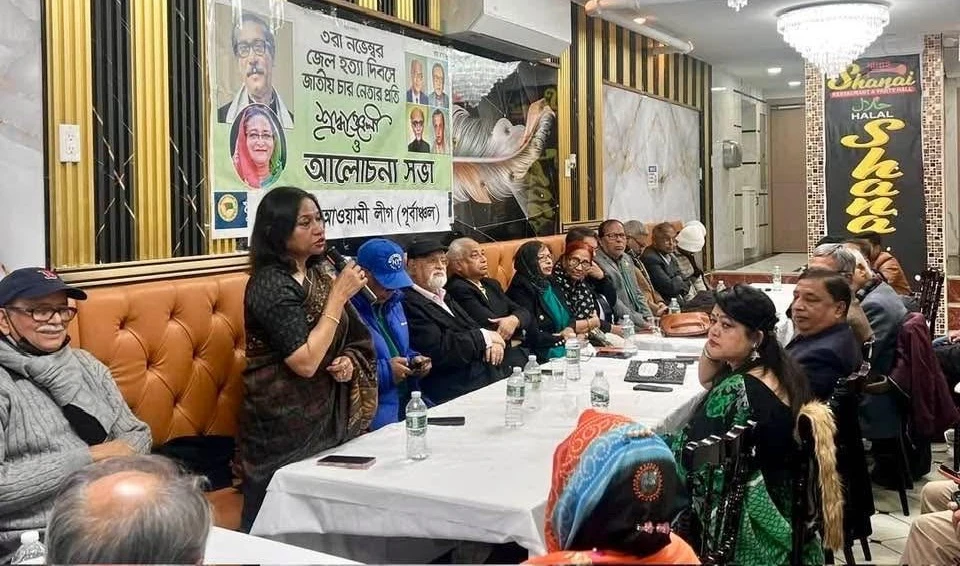
Speakers at a Jail Killing Day commemoration in New York have alleged that Awami League leaders and activists are being killed inside and outside prisons in Bangladesh almost daily.
Former Bangladesh Foreign Minister Dr. A.K. Abdul Momen said hundreds of Awami League leaders and activists had been killed since the government led by Sheikh Hasina was ousted on August 5, 2024, in what he described as a conspiracy involving domestic and foreign forces.
He alleged that hundreds of thousands of party members had been arrested or forced to flee their homes and the country. Many Awami League leaders and activists had also died in prison without trial or adequate medical treatment, he claimed.
Momen said Bangladeshi expatriates had a moral responsibility to mobilize public opinion at home and abroad against the alleged killings, persecution, and mistreatment of Awami League members.
He urged Awami League leaders in the United States to bring allegations of political repression and the situation in Bangladesh to the attention of American lawmakers and elected representatives.
Momen made the remarks as chief guest at a discussion and prayer gathering organized by the Eastern Chapter of the United States Awami League on November 8 to commemorate Jail Killing Day.
The former foreign minister said he had already written to several U.S. senators and members of Congress, informing them about the situation in Bangladesh.
“I believe those who are leading the Awami League here can also write to U.S. lawmakers and elected representatives to bring these issues to their attention,” Momen said.
Paying tribute to the four national leaders assassinated inside Dhaka Central Jail on November 3, 1975, Momen said the killings were carried out as part of an effort to eliminate the Awami League’s leadership following the assassination of Sheikh Mujibur Rahman on August 15 that year.
The four leaders — Syed Nazrul Islam, Tajuddin Ahmad, Captain M. Mansur Ali, and A.H.M. Qamaruzzaman — were assassinated inside Dhaka Central Jail, less than three months after Sheikh Mujibur Rahman and most of his family were killed on August 15, 1975.
Momen also recalled several significant events from the turbulent political period of 1975, drawing on his experiences as a witness to that era.
More Than 250 Custodial Deaths
The event was chaired by Dr. Pradip Ranjan Kar, convener of the Eastern Chapter of the United States Awami League, and moderated by Engineer Mohammad Ali Siddiqui, the organization’s joint convener.
Special guests included Farida Yasmin, former president of Bangladesh’s National Press Club and former member of parliament; Liberation War veteran Dr. Mohsin Ali; veteran journalist and columnist Md. Fazlur Rahman; former press minister at the Bangladesh High Commission in New Delhi and journalist leader Shaban Mahmud; and Sazzad Hossain Sabuj, a senior journalist and former press minister at the Bangladesh Embassy in Washington.
Abdul Hasib Mamun, another joint convener of the organization, delivered the welcome address.
Addressing the gathering, Farida Yasmin alleged that Awami League leaders and activists were being killed inside Bangladesh’s prisons following the political changeover of August 5, 2024, drawing a parallel with the 1975 jail killings.
She claimed that more than 250 Awami League leaders and activists had died in prison over the past two years because of inadequate medical treatment and negligence by prison authorities.
The reported death toll could not be independently verified.
Other speakers described the November 3, 1975, jail killings as one of the darkest chapters in Bangladesh’s history.
They accused Khondaker Mostaq Ahmad and General Ziaur Rahman of involvement in the assassinations.
The speakers further alleged that the killing of Sheikh Mujibur Rahman and members of his family in August 1975, followed by the assassination of the four national leaders in November, was part of a broader attempt to eliminate the Awami League’s political leadership.
They also alleged that Awami League leaders and activists continued to face killings both inside and outside prisons.
Prayers and Tributes
The commemorative program began with recitations from the Holy Quran and the Bhagavad Gita, followed by prayers for the four national leaders and others killed in Bangladesh’s political history.
Participants also observed a minute of silence in remembrance of the deceased.
The gathering brought together Awami League leaders, Liberation War veterans, journalists, community organizers, and political activists from the Bangladeshi diaspora.
Among those attending were Liberation War veterans Shawkat Akbar and Mokbul Talukder; Faruk Hussain; Hiru Bhuiyan; Ismail Khan Ansari; Professor Husne Ara; Mrs. Mohsin Ali; journalist Hakikul Islam Khokon; Abdul Rahim Badshah; Advocate Shah Md. Bakhtiar Ali; M.A. Karim Jahangir; and Shaheen Azmal, general secretary of the New York State Awami League.
Other participants included Ali Hossain Gaznabi, Ataul Gani Asad, Sheikh Atik, Helim Uddin, Nuruddin Chowdhury, Rumana Akter, Naznin Sultana, Rina Abedin, and Saleha Begum.
Also present were Manjur Chowdhury, acting president of the National Sramik League; its general secretary Jewel Ahmed; Awami League leader Shahidul Islam; Chhatra League president Mahmudul Hasan and general secretary Hridoy Mia; and former Chhatra League president Z.A. Joy and former general secretary Jahangir H. Mia.
The gathering was also attended by Fuad Hasan, a Republican leader involved in mainstream U.S. politics; Jalal Uddin Jalil, president of the Sheikh Hasina Mancha; the organization’s vice president T. Molla; youth leader and mainstream political activist Jamal Hossain; youth leader Ifzal Chowdhury; Sramik League leader Sohag; Jubo League leader and former chairman Iqbal Hossain; youth leader Raimul Islam Rahim; Mrs. Jalil; and Fatin Shah.

COMMENTS