
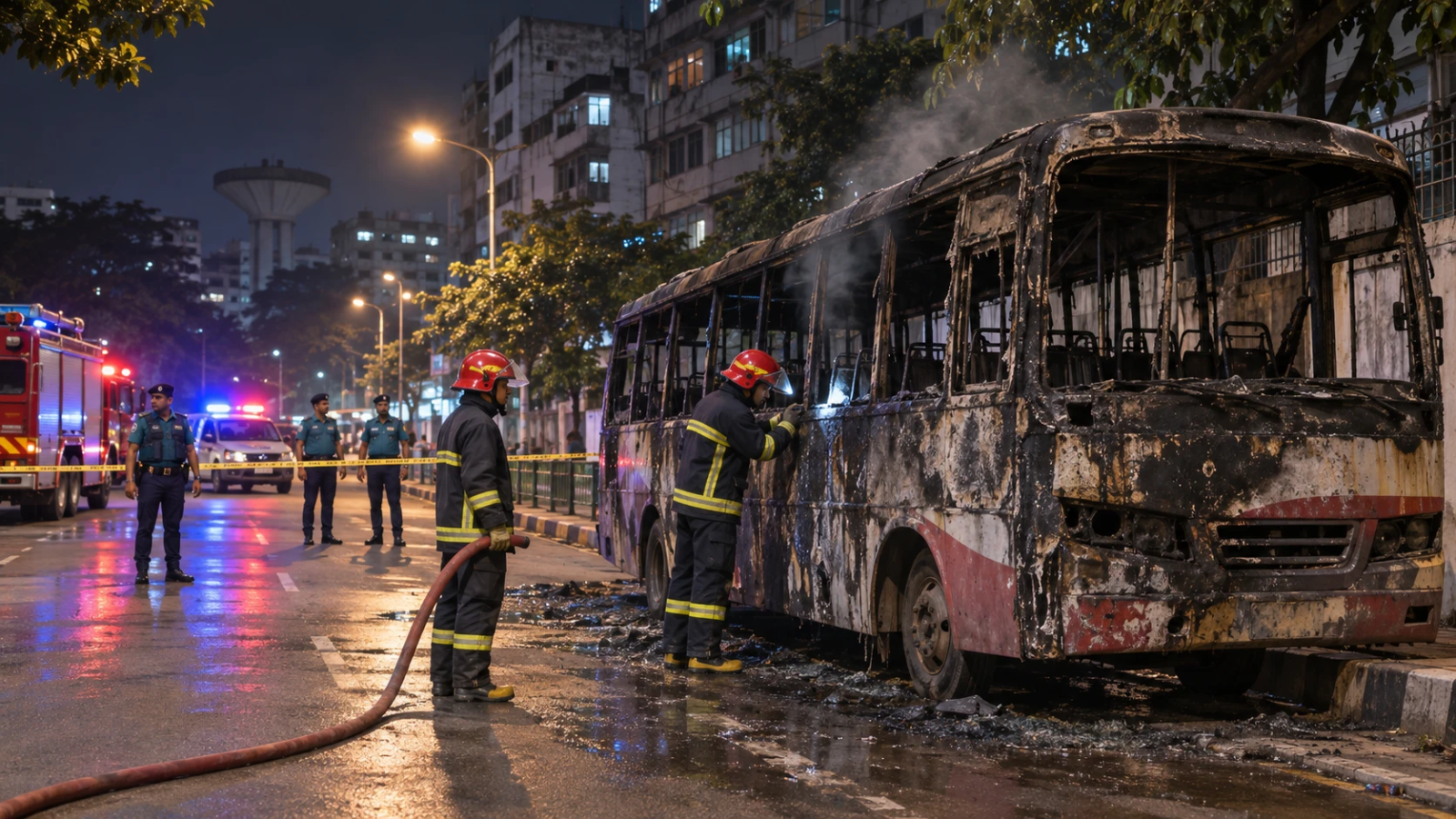
DHAKA : A series of cocktail bomb explosions and arson attacks targeting public transport and key locations across the capital has sparked widespread concern over security, with at least 15 sites, including Dhaka University and several police station compounds, reportedly targeted on Sunday night.
The wave of violence, which began on Friday (November 6), escalated on Sunday (November 8), when attackers carried out explosions at multiple locations across the city. A school bus parked outside Vatara Police Station and other passenger vehicles were also set on fire.
According to law enforcement officials, the incidents are believed to be part of a planned attempt by members of banned organisations to create instability and disrupt public order.
Dhaka University attacks followed by strikes on police stations
The latest series of incidents began on Sunday afternoon at Dhaka University, where cocktail bombs exploded at at least five locations, including the Teacher-Student Centre (TSC) and Nilkhet, within a span of around 30 minutes.
Police detained three people in connection with the explosions. One of them reportedly identified himself as a Bangladesh Nationalist Party (BNP) activist.
As night fell, the attacks spread to police stations and other sensitive locations across the capital.
At around 8:15pm, unidentified individuals threw a cocktail bomb into the Pallabi Police Station compound from an elevated section of the Pallabi flyover. The explosion reportedly injured a member of the Special Reserve Battalion (SRB).
Explosions were also reported in front of the Criminal Investigation Department (CID) headquarters in Malibagh and in the Paltan Police Station area.
At around 10pm, two consecutive explosions occurred near the entrance to Khilkhet Police Station, briefly triggering panic among police personnel. Police said they were examining CCTV footage to identify those involved.
Other targeted locations included Darus Salam, Uttara East and Rupnagar police stations. In Rupnagar, a local resident reportedly caught one suspect while he was fleeing after an attack and handed him over to police.
Cocktail attacks were also reported in areas including Mohakhali, Tejgaon, Panthapath, Dhanmondi, Gabtoli, Cantonment Station, near Hotel Radisson Blu and Jatrabari, with buses and private cars among the reported targets.
Videos circulated on social media
CCTV and dashboard camera footage circulating on social media reportedly show two helmeted individuals riding a motorcycle and throwing explosive devices at predetermined targets before fleeing the scenes.
Some footage of the attacks was also reportedly recorded and circulated online by the perpetrators, further heightening public anxiety.
The incidents have raised fresh concerns among residents, who fear a deterioration in the country’s law and order situation.
Abir Hossain, a private-sector employee living in Banasree, said the country had yet to recover from the violence of the 2024 movement.
“Such attacks even on police station premises could indicate the possibility of further instability,” he said.Another resident, Kamruzzaman Shahin, expressed concern over the economic and social consequences of renewed political unrest.
He said ordinary people were already struggling with rising prices and would suffer further if political stability deteriorated.
Housewife Rozina Islam and other residents called on the authorities to identify those responsible and bring them to justice without delay.
DMP steps up security measures
Dhaka Metropolitan Police (DMP) Deputy Commissioner for Media and Public Relations Md Aktar Hossain said the attacks appeared to have been carried out by an interest group seeking to create fear among the public and undermine security.
“Police are closely monitoring and investigating each incident. Several members of different banned organisations have already been arrested,” he said.
He added that surveillance had been strengthened over the purchase and sale of explosives and flammable materials, including through increased monitoring of petrol stations.
The DMP has also increased checkpoint duties and mobile patrols at key intersections across the capital to ensure public safety and protect lives and property.

COMMENTS