
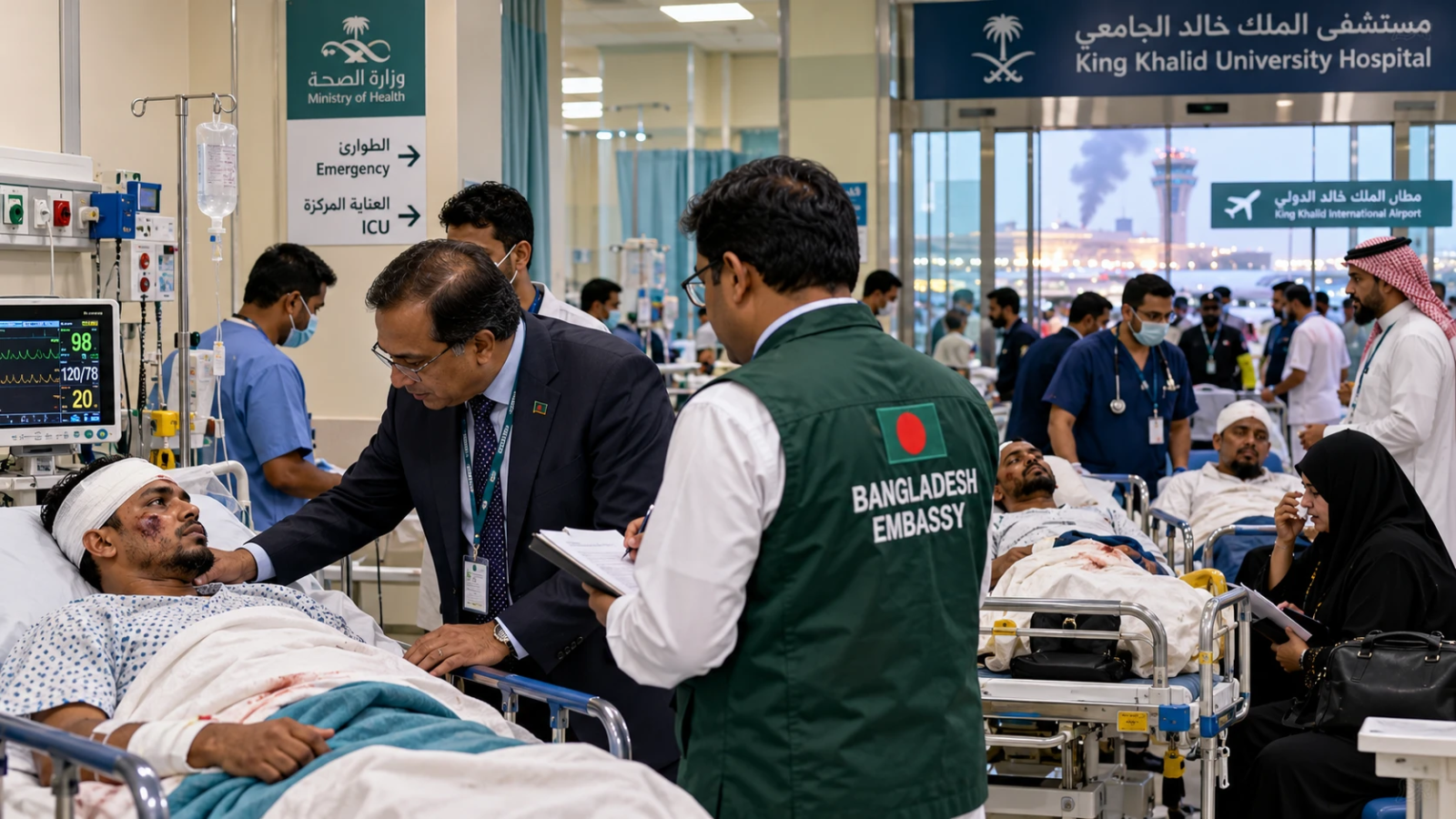
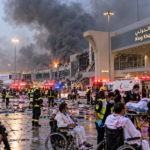
Two Bangladeshis were killed and 24 others injured in an attack on King Khalid International Airport in Riyadh, Saudi Arabia, the Bangladesh Embassy in Riyadh said on Sunday.
The injured include 11 migrant workers and 13 Umrah pilgrims. They are receiving treatment at various hospitals across the Saudi capital, with three Bangladeshis being treated in the intensive care unit (ICU) of King Abdullah Hospital. Their conditions are stable, according to the embassy.
The attack took place at around 3:15am on October 10, when a missile struck Terminal 3 of the airport, the embassy said. Preliminary information indicated that 12 people were killed and 309 injured in the incident, including the two Bangladeshi fatalities and 24 injured Bangladeshis.
The embassy said it was maintaining contact with hospitals to monitor the condition of the injured and coordinate their treatment. A delegation from the mission also visited the three Bangladeshis receiving intensive care at King Abdullah Hospital.
They were identified as Hafiz Hasan, from Dhaka; Kazi Nurullah, from Brahmanbaria; and Mohammad Omar Faruk, a Bangladeshi migrant worker in Saudi Arabia.
Injured Bangladeshis Receiving Treatment at Multiple Hospitals
According to the embassy, two Bangladeshis — Safkat Rahman of Naogaon and Mohammad Daudul Islam of Cumilla — are being treated at National Guard Hospital. Rahman remains unconscious.
Mohammad Saimul Islam Sourav and Abul Mansur Mohammad Riaz Uddin, both from Dhaka, are receiving treatment at Riyadh Medical Hospital. Mohammad Abdullah, also from Dhaka, is being treated at Prince Sultan Military Hospital.
Three Bangladeshi workers, including Arman Hossain of Dhaka, are receiving treatment at the Takhassusi branch of Sulaiman Al Habib Hospital.
Other injured Bangladeshis are being treated at Kingdom Hospital, King Khalid Medical City, Prince Mohammed bin Abdulaziz Hospital, Ijtihad Sanad Hospital, Sulaiman Fakeeh Hospital and the Al Sahafa branch of Sulaiman Al Habib Hospital.
The embassy said all the injured Bangladeshis had been waiting in transit at the airport to travel from Riyadh to Jeddah.
Authorities Arrange Accommodation and Alternative Travel
The attack disrupted travel plans for around 500 passengers arriving from Bangladesh or waiting to connect to domestic and international destinations through Riyadh. Passengers scheduled to travel from Riyadh to Bangladesh were also stranded.
The Bangladesh Embassy arranged accommodation and meals for around 100 passengers who had arrived on Saudia Airlines flight SV804, Riyadh Air flight RX17 and US-Bangla Airlines flight US281, as well as passengers waiting to travel to other Saudi destinations with flynas, flyadeal and Fly Riyadh.
They were accommodated at the Marriott and Radisson hotels and in dormitories at Princess Nourah bint Abdulrahman University, the embassy said.
Special buses were arranged to transport 67 Umrah pilgrims from Bangladesh, who were already wearing ihram garments, from Riyadh to Jeddah.
Authorities also made arrangements to send around 400 Bangladeshi passengers stranded after the cancellation of Saudia Airlines’ Riyadh-Dhaka flight SV804 to Bangladesh via King Fahd International Airport in Dammam.
The embassy also assisted two Bangladeshi workers travelling from Riyadh to Bahrain through the Al Khobar land border.
Government Working to Repatriate Victims’ Bodies
Earlier on Sunday, Foreign Affairs State Minister Shama Obaed Islam confirmed the deaths of two Bangladeshis in the airport attack. She initially said four injured Bangladeshis were receiving treatment in the ICU at King Khalid Hospital.
“We are trying to confirm everyone’s identity,” she told reporters at the Ministry of Foreign Affairs, adding that the Bangladesh mission was in contact with other Bangladeshis in Saudi Arabia to gather information about the victims and their conditions.
The state minister said the Ministry of Foreign Affairs and the Ministry of Expatriates’ Welfare would work together to provide necessary assistance to the affected families.
She added that the government would coordinate with the Saudi authorities and employers, where necessary, to complete the formalities for bringing the deceased Bangladeshis’ bodies home as soon as possible. The government generally bears the cost of repatriating the bodies of Bangladeshi migrant workers, she said.
The Bangladesh Embassy said it was continuing to coordinate medical assistance and travel arrangements for affected Bangladeshi nationals.
COMMENTS