
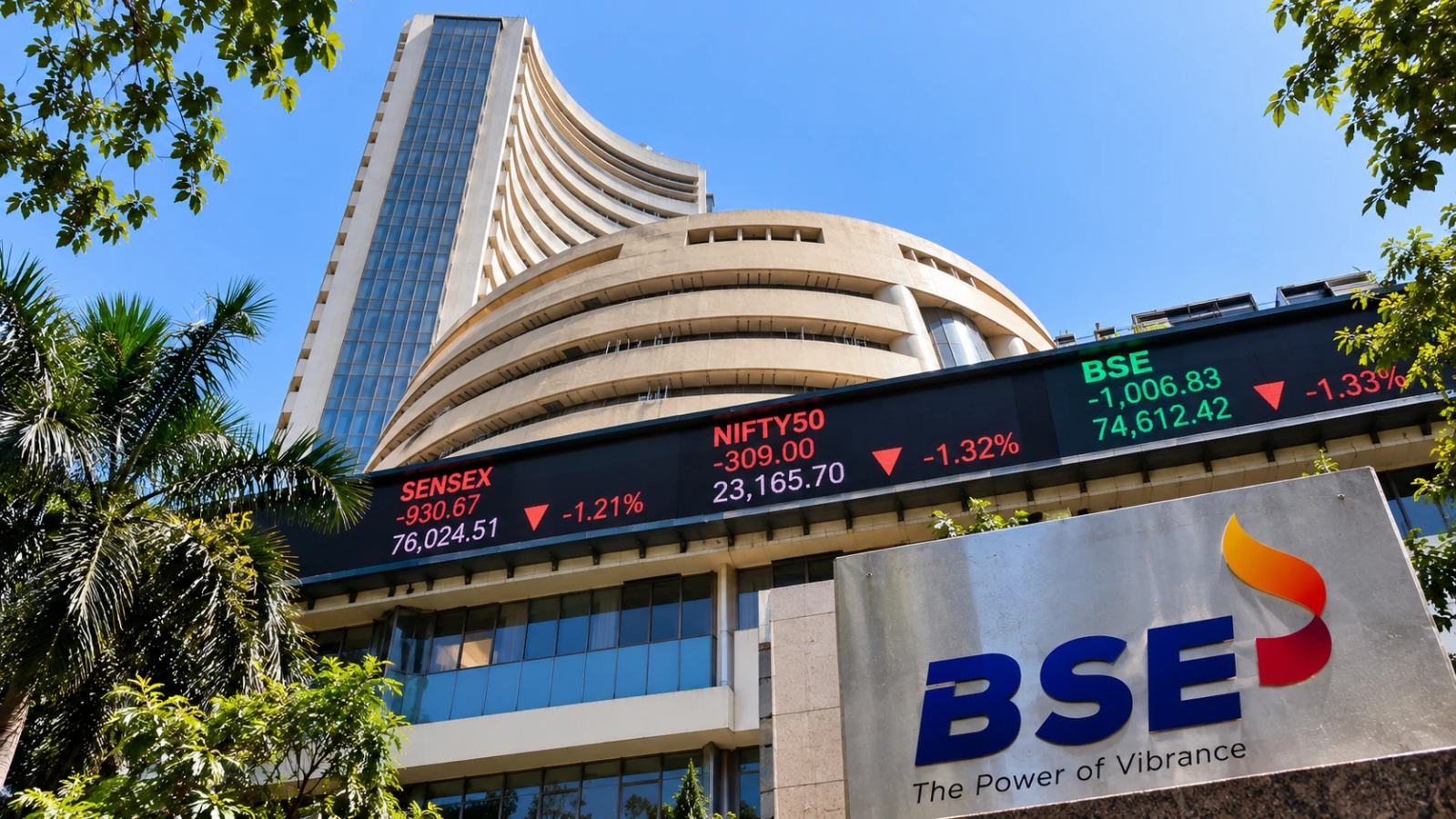
NEW DELHI — India’s stock market suffered a sharp sell-off on Thursday, with the benchmark Sensex falling more than 1,000 points by early afternoon as continued selling by foreign investors intensified pressure on equities.
The benchmark Nifty 50 also slipped below 22,300, while the total market capitalisation of companies listed on the Bombay Stock Exchange (BSE) fell by nearly 9 trillion rupees within a few hours.
The combined market value of BSE-listed companies stood at 471.86 trillion rupees at the start of trading. By 1:45 p.m., it had dropped to 462.72 trillion rupees, representing a decline of about 9.15 trillion rupees.
Foreign institutional investors have remained persistent sellers of Indian equities. On September 30 alone, they sold shares worth more than 100 billion rupees, while their combined selling over the previous two trading sessions exceeded 200 billion rupees.
US yields, rupee weakness add to pressure
One of the key factors weighing on emerging-market equities is the rise in US Treasury yields. The yield on the 10-year US Treasury bond has climbed above 5.3%, making dollar-denominated fixed-income assets more attractive to global investors and potentially reducing demand for comparatively riskier assets in emerging markets.
The Indian rupee has also weakened against the US dollar, falling below 96 per dollar on Thursday. A weaker rupee can reduce the attractiveness of Indian equities for overseas investors when returns are converted back into dollars.
Oil prices have added another layer of uncertainty. Supply disruptions linked to the conflict involving Iran have increased concerns about energy prices. India imports a large share of its crude oil requirements, making higher oil prices a potential source of pressure on the economy and corporate profitability.
Market volatility has also increased, with the India VIX, a gauge of expected stock-market volatility, rising alongside the sell-off.
Mid- and small-cap stocks tell a different story
Despite the steep decline in the benchmark indices, analysts caution that the Sensex and Nifty 50 do not necessarily reflect the performance of the entire Indian equity market.
Ishan Lazarus, founder and chief executive of 021 Trade, said the Nifty 50 represents only a segment of the broader market, while many retail investors have increasingly allocated money to mid- and small-cap companies.
The Nifty MidSmall 400 index, he said, remains only around 5% to 6% below its record high.
Lazarus also pointed to a significant expansion in India’s investor base. The number of investors registered with the National Stock Exchange (NSE) more than tripled between the end of 2020 and 2025, according to his assessment.
He said investors who became accustomed to annual returns of 20% to 30% during strong market conditions could find single-digit returns disappointing.
Despite the immediate pressure, Lazarus said investors should also consider the longer-term outlook rather than avoiding equities altogether simply because of a market decline.






COMMENTS