
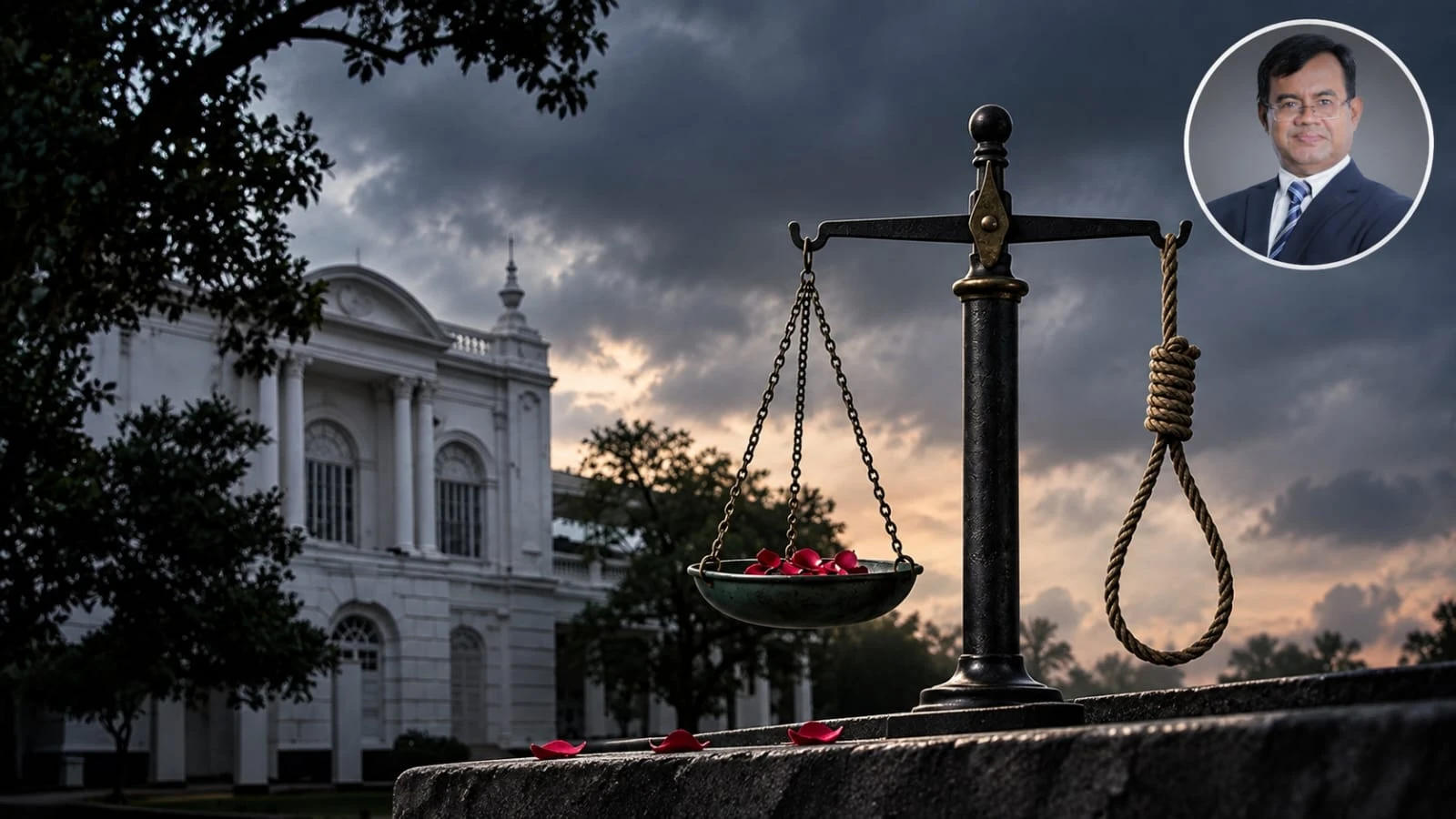
Bangladesh’s International Crimes Tribunal (ICT) is increasingly turning to the death penalty in cases arising from the country’s political upheaval. Accountability for serious crimes is necessary, but the growing number of capital punishments raises a fundamental question about whether the tribunal is delivering justice or whether the death penalty is becoming an instrument of political retribution and a means of silencing opposing voices.
The International Crimes Tribunal, set up in 2010 to try the collaborators of the 1971 genocide during Bangladesh’s Liberation War, was meant to be a solemn instrument of historical reckoning. It was built to give voice to the millions who suffered under Pakistani occupation and their local collaborators, a project rooted in the secular, pluralist vision that Bangladesh’s founders had for the nation. Today, that same tribunal has been repurposed, almost overnight, to try the leaders of the very party that once championed that vision.
From 1971 Cases to July Verdicts
In November 2025, the tribunal sentenced former Prime Minister Sheikh Hasina to death in absentia, along with her former home minister Asaduzzaman Khan Kamal, for crimes against humanity linked to the so called crackdown on protesters. Seven senior Awami League figures have followed a similar path, and the total number of July related death sentences now stands at 22. The optics are hard to ignore. A tribunal created to deliver justice for 1971 is now the chosen forum for the interim government to settle the political scores of 2024.
This should worry anyone who cares about the rule of law, regardless of what one thinks of Sheikh Hasina or her party’s record in office. A trial in absentia, without the accused present to defend themselves, without counsel of their own choosing, ending in a death sentence, is not accountability in any meaningful sense. It is closer to a verdict written before the gavel fell. Human Rights Watch and Amnesty International have both flagged serious fair trial concerns, and Amnesty’s Secretary General went so far as to call the Hasina verdict a grave miscarriage of justice that risks deepening the country’s human rights crisis. Even the UN human rights office, while welcoming accountability in principle, has insisted that any such trial must meet international standards, a standard many independent observers say has simply not been met here.
A Widening Net for Capital Punishment
What makes this moment more troubling is the pattern around it. Bangladesh already carries one of the largest death row populations in the world, with more than 2,600 people awaiting execution. Rather than narrowing the scope of capital punishment, as much of the world has been doing, Bangladesh is widening it. The Cabinet’s approval of the Enforced Disappearance Prevention and Redress Act in August 2026, which allows the death penalty even in cases where a victim is never recovered within five years, adds an extraordinarily punitive tool to an already overstretched system. Combine this with well documented research showing that poor and marginalized defendants facing capital charges are routinely denied competent legal representation, and what emerges is not a justice system correcting past wrongs but one that risks becoming an instrument of intimidation.
The deeper question is who actually bears the brunt of this shift. The Awami League has historically been the party most closely associated with Bangladesh’s secular founding ideals and the legacy of its 1971 Liberation War. Many of its leaders and supporters, along with independent secular voices and progressive activists who do not necessarily belong to the party, now find themselves under the same tribunal that once tried the killers of Bangabandhu’s family and the razakars who sided with Pakistan. When an institution built to defend secularism and pluralism becomes the vehicle for punishing the very people who once carried that banner, something has gone seriously wrong with the moral architecture of the state.
Democracy Needs Room to Disagree
A healthy democracy needs space for dissent, for secular argument, for political defeat that does not end in the gallows. Freedom of speech and genuine diversity of political thought cannot survive in a climate where the ultimate penalty is used as a message to anyone who might challenge the new order. Bangladesh’s friends abroad, and its own citizens, would do well to ask a hard question. Is this tribunal delivering justice for the victims of July and August 2024, or is it quietly working to erase an entire political and ideological tradition from public life.
Accountability for serious crimes is essential, and those responsible for deaths and abuses must face justice. But the International Crimes Tribunal was created to prosecute genocide, crimes against humanity and war crimes committed during the 1971 Liberation War. Its expanding use in cases arising from recent political violence therefore raises legitimate questions about its legal basis, jurisdiction and independence. The growing number of death sentences also raises serious human rights concerns, particularly because the death penalty is irreversible and international human rights bodies have stressed the importance of fair trial safeguards. Justice must punish proven crimes, not become a tool for political retribution or the cleansing of opposition from public life.
Parvez Hashem is a Lawyer and Human Rights Defender


COMMENTS