
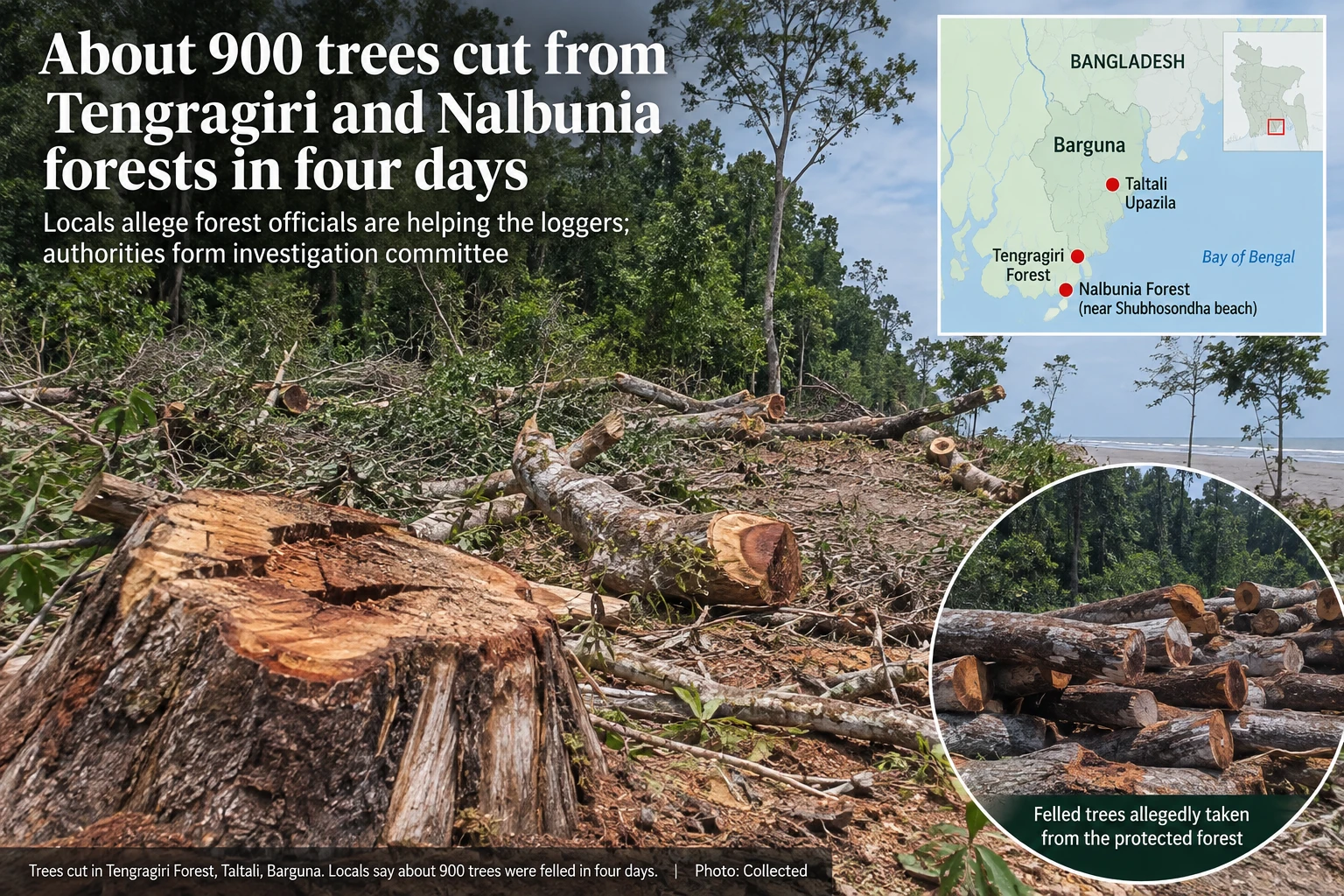
Armed groups have allegedly cut and removed about 900 trees from two protected coastal forest areas in southern Bangladesh in just four days, prompting an official investigation and allegations that some Forest Department personnel may have facilitated the logging.
The tree cutting took place in Tengragiri Forest and the nearby Nalbunia forest area adjoining Shubhosondha sea beach in Taltali upazila of Barguna district, according to local residents and environmental activists.
Tengragiri serves as an important natural barrier for coastal communities exposed to cyclones, storm surges and strong winds from the Bay of Bengal. Environmentalists warn that continued destruction of the forest could weaken that protection as well as threaten wildlife and the wider coastal ecosystem.
Local residents and environmental groups said the cutting began on Sept. 12 and that more than 900 trees had been felled in the two forest areas by Sept. 16.
About 400 trees were allegedly cut from Tengragiri and another 500 from the Nalbunia forest near Shubhosondha beach, about two kilometers north of Tengragiri.
The felled trees included rain trees, keora, gewa, jhau and jalebi trees.
Residents alleged that organized groups have been stealing trees from the forests for a long time and accused some Forest Department personnel of protecting those involved.
Several residents, including Md Rifat and Babul Hawlader, said people were afraid to protest because Forest Department officials allegedly threatened to implicate them in tree-cutting cases if they spoke out.
As a result, they said, residents have watched the forest being depleted but have been reluctant to intervene.
Sonakata Union Parishad Chairman Dr. Kamruzzaman Bachchu also alleged Forest Department involvement.
“Forest Department people are involved in the tree cutting,” he said. “If they were not involved, how could the thieves keep cutting trees for so long while they took no action?”
He called for those responsible to be brought to justice.
Residents said members of the groups involved generally transport the stolen timber under cover of darkness. In some cases, they allegedly cut trees and leave them inside the forest before removing them when conditions are favorable.
They also allegedly uproot tree stumps to erase evidence that trees had been cut.
Nalbunia Beat Officer Md Shawon denied having knowledge of the tree cutting.
“I don’t know anything about the tree cutting,” he said, declining to comment further.
However, Taltali Range Officer Md Ziaul Islam said Forest Department personnel inspected the area after receiving complaints and found evidence of illegal tree cutting.
He said a case had been filed over the incident.
The contrasting statements from the two Forest Department officials come amid demands from residents and environmental activists for an investigation into allegations of complicity by forest personnel.
Arifur Rahman, coordinator of the Taltali branch of environmental organization Dharitri Rokhhay Amra, or DHORA, said the group had received information that more than 900 trees were cut from Tengragiri and Nalbunia over four days.
He warned that the consequences could extend well beyond the loss of trees.
The coastal forests act as a natural shield against cyclones, storm surges and severe winds, protecting communities in one of Bangladesh’s most disaster-prone regions, he said. Continued deforestation would damage the ecological balance and increase disaster risks for coastal settlements.
Rahman said his organization had also received allegations of wildlife hunting in the forests, including crabs, monitor lizards and wild boars.
He alleged that Forest Department personnel were aware of what was happening but had remained silent.
A Forest Protecting the Coast
Tengragiri Forest is located in Sonakata union of Taltali upazila. According to Forest Department figures, it covers 13,644 acres.
The area was once part of the greater Sundarbans ecosystem. It was declared a reserved forest on July 12, 1960, and named Tengragiri Forest in 1967.
Its tree species include gewa, jam, dhundul, keora, sundari, bain, karamcha, kewaa, palm, kakra, wild jackfruit, rain tree, hetal, tambulkata and garan.
The forest is also habitat for squirrels, monkeys, porcupines, wild boars, turtles, foxes, junglefowl and about 40 species of snakes, among other wildlife.
Its environmental importance is particularly significant because of its coastal location. Forest belts along Bangladesh’s southern coast help absorb some of the force of high winds and storm surges during tropical cyclones, providing an additional layer of protection for settlements behind them.
The alleged removal of hundreds of trees in a matter of days has therefore raised concerns not only about forest crime but also about the longer-term vulnerability of communities along the coast.
Five-Member Committee to Investigate
Taltali Upazila Nirbahi Officer Atish Sarkar formed a five-member committee on Sept. 14 to investigate the allegations.
Upazila Agriculture Officer Abu Zafar Mohammad Elias has been appointed convener of the committee.
Elias said he had received the committee’s official letter on Thursday and expected the investigation to begin the following week.
Sarkar said the committee was formed after authorities received information about trees being cut in the Tengragiri and Nalbunia forests.
Legal action would be taken after the committee submits its findings, he said.
The investigation is expected to examine not only the scale of the illegal logging but also allegations that people entrusted with protecting the forests may have enabled those responsible.
For communities living along Bangladesh’s cyclone-prone southern coast, the stakes extend beyond the monetary value of the stolen timber. Every section of coastal forest that disappears potentially reduces a natural barrier standing between their homes and the Bay of Bengal.




COMMENTS