
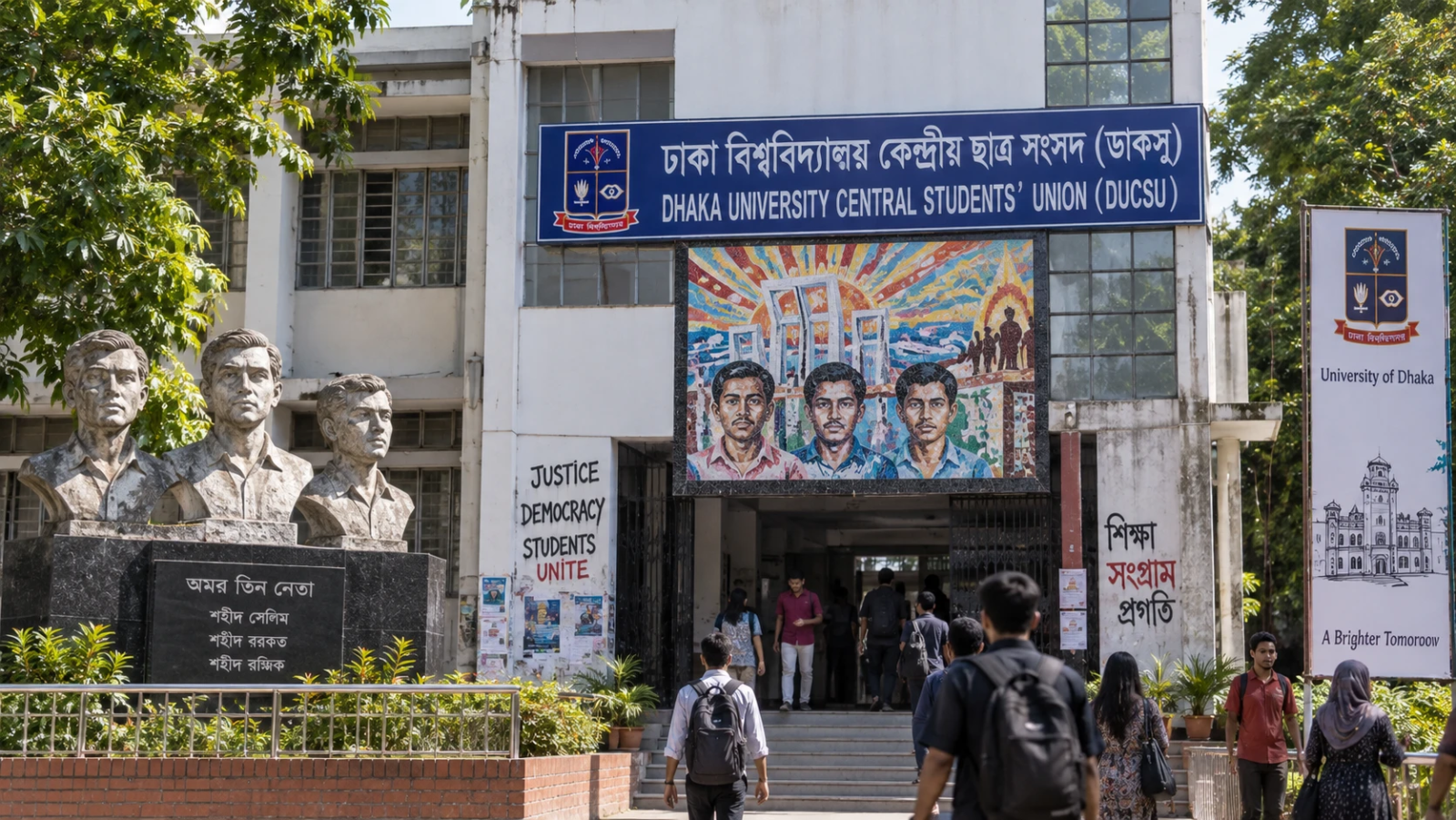
The Blue Panel, an organisation of pro-Liberation War, democratic and progressive teachers at the University of Dhaka, has strongly protested the display and inclusion of photographs of Pakistan’s founder Muhammad Ali Jinnah and other war criminals at the DUCSU Museum.
In a statement issued on Monday (September 14), signed by the organisation’s acting convener, Professor Zinat Huda, the Blue Panel expressed grave concern over what it described as an attempt to distort the history of Bangladesh’s independence.
The statement recalled that Jinnah had opposed the recognition of Bangla as a state language and advocated Urdu as the sole state language of Pakistan, despite Bangla being the mother tongue of the overwhelming majority of people in what was then East Pakistan.
According to the Blue Panel, placing Jinnah’s photograph in the DUCSU Museum amounts to disregarding the linguistic and cultural identity of millions of Bengalis and undermining the historical significance of the 1952 Language Movement, in which students and activists laid down their lives defending the right to speak their mother tongue. The movement, it said, became a defining force in the emergence of Bengali nationalism and ultimately contributed to the birth of Bangladesh.
The teachers’ organisation further alleged that displaying photographs of Jinnah and other war criminals, while removing or omitting photographs documenting the Liberation War, its martyrs and freedom fighters, as well as those of Bangabandhu Sheikh Mujibur Rahman, represents an attempt to rewrite the history of Bangladesh’s independence.
The Blue Panel said Bangladesh did not emerge from Jinnah’s two-nation theory. Rather, it argued, the country was born out of decades of popular struggle, the Language Movement, the rise of an inclusive and secular Bengali national identity, and the Liberation War led by the call for an armed struggle under Bangabandhu Sheikh Mujibur Rahman.
“History cannot be controlled, nor can its course be rewritten,” the statement said, warning that the selective inclusion of controversial figures and removal of historical representations of the Language Movement and Liberation War would constitute a new dimension of historical distortion and cultural devaluation.
The Blue Panel expressed confidence that attempts to distort the history of Bangladesh, founded on the sacrifice of millions of lives, would ultimately fail.


COMMENTS