
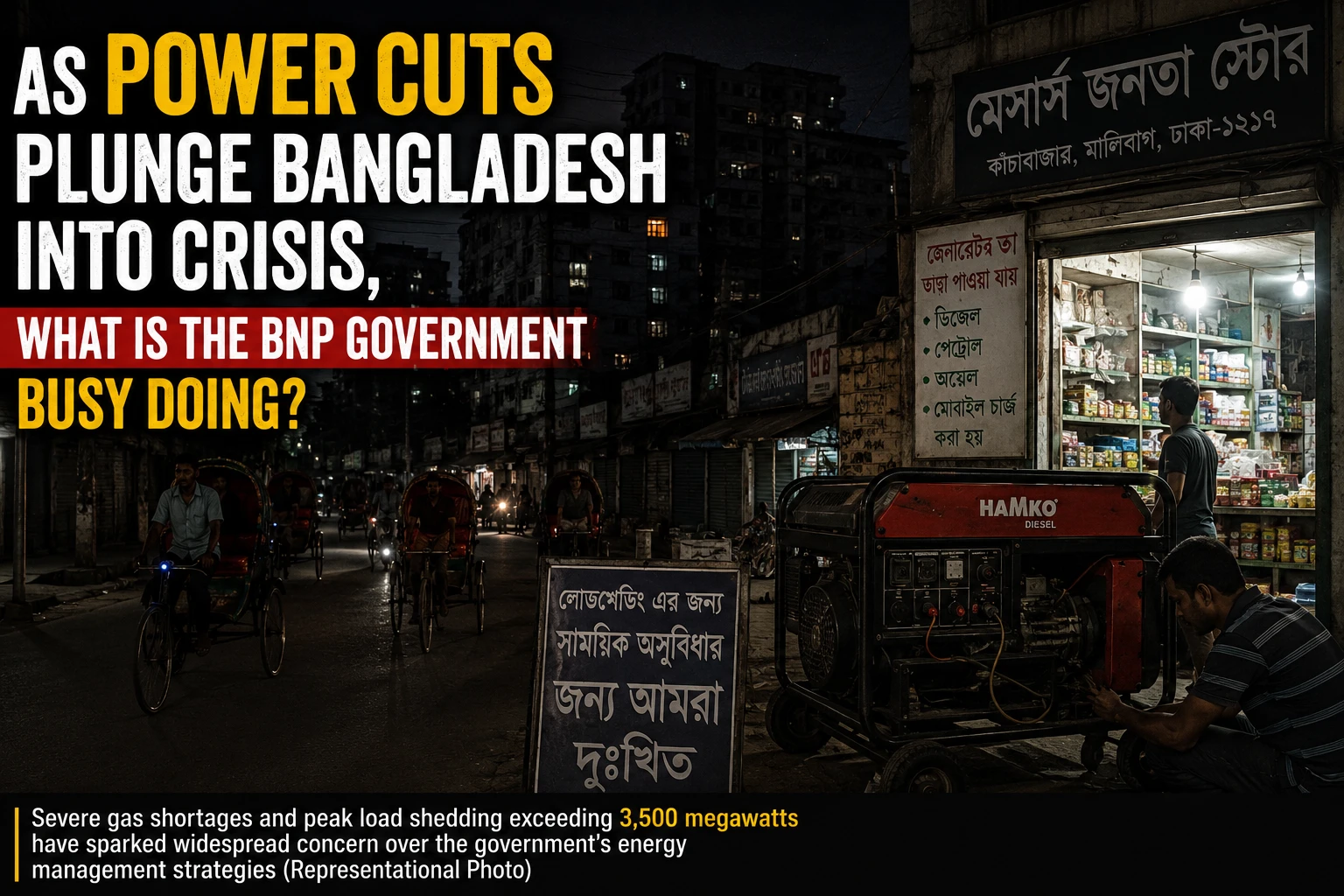
Bangladesh is facing one of its worst power and gas crises in years, with ordinary people across both rural and urban areas suffering from severe load shedding and energy shortages during the first six months of the BNP-led government.
The crisis has disrupted industrial production, businesses and daily life, while frequent power cuts have emerged as a major source of public hardship. On Thursday afternoon, nationwide load shedding exceeded 3,500 megawatts. The highest level recorded this year was 3,757MW on August 10.
The government has attributed the ongoing energy crisis to an accident involving an LNG terminal, the Iran war and policies pursued by previous governments.
However, analysts say the current situation cannot be explained solely by past policies or unforeseen accidents. They argue that weaknesses in the present government’s management and its failure to take effective immediate measures have also contributed to the severity of the crisis.
Anu Muhammad, former member secretary of the National Committee to Protect Oil, Gas, Mineral Resources, Power and Ports, said six months was not enough time to resolve every problem in the energy sector, but questioned the government’s ability to manage and contain the crisis.
“Six months may not be enough time to solve all the problems, but we have not seen any serious attention to management,” he said.
“We have not seen any attempt to change direction or properly identify the crisis and find a way out of it. Instead, what we are seeing is an interest in expanding the businesses of certain domestic and foreign business groups,” he added.
Former Power Cell Director General B.D. Rahmatullah also pointed to what he described as a lack of short-term emergency measures to deal with the worsening situation.
He said the government has announced plans to generate 10,000MW of solar power by 2031, but questioned what immediate steps were being taken to address the current power crisis.
“In any crisis, a sector needs three types of programs—a crash program, a mid-term program and a long-term program,” Rahmatullah said.
“The problem is that they still do not know what the crash program should be. I have spoken with many people, and they cannot clearly explain how the country can immediately be relieved from this power disruption.”
He said the institutions responsible for the power sector—including the Power Cell, Bangladesh Power Development Board and other relevant agencies—must develop an urgent and coordinated plan to address the immediate crisis.
Energy analysts say Bangladesh’s current power shortages are being driven by a combination of fuel constraints and weaknesses in government management. They warn that without an immediate emergency response, the crisis could have increasingly serious consequences for industrial production, businesses, employment and the wider economy.
As villages and cities alike continue to suffer from prolonged power cuts and gas shortages, a growing question remains: as Bangladesh’s energy crisis deepens, what is the BNP government busy doing?



COMMENTS