
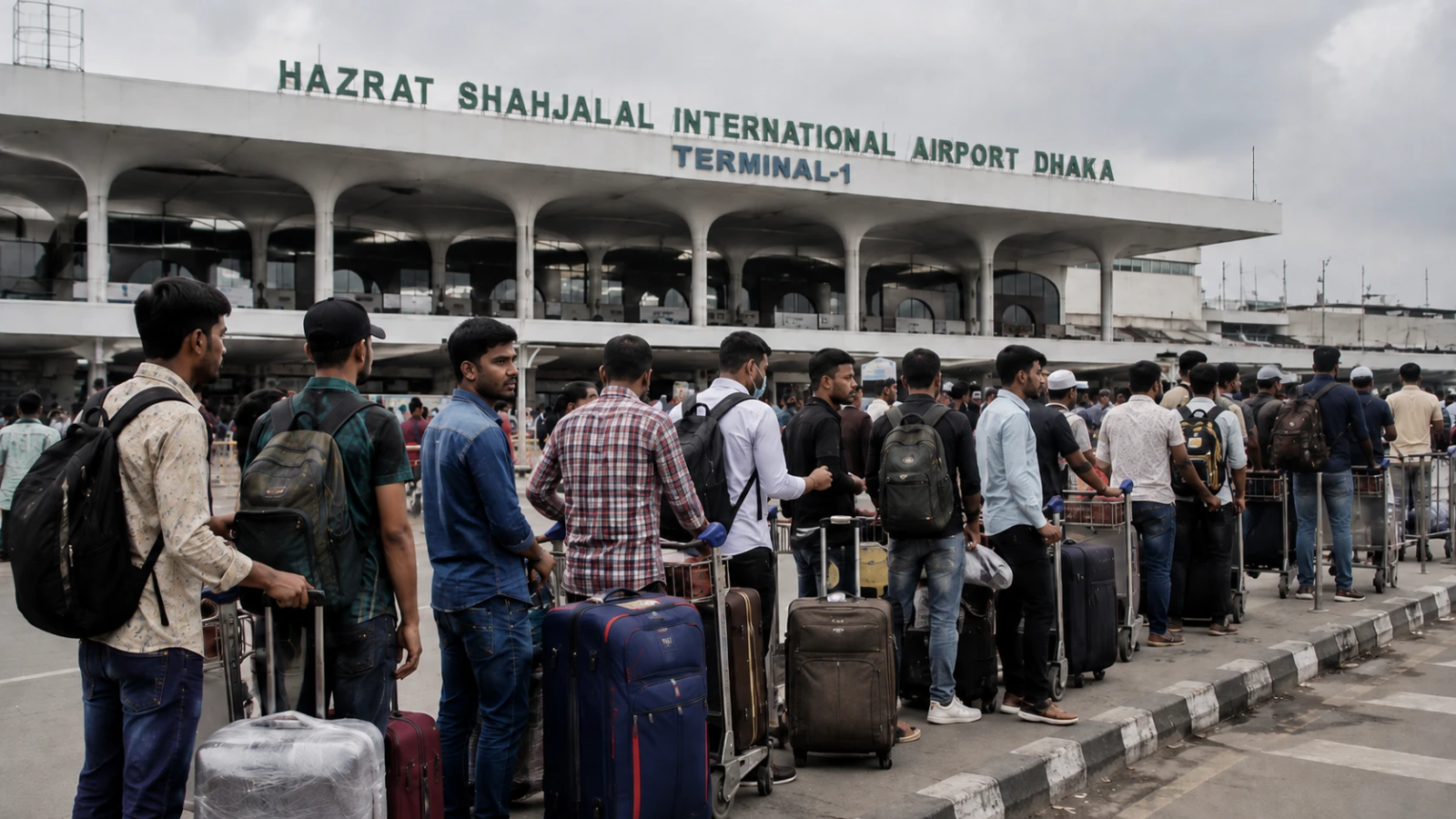
Dhaka – Bangladesh’s overseas employment has declined sharply this year, with the number of workers leaving the country for jobs abroad falling by nearly 32 percent in the first seven months compared with the same period last year.
According to data on expatriate welfare and overseas employment, 480,104 Bangladeshis travelled abroad for employment between January 1 and August 22 this year, compared with 704,603 during the corresponding period of 2025.
The decline amounts to 224,499 fewer workers, or around 32 percent year-on-year.
Saudi Arabia sees biggest decline
Saudi Arabia, Bangladesh’s largest overseas labour market, has recorded the steepest fall.
A total of 267,103 Bangladeshi workers travelled to Saudi Arabia between January 1 and August 22, compared with 482,918 during the same period last year. The number therefore fell by 215,815, or about 45 percent.
Other major Middle Eastern markets have also experienced significant declines. Qatar received 42,105 Bangladeshi workers this year, down from 66,673 last year—a fall of about 37 percent.
Kuwait saw an even sharper decline, with 17,250 Bangladeshi workers travelling there this year compared with 30,429 during the same period last year, a decrease of about 43 percent.
Some markets show growth
Not all destinations have seen declines. Bangladesh’s labour migration to Jordan and the United Arab Emirates increased during the period.
The number of Bangladeshi workers travelling to Jordan rose to 11,463, up from 7,043 last year. The UAE received 15,803 workers, compared with 7,202 during the same period last year.
Iraq also received a significant number of Bangladeshi workers, with 4,808 travelling there through August 22.
Overall, 348,532 Bangladeshi workers travelled to Saudi Arabia, Qatar, Kuwait, the UAE, Jordan and Iraq this year. Compared with the five comparable major Middle Eastern markets last year, worker departures have fallen by about 41 percent.
Singapore and Italy attract more workers
Outside the Middle East, Singapore has emerged as a relatively stronger destination. As many as 49,557 Bangladeshi workers travelled there through August 22, compared with 44,348 during the same period last year.
Italy also recorded an increase, receiving 6,284 Bangladeshi workers this year, compared with 5,038 last year.
Meanwhile, 20,309 workers travelled to the Maldives, slightly below last year’s 20,703. Portugal received 4,699 Bangladeshi workers through August 22.
Experts call for skilled migration
Shariful Islam Hasan, associate director of BRAC’s Migration and Youth Platform, said the success of migration should not be measured only by the number of workers leaving the country.
He stressed the importance of workers’ skills, earnings and ability to send remittances home. He noted that although around 2.5 million Bangladeshis had travelled to Saudi Arabia for work over the past five years, remittances from the country had declined by around $2 billion during the same period.
Hasan said the conflict that began in the Middle East in March had affected overseas employment across the region, including Saudi Arabia. However, he described the current decline as a temporary challenge and urged the government to focus on sending more skilled workers over the next six months to two years.
Migration and refugee affairs expert Asif Munir warned that the impact of the Middle East crisis could continue throughout the year. He said Bangladesh needs to diversify its overseas labour markets and formally develop new destinations while expanding existing ones.
Shrinking legal routes fuel irregular migration
The decline in legal overseas employment is also raising concerns about irregular migration.
According to International Organization for Migration (IOM) data, Bangladeshis accounted for the largest share of irregular migrants from the Asia-Pacific region reaching Europe by land and sea in 2025. Of around 47,200 migrants who reached Europe from the region, Bangladeshis accounted for about 50 percent, followed by Afghans at 32 percent, Pakistanis at 12 percent and Iranians at 6 percent.
Italy and Greece remain among the main destinations for Bangladeshis travelling to Europe through irregular routes.
IOM’s Missing Migrants Project recorded at least 1,329 Bangladeshi deaths and another 859 missing persons on nine irregular migration routes between 2015 and 2025.
The Mediterranean route has been particularly deadly. At least 1,171 Bangladeshis reportedly died and 773 went missing while attempting to reach Italy from Libya or Tunisia.
Calls to prevent trafficking and expand labour markets
Shariful Islam Hasan said that while legal migration opportunities have declined, irregular migration is increasing, particularly among those seeking to reach Europe. Some Bangladeshis are reportedly travelling abroad as tourists and then attempting to find work.
Experts have called for stronger measures to prevent human trafficking and protect migrants from exploitation.
Former BAIRA joint secretary-general Fakhrul Islam suggested forming a core committee involving government agencies, industry associations and other stakeholders to work on reopening closed labour markets.
He also stressed the need to eliminate syndicates from the overseas recruitment process and make labour migration more transparent and accessible.



COMMENTS