
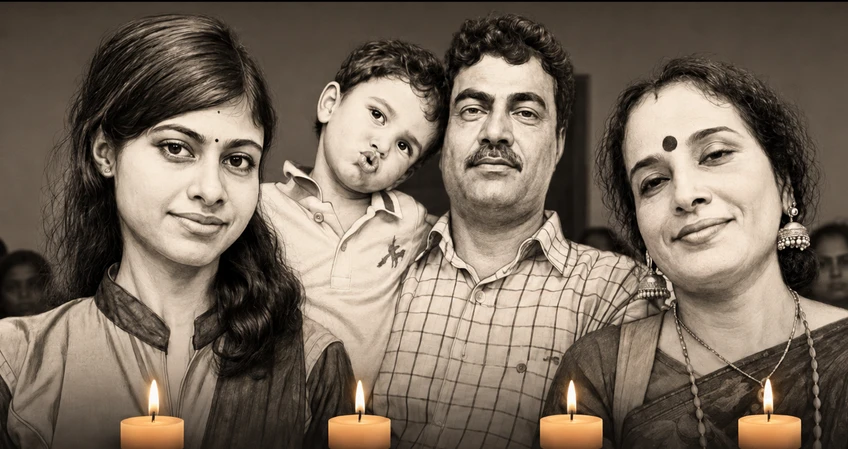
The killing of a retired teacher and his entire family in Rangpur, in northern Bangladesh, has raised disturbing questions about law enforcement, minority security, and the credibility of criminal investigations in the country.
Teacher Ganapati and his family were reportedly found dead inside their home after remaining there for several days. According to reports, the family may have been dead for three or four days before their bodies were discovered. Police subsequently arrested suspects within a remarkably short period. While a swift arrest is not itself evidence of wrongdoing, the speed of the investigation, given the circumstances, warrants careful public scrutiny.
This is not simply another criminal case. If the reported facts are accurate, the killing raises fundamental questions about whether citizens are adequately protected when they face threats and intimidation, and whether the authorities take such warnings seriously.
According to reports published by several newspapers, Ganapati had been using his retirement savings to construct a house. He had allegedly been receiving threats and demands for extortion for nearly a year and a half. If those reports are accurate, the most important question is straightforward: What action did the authorities take when the family was allegedly threatened for such a prolonged period?
An entire family has now lost its life. The state cannot respond to such a tragedy merely by announcing arrests. It has a responsibility to establish what happened, why it happened, whether earlier warnings were ignored, and whether everyone responsible will be brought to justice.
Questions Surrounding the Investigation
Several reported details of the case deserve independent and careful examination.
The alleged killer was reportedly wearing clothing associated with a police informant. The victims and the alleged suspects are reportedly members of the Hindu community. The suspects are also alleged to have consumed yaba openly on a rooftop.
There are further questions about the alleged perpetrators. Two reportedly drug dependent and physically frail young men have been accused of killing four people. It has also been reported that, rather than using a nearby under construction house, they allegedly went to the rooftop of an occupied home to consume drugs.
None of these circumstances, by themselves, proves guilt or innocence. They should not be treated as proof of an alternative theory either. But they are legitimate questions that investigators must address through evidence. A credible investigation should explain how the physical evidence, forensic findings, witness statements, communications, financial records, and other available evidence support the official account.
The public has a right to know whether the investigation is based on evidence or whether a convenient explanation has been reached before all the relevant questions have been answered.
Lessons From Bangladesh’s Troubled Record
Bangladesh has witnessed several cases of major political violence in which the credibility of investigations and prosecutions has subsequently become a matter of serious public controversy. The August 21, 2004 grenade attack in Dhaka is one such case. Questions surrounding the investigation, prosecution, and accountability in that case demonstrate why criminal justice must remain independent, evidence based, and transparent.
When an investigation is rushed, incomplete, or shaped around a predetermined narrative, the consequences can be devastating. The wrong people may be punished, the real perpetrators may escape, and public confidence in the justice system can be permanently damaged.
There are also allegations that the circumstances of the Rangpur killings bear similarities to methods associated with the militant organization known as Neo JMB. Such allegations must be investigated seriously, but they must also be established through evidence. Neither the authorities nor the public should reach conclusions before the facts are properly examined.
The Vulnerability of Minorities
The Rangpur killings also need to be viewed against the wider security situation faced by religious and ethnic minorities in Bangladesh.
For years, minorities have reported attacks on homes and places of worship, land grabbing, forced displacement, intimidation, and violence against women. Religious and ethnic minority communities often find themselves particularly vulnerable when political instability and social intolerance increase.
Since August 2024, concerns have grown about the increasing influence and social power of Islamist forces in Bangladesh. For many minorities, this has contributed to a heightened sense of insecurity. Attacks and intimidation directed at minority communities cannot be dismissed as isolated incidents when they occur repeatedly across different parts of the country.
The term “ethnic cleansing” is a serious one and should be used carefully, based on documented evidence and established patterns rather than political rhetoric. At the same time, the scale and persistence of attacks, displacement, land dispossession, and intimidation against minority communities deserve far more serious attention from the state and from independent institutions.
A democratic state has a duty to protect its citizens regardless of their religion or ethnicity. Minority citizens should not have to live with the fear that their homes, property, livelihoods, or lives can be taken from them without effective protection or meaningful justice.
Bangladesh Needs a Minority Protection Act
The recurring vulnerability of religious and ethnic minorities demonstrates the need for stronger legal protection.
Bangladesh urgently needs a comprehensive Minority Protection Act that specifically safeguards the rights, security, property, dignity, and equal citizenship of religious and ethnic minorities.
Such legislation should provide effective mechanisms to prevent attacks, protect vulnerable communities, investigate crimes against minorities, address unlawful land dispossession, ensure accountability for perpetrators, and provide meaningful remedies to victims. It should also establish institutional safeguards so that complaints from minority communities cannot simply be ignored or treated as ordinary disputes when there is evidence of systematic intimidation or targeting.
The protection of minorities is not a favor granted by the majority. It is a fundamental obligation of a democratic state.
Justice Must Not Be a Script
The Rangpur case therefore demands more than arrests. It demands answers.
The authorities should conduct a credible, impartial, and transparent investigation into the family’s reported history of threats, the circumstances surrounding their deaths, the forensic evidence, possible motives, communications, alleged extortion demands, the identities and backgrounds of the suspects, and any possible involvement of others.
The investigation should also establish whether the family sought help from the authorities before the killings and, if so, what action was taken.
No innocent person should be framed. No guilty person should be protected. No investigation should be manipulated to satisfy political, religious, or institutional interests.
An entire family has lost their lives. Their deaths should not become another case in which the public is presented with a convenient story while uncomfortable questions remain unanswered.
Justice is not merely the arrest of a suspect. Justice is the discovery of the truth, the protection of the innocent, the punishment of the guilty through due process, and the assurance that such crimes will not be repeated.
For Bangladesh’s religious and ethnic minorities, the question is even more fundamental: Can they trust the state to protect them when they are threatened, attacked, or killed?
The answer must not be a slogan. It must be demonstrated through law, institutions, accountability, and justice.
The truth must come first.
Parvez Hashem, Lawyer and Human Rights Defender



COMMENTS