
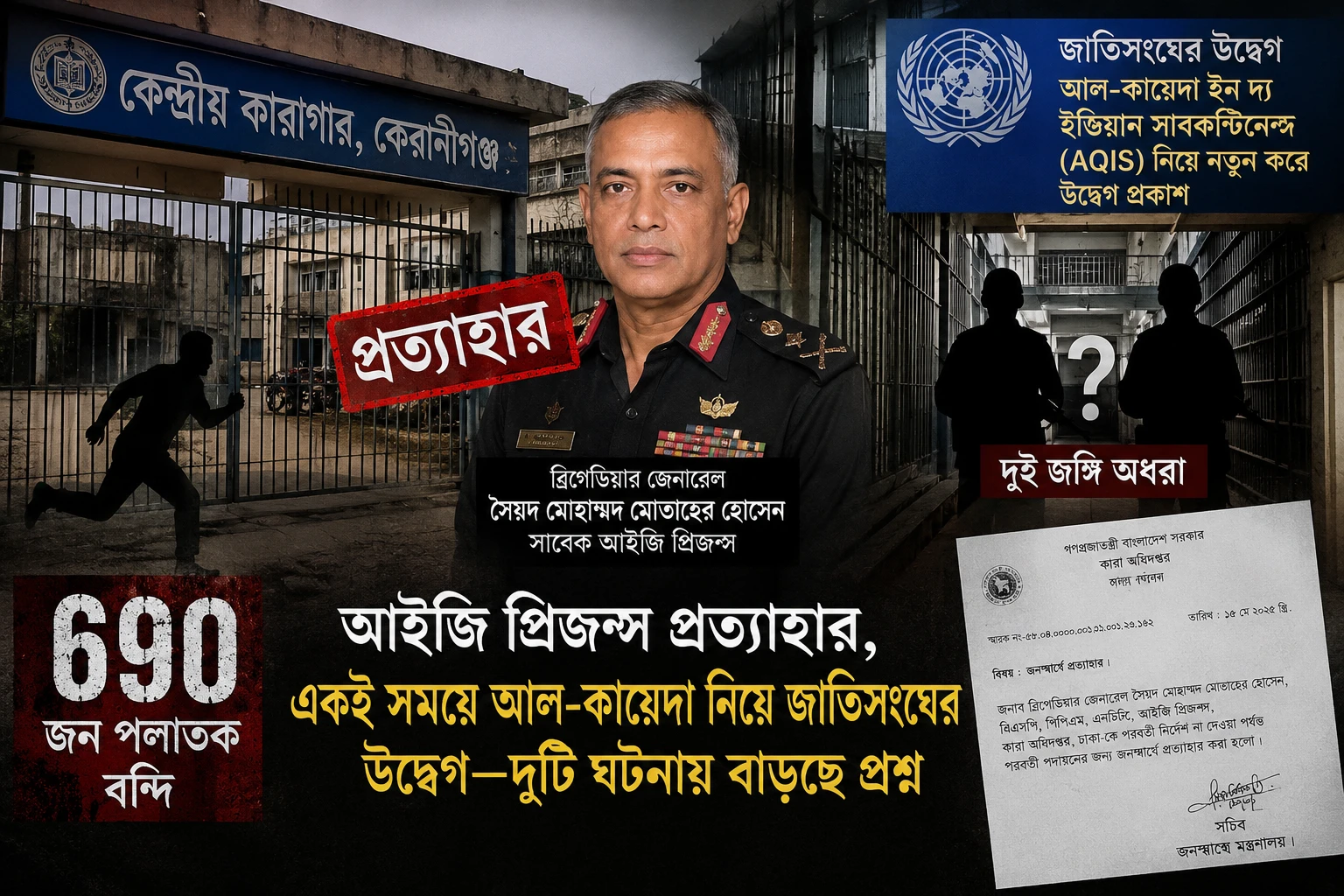
Dhaka, August 20 — The government has withdrawn Brigadier General Syed Md Motaher Hossain from his post as Inspector General of Prisons, a day after he publicly disclosed that 690 prisoners who escaped from several prisons during the July-August violence of 2024 remain at large, including two militants.
The government did not provide any reason for the decision, prompting questions over the timing of the move. Brig Gen Motaher Hossain has been reassigned to the Armed Forces Division.
According to a notification issued Wednesday by the Ministry of Public Administration’s Deputation-1 branch and signed by Deputy Secretary Mohammad Nur-Alam, the officer has been withdrawn from his current deputation and placed with his parent service. The order, issued in the public interest, took immediate effect.
The notification does not indicate whether his removal is connected in any way to the figures he disclosed at a press conference the previous day. No such link has been officially established.
What the Prisons Chief Disclosed a Day Earlier
At a press conference at the Department of Prisons headquarters in Dhaka on Tuesday, Brig Gen Motaher said more than 2,200 prisoners had escaped from several prisons amid attacks, arson and the collapse of security arrangements during the political violence of July and August 2024.
A substantial number were subsequently recaptured or surrendered. But according to the latest figures, 690 remain at large.
More significantly, the prisons chief said two militants were still among the fugitives.
The disclosure has renewed concerns over the effectiveness of the country’s prison security and law-enforcement systems, particularly because some of those who escaped were convicted prisoners or individuals facing serious criminal charges.
A Major Security Breakdown in the Prison System
The prison escapes followed a series of attacks on correctional facilities during the political violence of July-August 2024.
According to earlier prison authorities’ figures, at least eight prisons were attacked, with prisoners escaping from five of them.
Narsingdi District Jail was among the worst affected. Following an attack and arson on July 19, a total of 826 prisoners escaped from the facility. Authorities subsequently recaptured or secured the surrender of 690 of them.
Other prisons, including facilities in Kashimpur, Sherpur and Satkhira, also experienced attacks, arson, security breaches and prisoner escapes.
Earlier reports also indicated that firearms and ammunition were looted during some of the incidents, adding another dimension to the security breakdown.
The Number Has Fallen, but the Security Gap Remains
In September 2024, prison authorities reported that 901 escapees were still at large. Among those who had escaped were 98 militants, including 70 convicted prisoners, while 27 militants were still unaccounted for at the time.
By December, roughly 1,500 of the more than 2,200 escapees had been recaptured or had surrendered, leaving around 700 still at large.
The latest figure of 690 represents some progress in recovering the fugitives. But the fact that hundreds remain unaccounted for two years after the mass prison escapes remains a serious security concern.
UN Raises Fresh Concerns Over AQIS Activity
The prison issue comes at a time when Bangladesh is also facing renewed international scrutiny over the regional terrorist threat.
The United Nations Security Council’s Analytical Support and Sanctions Monitoring Team (ASMT), in its latest report, raised concerns over attempts by Al-Qaida in the Indian Subcontinent (AQIS) to exploit Bangladesh to establish cells. The report, published on August 10, assesses developments between December 2025 and June 2026.
The report says AQIS has evolved from a fragmented organisation into a regional terrorist entity, developing logistical and financial networks while operating through decentralised, small and scattered cells. It also officially attributed the November 2025 attack near Delhi’s Red Fort to AQIS.
The assessment is significant, but it should not be interpreted as establishing that an operational AQIS cell is already functioning in Bangladesh. Rather, the UN monitoring mechanism has recorded concerns over efforts to establish such cells.
Immediate Rebuttal, Long-Term Strategy
The government has responded promptly to the UN assessment, with the Home Minister dismissing the relevant concerns as speculative. From an immediate political and diplomatic standpoint, such a response is understandable. When an international monitoring mechanism raises concerns about the possibility of terrorist networks expanding within a country, the government has both the responsibility and the right to clarify its position.
But there is a more consequential second layer to the issue.
Rejecting an international security assessment as speculative or politically motivated may be a legitimate immediate response; it cannot, by itself, substitute for a systematic examination of the intelligence and evidence underlying that assessment.
Bangladesh has witnessed a number of security incidents in recent months, including bomb explosions and attempted attacks, arrests in connection with alleged militant or extremist activities, and the recovery of materials reportedly linked to explosive-making during security operations. These incidents do not, by themselves, establish a connection to AQIS or any other international terrorist organisation.
But neither should they be dismissed without examining whether there are common patterns, networks, financing channels, recruitment structures or cross-border links.
That is where a credible long-term national security strategy becomes essential.
The UN Monitoring Team’s assessment is not a judicial verdict, nor should every element of it automatically be accepted as established fact. But it is also not something that can be responsibly dismissed without examination. Bangladesh’s strongest response would therefore be an evidence-based one: independently assess the findings, test them against national intelligence and law-enforcement information, and, where necessary, present documented evidence to international partners.
In other words, the most effective response is not simply to say “the assessment is wrong,” but to demonstrate, through credible evidence, why it is wrong—or, where elements are substantiated, what Bangladesh is doing to address them.
That distinction matters particularly in counterterrorism, where intelligence sharing, financial monitoring, border security and international cooperation are central to preventing threats before they become operational.
Two Separate Developments, One Broader Security Question
There is currently no evidence establishing a direct connection between the removal of the Inspector General of Prisons and the UN’s concerns regarding AQIS.
Yet their convergence in time inevitably draws attention to a broader question about Bangladesh’s security capacity.
On one side, 690 prisoners remain at large two years after the 2024 prison breaches, including two militants according to the prisons chief. On the other, an international UN monitoring mechanism has raised concerns about attempts by AQIS to establish cells in Bangladesh.
Taken separately, these are distinct issues. Viewed together, however, they underscore the importance of institutional capacity, intelligence coordination, information transparency and effective law enforcement.
Why the IG Prisons Decision Matters
The government has not explained why Brig Gen Motaher Hossain was removed from his post. It would therefore be premature to conclude that his disclosure about the 690 fugitives had anything to do with the decision.
But the sequence of events is difficult to ignore.
On Tuesday, the prisons chief publicly disclosed that 690 escapees remained at large, including two militants. On Wednesday, the government removed him from the post.
If the government provides an administrative, organisational or other specific explanation for the decision, it could help dispel the uncertainty surrounding the timing.
Ultimately, however, the issue extends far beyond the career of one senior officer.
It concerns the security of Bangladesh’s prison system, the state’s ability to locate and recapture fugitives, its preparedness to deal with militant threats, and its capacity to respond credibly to international security assessments.
The central question, therefore, is no longer simply why was the Inspector General of Prisons removed?
It is also this:
Two years after more than 2,200 prisoners escaped, where are the remaining 690, how have two alleged militant fugitives remained beyond the reach of law enforcement, and how prepared is the state to close this persistent security gap?




COMMENTS