
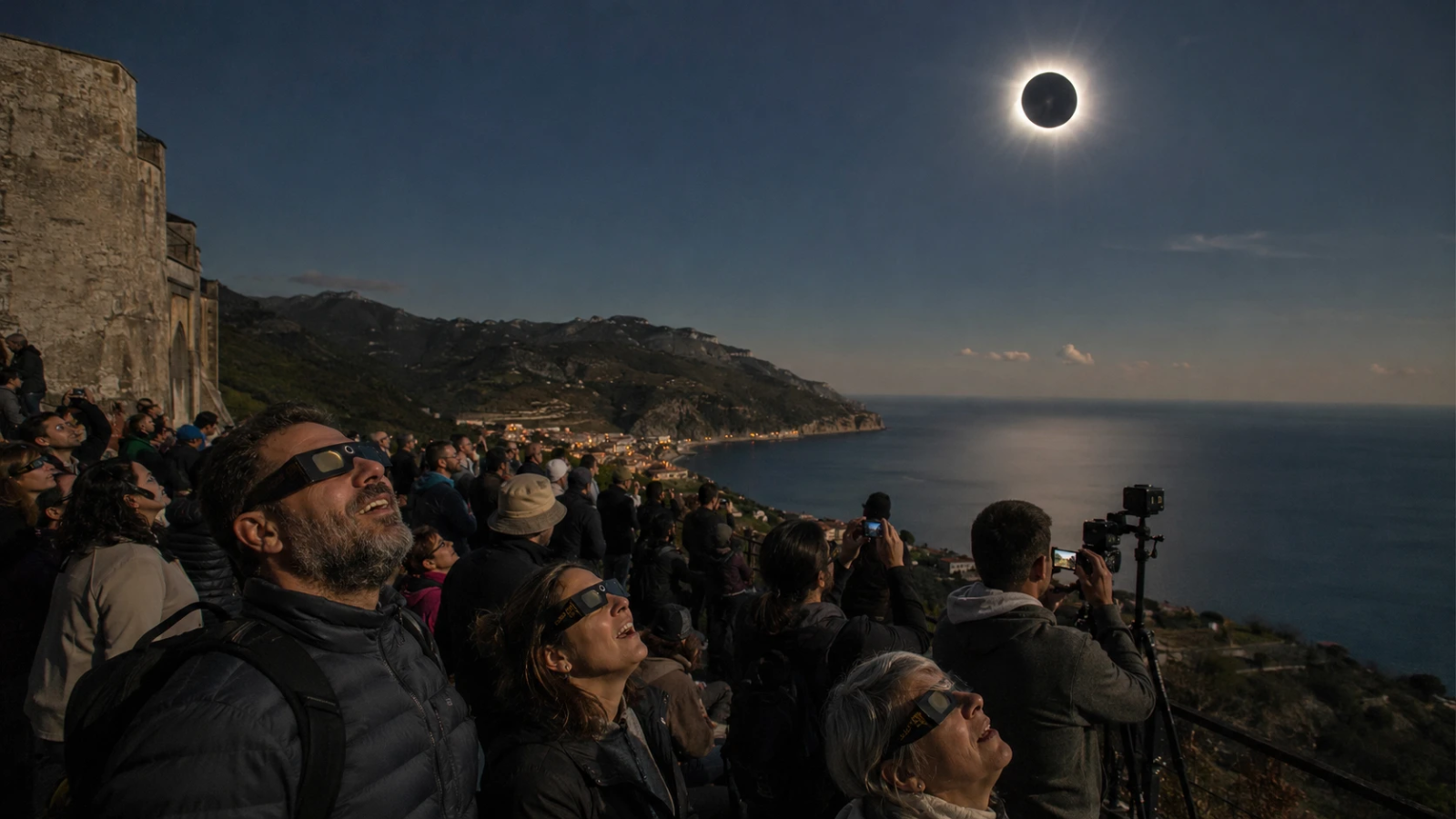
LONDON, August 13, 2026: The Moon completely blocked out the Sun in parts of Europe on Wednesday, giving millions of skywatchers a rare glimpse of a total solar eclipse nearly three decades after the region witnessed a similar spectacle.
Across most of the United Kingdom, the Moon covered more than 90 percent of the Sun. In Cornwall, coverage reached around 95 percent. However, totality was visible from parts of Spain, Iceland and Greenland, where the Moon moved directly between the Sun and Earth.
The eclipse reached its peak in the UK shortly after 7 p.m. local time. Clear skies allowed people in central and southern England and Wales to get relatively unobstructed views, while cloudy conditions affected parts of Scotland, northern England and Northern Ireland.
Large crowds gathered at popular viewing locations, including Calton Hill in Edinburgh. Many spectators used specially designed eclipse glasses, although shortages of the protective eyewear were reported ahead of the event.
Spain plunged into darkness
While the UK experienced a partial eclipse, parts of Spain witnessed the much more dramatic total phase.
At around 8:30 p.m. local time, the Sun, Moon and Earth aligned closely enough for the Moon to completely cover the Sun. Daylight faded for several minutes, leaving some areas in darkness resembling night.
Images captured in Ariza, Spain, showed the Moon gradually covering the Sun until its bright disk disappeared completely. Only the Sun’s outer atmosphere, known as the corona, remained visible.
Chilean scientist Yasmin Catrichio travelled thousands of miles to A Coruña in northwestern Spain to witness the total eclipse. Describing the experience, she said the crowd erupted in cheers and that the sight was difficult to put into words.
Why does a solar eclipse occur?
A solar eclipse occurs when the Moon passes between the Sun and Earth, blocking some or all of the Sun’s light and casting its shadow over part of Earth.
When the Moon completely covers the Sun, it is known as a total solar eclipse. When only part of the Sun is obscured, it is a partial solar eclipse.
Although around 90 percent of the Sun was hidden from most parts of the UK during Wednesday’s event, totality was not visible there because the Sun, Moon and Earth were not perfectly aligned from the UK.
Why are total solar eclipses so rare?
A total solar eclipse occurs somewhere on Earth roughly once every 18 months on average. However, seeing totality from the same location is extremely uncommon, with some places potentially waiting hundreds of years for another one.
During totality, the Moon blocks the bright surface of the Sun, allowing observers to see the corona—the Sun’s extremely hot outer atmosphere. Prominences, or loops of glowing gas extending from the Sun’s surface, can also sometimes be seen.
Thousands of people across Spain witnessed these extraordinary features during Wednesday’s eclipse.
A remarkable cosmic coincidence
The possibility of a total solar eclipse depends on a remarkable coincidence of scale and distance.
The Sun is roughly 400 times wider than the Moon, but it is also about 400 times farther from Earth. As a result, the two bodies appear nearly the same size in Earth’s sky.
This allows the Moon, when positioned precisely between Earth and the Sun, to cover the Sun’s visible disk almost completely.
Three more total eclipses ahead
The period from 2026 to 2028 is being regarded as an exceptional period for eclipse enthusiasts, with three total solar eclipses visible from different parts of the world.
However, people in the UK will not see totality during these events. A partial solar eclipse in 2027 could cover up to about 45 percent of the Sun from some parts of the country.
The next eclipse visible from the UK with substantially greater coverage could occur in 2081, when some areas may see up to 99 percent of the Sun obscured. The next total solar eclipse visible from the UK is expected in 2090.
For British skywatchers, therefore, Wednesday’s eclipse was a rare celestial spectacle that may not be repeated in their skies for generations.





COMMENTS