
Dhaka, 13 August- The political transformation that unfolded in Bangladesh on 5 August 2024 deserves to be examined beyond the immediate drama of a government falling after weeks of mass protest. It was undoubtedly driven by a powerful domestic uprising, intensified by the government’s violent response and the accumulation of deep political grievances. Yet the subsequent transformation of the state, the changing balance among political forces and the role played by the military leadership raise broader questions about whether Bangladesh entered a geopolitical transition whose consequences extend far beyond the fall of Sheikh Hasina.
One historical framework frequently invoked in discussions of such transformations is what journalist Vincent Bevins has called the Jakarta Method, referring to the Indonesian experience of 1965 and the wider Cold War pattern in which anticommunist forces, military institutions and foreign powers combined to destroy an established political order. Historical scholarship documents extensive American support for Suharto’s rise and the violent suppression of the Indonesian left.
The comparison with Bangladesh, however, should be treated as an analytical proposition rather than an established historical fact. There is no publicly demonstrated evidence that the events of 2024 constituted a literal replication of the Indonesian model. What deserves examination is whether certain structural similarities are visible in the way political legitimacy was contested, military power became decisive and the political balance subsequently shifted.
The Jakarta Method as a Historical Lens
The importance of the Jakarta experience lies in its broader political logic. A government can fall through popular mobilisation, but the deeper transformation begins when the political forces that inherit the vacuum redefine the country’s ideological and institutional direction.
In Indonesia, the military became the decisive instrument in dismantling Sukarno’s political order and suppressing the Indonesian Communist Party. The United States and its allies regarded the struggle through the prism of the Cold War, and Washington’s relationship with the Indonesian military became an important element of the subsequent political transformation.
Bangladesh in 2024 was obviously a profoundly different case. The uprising began with a student movement over public sector recruitment quotas and developed into a nationwide demand for Sheikh Hasina’s resignation. By early August, the confrontation had become a national political crisis, with severe violence and mounting casualties.
Yet the critical question begins at the moment of transition itself. Who controlled the state when the previous political order collapsed? Who was invited into the process of constructing the next order? And which political forces gained greater space as a result?
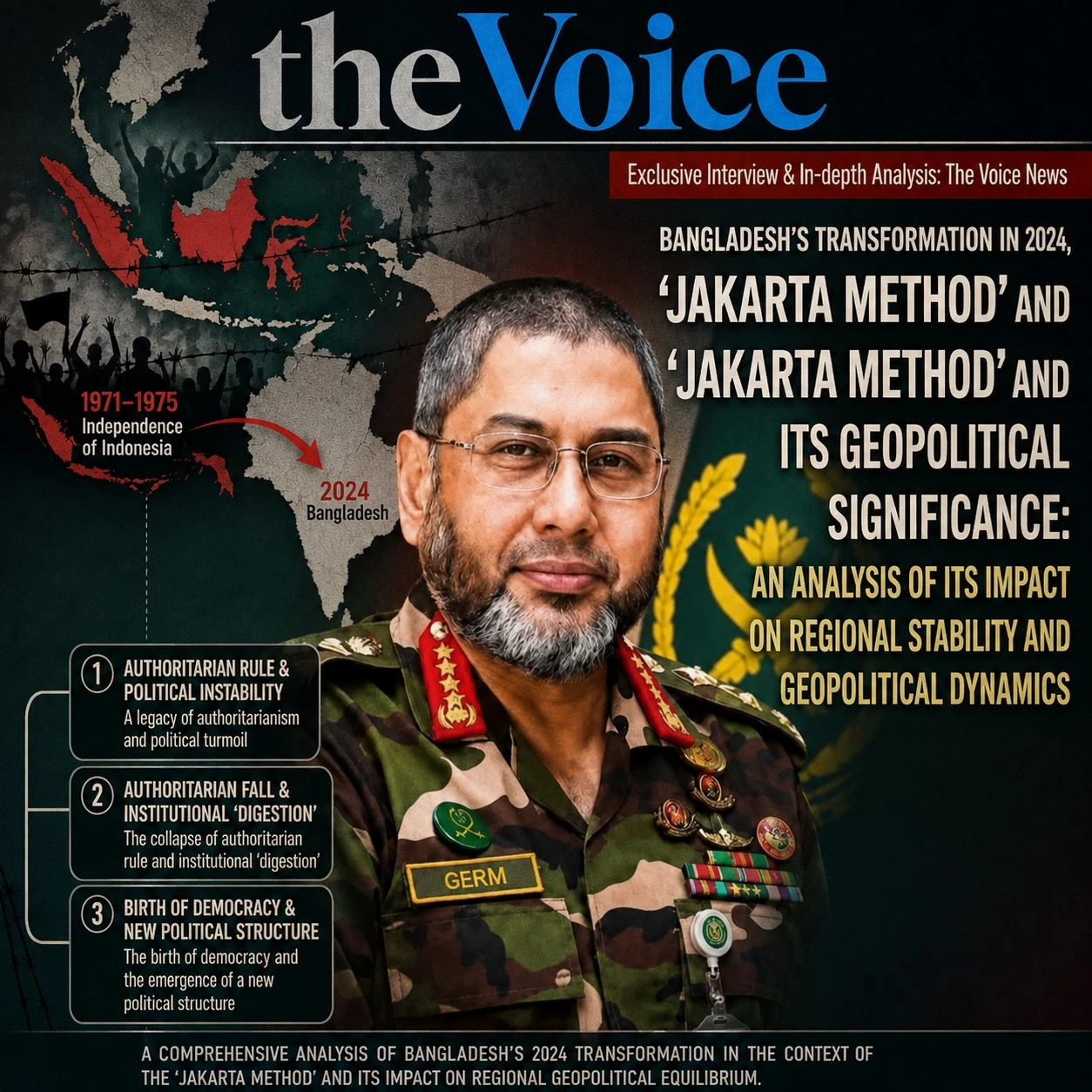
Those questions make the role of the military particularly important.
General Waker and the Politics of the Transition
On 5 August, Army Chief General Waker Uz Zaman announced that Sheikh Hasina had resigned and that an interim government would be formed. He subsequently held discussions with representatives of major political parties and other political actors concerning the formation of that government.
The composition of those consultations is politically significant. Representatives of the BNP, Jatiya Party, Jamaat e Islami, Hefazat e Islam and several other political groups participated. No Awami League representative was present.
This does not, by itself, establish a predetermined military plan. Nor does the presence of Jamaat representatives prove that the military sought to promote any particular ideological force. But it does demonstrate that, at the decisive moment of political transition, the military became an essential intermediary between the collapsing government and the emerging political order.
That is a crucial fact of the 2024 transition.
The army was not merely restoring public order. It was participating in the process through which political authority was reorganised. The distinction matters because political transitions are ultimately determined not only by who leaves office, but also by who is permitted to participate in constructing what follows.
The “Meticulously Designed” Question
Another element has subsequently fuelled debate over whether the uprising was entirely spontaneous or whether it contained a carefully organised political dimension.
At a Clinton Global Initiative event in New York in September 2024, Chief Adviser Muhammad Yunus described the student movement as an “amazing meticulously designed” development and introduced student leaders whom he described as the people behind it. Contemporary reporting interpreted his remarks as suggesting that the movement had been organised rather than simply emerging spontaneously.
The statement deserves attention, but it should not be transformed into proof of an international conspiracy. Mass political movements can contain both spontaneous popular anger and organised leadership. Indeed, these two forces frequently reinforce one another.
The more consequential question is whether the organisation that became visible during the uprising was later converted into political authority and whether the transformation ultimately produced a new ideological balance within the state.
That question remains open to historical interpretation.
From Political Change to Ideological Reordering
The most consequential feature of the post August environment was not simply the removal of one government. It was the rapid reconfiguration of political space.
For fifteen years, the Awami League had dominated Bangladesh’s political system. Its removal created an extraordinary vacuum. Political forces that had previously occupied the margins suddenly acquired greater freedom to organise, mobilise and compete for influence.
This included forces that had been politically constrained under the previous order. The question therefore became whether Bangladesh was witnessing merely a change of government or a deeper redefinition of the country’s political identity.
That distinction is essential.
A democratic transition should broaden political participation without converting the defeat of one political force into the permanent exclusion of another. If political competition instead becomes a process of systematically delegitimising an entire ideological constituency, the character of the transition becomes considerably more complicated.
The Awami League Question
The treatment of the Awami League after August 2024 has consequently become central to the debate.
The party’s political exclusion, the legal cases against its leaders and the subsequent prohibition of its activities have transformed what began as a popular movement against a government into a much broader confrontation over the future of a major political tradition. In May 2025, the interim government formally banned Awami League activities under the Anti Terrorism Act pending proceedings against the party and its leaders.
The argument advanced by supporters of the ban is based on accountability for violence and alleged abuses committed during the uprising. That question cannot simply be dismissed.
But another question must also be asked: can accountability for individuals be reconciled with the political exclusion of an entire historical constituency?
This is where the comparison with the Jakarta Method becomes intellectually provocative. The Indonesian experience demonstrated how political violence can move beyond the removal of a government and become a project for permanently restructuring ideological space.
Bangladesh has not reproduced that history. But the warning contained within that history remains relevant.
A Geopolitical Transition, Not Merely a Political One
The transformation of Bangladesh also has a geopolitical dimension.
The country occupies a strategically important position between India, China and the Bay of Bengal. Its relations with India, its growing engagement with China, its economic dependence on Western markets and its strategic position in the Indo Pacific all give domestic political change an international dimension.
This makes it difficult to interpret the events of 2024 exclusively through the language of domestic politics.
At the same time, claims that a particular foreign power designed or controlled the entire uprising require evidence far stronger than political coincidence. The responsible approach is therefore neither to dismiss geopolitical influence nor to convert suspicion into certainty.
The real historical task is to identify the interaction between domestic mobilisation, institutional power and international interests.
The Historical Lesson
The greatest danger in studying the Jakarta Method is turning history into a conspiracy template. The value of the concept lies elsewhere. It reminds us that political transformations can have consequences far beyond the original movement that brings down a government.
Indonesia’s 1965 crisis did not end when Sukarno’s authority collapsed. It produced a fundamentally different political order that endured for decades.
Bangladesh’s transformation began differently and under very different circumstances. Yet the same broader question now confronts the country: will the events of 2024 ultimately be remembered as a democratic uprising that restored political pluralism, or as a transition that replaced one dominant political order with another?
General Waker’s role on 5 August therefore deserves serious historical scrutiny, not because his actions prove a predetermined conspiracy, but because the military became a central political intermediary at the precise moment when Bangladesh’s constitutional and political order was being rewritten. The consultations that followed, including the participation of Jamaat and other opposition forces, are documented facts. Their ultimate political meaning remains a matter for history to judge.
The 2024 uprising unquestionably represented a profound rupture in Bangladesh’s political history. Whether that rupture becomes a democratic opening or an ideological reordering will depend not only on who holds power, but on whether the country preserves political pluralism, historical memory and the right of competing traditions to exist within the national political framework.
History offers warnings. It does not offer predetermined conclusions.
Author Dastagir Jahangir is Editor and Chief Executive, The Voice News

COMMENTS