
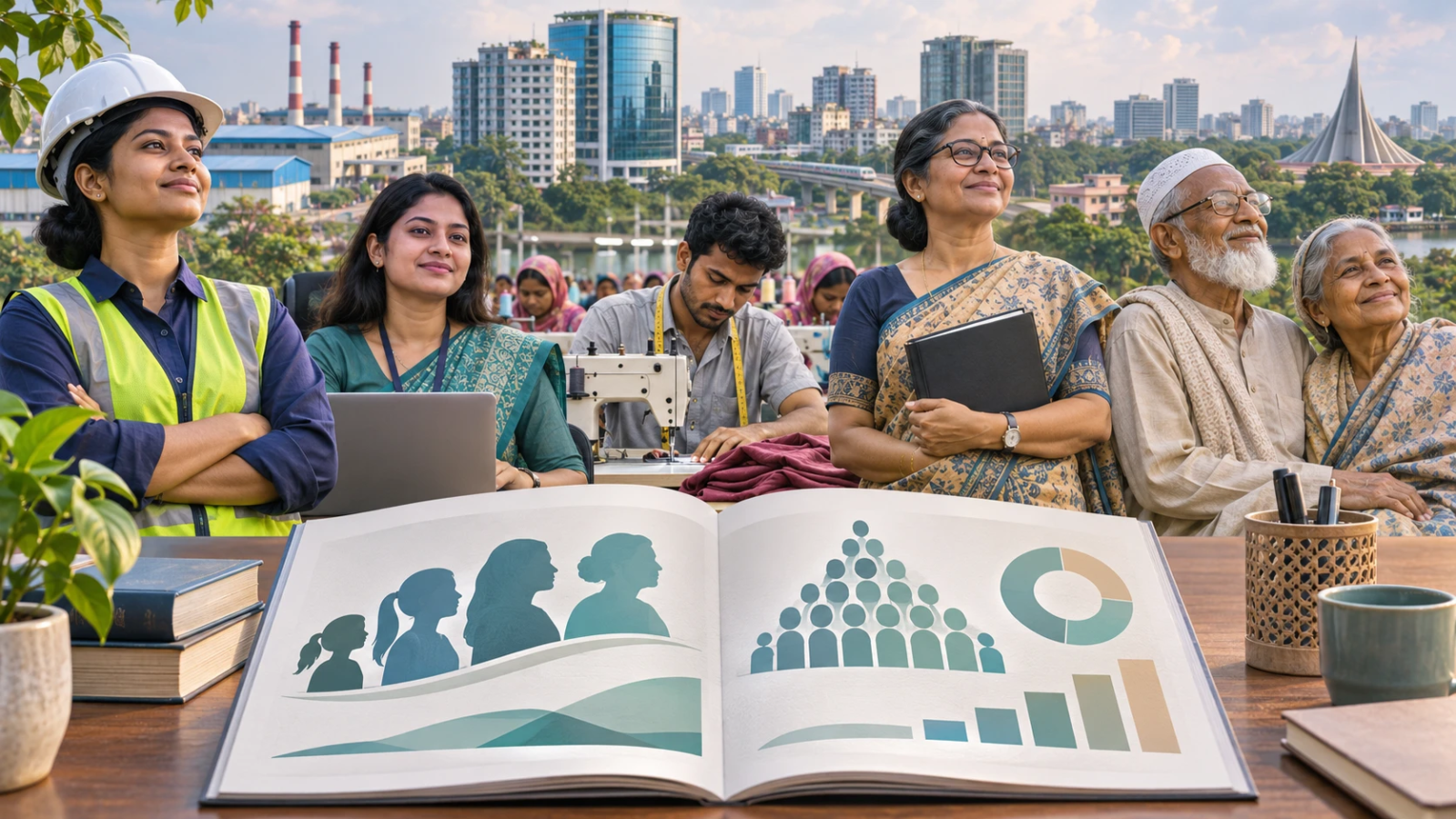
Bangladesh has roughly two decades to capitalise on its demographic dividend before the proportion of its working-age population begins to decline after 2045, according to a new World Bank report.
The report warns that the country must act swiftly to create adequate and quality jobs, improve skills among young people and increase women’s participation in the labour market to fully benefit from its favourable population structure.
Titled Demographic Change in South Asia: From Tailwinds to Headwinds for Development, the report was released on Tuesday (November 3). It says South Asia currently has 1.17 billion people of working age, but the region’s working-age population is expected to peak within less than a decade before beginning to shrink.
South Asia is projected to become an ageing region by 2049, when people aged 65 and above will account for 14 per cent of its total population. Bangladesh is expected to reach that stage by 2051, giving it slightly more time than many other countries in the region to benefit from its demographic advantage.
The report notes that the rising share of working-age people has contributed an annual 0.4 percentage points to South Asia’s gross domestic product (GDP) growth and 1.1 percentage points to labour productivity growth since 2000.
However, the contribution of demographic changes to GDP growth is projected to fall to just 0.1 percentage points annually by 2050.
Employment gap and widespread informality
A major challenge for Bangladesh is the inability to generate enough productive and formal employment despite the growing working-age population.
According to the World Bank, around 84 per cent of the country’s employed population, or approximately 58 million people, work in the informal sector. Even among university graduates, 44 per cent are employed informally, highlighting the shortage of quality formal jobs.
The report also points to slow employment growth in formal businesses and a decline in the average number of workers employed by smaller enterprises in recent years.
World Bank Vice President for South Asia Johannes Zutt said countries in the region were facing the challenges of population ageing relatively early in their development process.
He stressed the need to create more and better-quality jobs, develop policies and infrastructure to harness the potential of young people, and prepare for the needs of an ageing population.
He added that older people could also contribute to the economy if they were provided with good health and adequate social protection, opening the way for a second demographic dividend.
Women’s employment and skills development crucial
Jean Pesme, World Bank Division Director for Bangladesh and Bhutan, said the extent to which Bangladesh could benefit from its demographic potential would depend on the actions taken now.
He emphasised supporting businesses to create better jobs, providing young people with market-relevant skills and removing barriers that prevent women from entering the workforce.
He also called for early measures to strengthen healthcare and old-age income security, noting that increasing domestic revenue mobilisation would be important to finance these reforms.
South Asia unprepared for ageing population
The report warns that countries across South Asia remain inadequately prepared to address the needs of their ageing populations, despite rising life expectancy.
Long-term healthcare, elderly care services and pension systems remain underdeveloped, posing significant risks to the financial and health security of older people in the coming decades.
Only 17 per cent of the region’s working-age population contributes to a pension scheme, while just 10 per cent of people aged 65 and above receive some form of pension benefit. The latter figure is among the lowest in the world.
World Bank outlines policy priorities
To address the demographic transition, the World Bank has recommended expanding access to finance for micro, small and medium enterprises (MSMEs), simplifying business regulations and increasing investment in education and skills development.
It has also called for removing barriers to women’s employment, improving the quality of healthcare and education, and raising productivity among working-age people.
At the same time, countries need to strengthen healthcare services, long-term care and pension systems to prepare for an ageing population. Encouraging savings and investment and improving overall economic productivity are also essential.
The report concludes that South Asian countries must pursue two priorities simultaneously: maximising the economic benefits of their large young and working-age populations while building stronger healthcare and social protection systems for the future.
For Bangladesh, the next two decades could prove decisive in determining whether its demographic advantage becomes a lasting driver of economic growth or a missed opportunity.


COMMENTS