
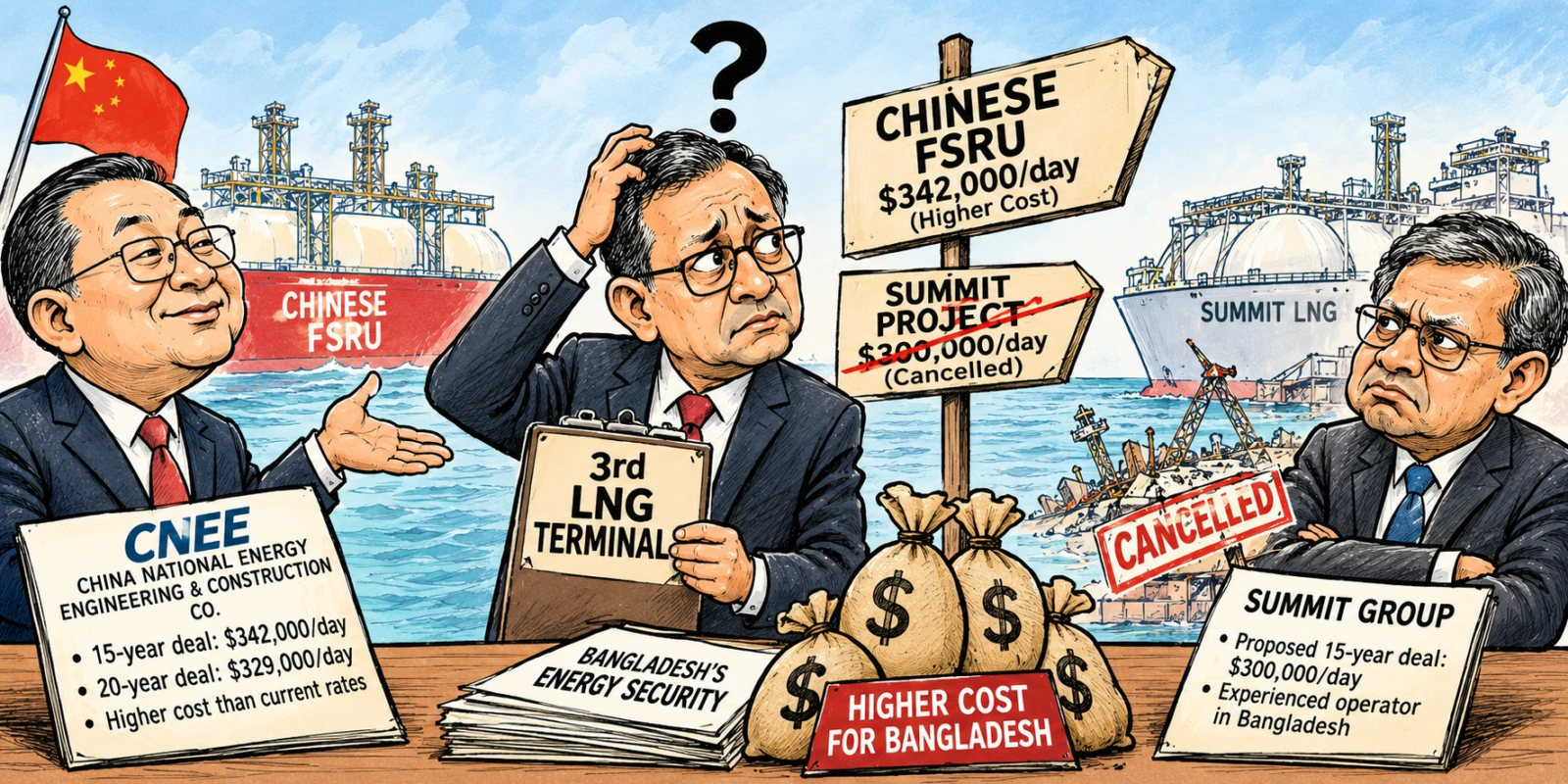
DHAKA — Bangladesh is moving toward awarding its proposed third floating LNG terminal to a Chinese state-owned company at a substantially higher cost than the country currently pays for similar services, reviving questions about whether the cancellation of an earlier project awarded to Bangladesh’s experienced Summit Group has contributed to the country’s deepening energy crisis.
The proposed deal would allow China National Energy Engineering & Construction Co. Ltd., or CNEE, to develop and operate a floating storage and regasification unit, or FSRU, at Kutubjom in Maheshkhali under a government-to-government arrangement.
Under one option recommended by a government negotiation committee, Bangladesh would pay CNEE $342,000 a day for 15 years — about 35% to 37% more than the daily fees currently paid to the country’s two operating LNG terminals.
The proposed Chinese terminal follows the decision of the previous interim administration, led by Muhammad Yunus, to cancel an agreement signed under the Awami League government with Summit Group to build Bangladesh’s third FSRU. Critics argue that abandoning the existing project—followed by nearly two years of uncertainty over a replacement—has left Bangladesh paying more for a venture that could have been completed earlier.
The comparison has become more politically sensitive because Summit Group is controlled by businessman Muhammed Aziz Khan, whose brother, former minister and Awami League leader Lt. Col. (retd.) Faruk Khan, was arrested after the fall of the Awami League government. Aziz Khan and his family members have also faced legal and financial harassment, including the freezing of personal bank accounts.
While the government has not formally described the cancellation of the Summit project as politically motivated, critics argue that the treatment of the company and its proposed LNG terminal cannot be separated from the wider political and business environment that followed the change of government in August 2024.
Higher price, no clear explanation
CNEE submitted its proposal on June 19 to develop an offshore LNG terminal with a base regasification capacity of 600 million cubic feet per day, or mmcfd, and a peak capacity of 750 mmcfd.
The seven-member government negotiation committee has placed two options before the authorities: a 15-year agreement at $342,000 a day or a 20-year agreement at $329,000 a day.
Under the 15-year proposal, the daily charge would include a fixed fee of $246,000, an operational fee of $59,000 and a port service fee of $37,000.
By comparison, Bangladesh currently pays $254,000 a day for the FSRU operated by U.S.-based Excelerate Energy and $249,115 a day for the Summit LNG terminal.
The proposed Chinese price is also higher than the $300,000 daily fee agreed in March 2024 for Summit’s planned second FSRU, which was intended to become Bangladesh’s third floating LNG terminal.
Petrobangla terminated that agreement in October 2024 after the fall of the Awami League-led government. Summit challenged the decision, and the legal dispute remains unresolved. The Supreme Court’s Appellate Division later stayed a proposed re-tender process while litigation over the cancellation continued.
The proposed CNEE fee also exceeds the $239,653-per-day benchmark recommended in a 2025 feasibility study conducted by the state-owned Rupantarita Prakritik Gas Company, or RPGCL.
Most significantly, the government’s own negotiation committee acknowledged that it could not determine how much of the proposed price increase was actually justified.
CNEE cited the Middle East war, uncertainty over global energy supplies, higher shipbuilding-material costs, growing international demand for FSRUs and the requirement to deliver the facility within 18 months as reasons for its higher price.
According to a Daily Star report, the committee said those factors could justify some increase in the regasification fee but concluded that, without a more detailed assessment, it could not determine what a reasonable increase should be.
That admission raises a fundamental question: Why is Bangladesh moving toward a long-term agreement worth more than $1 billion without first independently determining whether the proposed price is reasonable?
The committee estimated Petrobangla’s payment obligation under the 15-year option at about $1.002 billion, or approximately Tk 12,324 crore at a 12% discount rate.
Expert questions price and timeline
Energy expert Mohammad Tamim has questioned both the proposed fee and the timetable offered by the Chinese company.
“If the previous ones were cheaper, why should we now opt for a new one at a higher price? I don’t see the justification,” Tamim was quoted as saying in the Daily Star.
He said the government should commission an independent assessment of both the price and the project’s feasibility before committing Bangladesh to such a large and long-term financial obligation.
“There are many companies around the world that work on FSRUs, and there are consultants who do this kind of assessment,” he said. “It can be assessed by such a consultant or a third party.”
Tamim said the cost of such an assessment would be insignificant compared with the scale of the proposed investment.
“We are going to spend so much money on this project,” he said. “Even if it costs $1 million, $2 million or $3 million to carry out the assessment, it can be done.”
He also questioned whether CNEE could realistically complete the project within the proposed 18 months.
CNEE’s own website does not indicate prior experience in developing FSRUs, according to the report reviewed for this story.
Tamim said that even if the company already had access to a suitable LNG carrier and financing arrangements in place, converting a vessel and completing the necessary infrastructure within 18 months would be difficult.
“Only if they already have the carrier in hand might 18 months be possible, but even then, it is very unlikely,” he said, adding that such projects would normally take around 24 months or longer.
An FSRU project involves far more than preparing the vessel, he said.
“The work is not only about the vessel. There is the area where it will be installed, geological surveys, wave analysis and many other types of work. Those take time.”
An experienced project was canceled
The current debate over the Chinese proposal has renewed scrutiny of the decision to terminate the earlier Summit project.
Bangladesh’s two existing FSRUs — one operated by Excelerate Energy and the other by Summit LNG — were developed during the Awami League government’s period in office.
As demand for gas grew alongside Bangladesh’s expanding economy and electricity system, the Awami League government moved to establish a third terminal.
The Summit project was approved in December 2023, and agreements were signed with Petrobangla on March 30, 2024. The proposed facility was designed to have a regasification capacity of 600 mmcfd and was expected to begin supplying gas from late 2026 under the original plan.
Critics therefore question why Bangladesh abandoned a project involving a company already operating an FSRU in the country, only to begin negotiating another non-competitive arrangement with a company whose experience in FSRU development has been questioned.
The interim government canceled the Summit agreement in October 2024, and Bangladesh has since spent nearly two years without completing a replacement arrangement.
Supporters of the previous project argue that, had construction proceeded as planned, Bangladesh could now have been approaching the start of gas supply from the third terminal rather than negotiating a new and more expensive contract.
The cancellation removed a planned additional source of regasification capacity from Bangladesh’s energy system at a time when demand continued to rise.
Energy crisis exposes dependence on two terminals
The vulnerability of Bangladesh’s LNG infrastructure became painfully clear this year when one of the country’s two operating FSRUs went out of service.
A fire and technical failure involving Excelerate Energy’s FSRU at Maheshkhali on July 21 sharply reduced imported gas supplies and contributed to severe shortages affecting electricity generation, industries and households.
The shutdown removed about 450 mmcfd of gas supply from the national system, nearly halving Bangladesh’s imported LNG capacity.
The incident demonstrated the risk of relying on only two offshore terminals for a major share of Bangladesh’s imported gas.
Summit’s terminal and Excelerate’s facility together have a combined capacity of around 1,000 mmcfd, making their uninterrupted operation critical to the national gas supply.
The crisis was further intensified by disruptions to LNG shipments from Qatar.
QatarEnergy, Bangladesh’s largest LNG supplier, reduced its planned deliveries for 2026 after the Middle East conflict disrupted shipping through the Strait of Hormuz, forcing Bangladesh to increase its reliance on expensive spot-market purchases.
The Energy Ministry now expects LNG subsidies to reach around Tk 40,000 crore during the current fiscal year, compared with Tk 14,500 crore in the previous year, according to recent government projections reported in the national media.
Development gains now under pressure
The current energy difficulties have also revived a broader political debate over Bangladesh’s development trajectory.
Official Power Division data show that electricity generation capacity expanded dramatically after 2009. When the Awami League government took office in January of that year, the country’s generation capacity stood at 3,267 megawatts against estimated demand of 5,200 megawatts. The government subsequently pursued rapid expansion through gas, coal, liquid fuel, nuclear energy and renewable sources.
The expansion of electricity generation and gas infrastructure was one of the central features of Bangladesh’s economic growth during the Awami League period, although the rapid development of the energy sector also generated debates over costs, capacity payments, fuel dependence and procurement practices.
Since the political change of August 2024, critics of the successive administrations have argued that Bangladesh’s development projects have increasingly become entangled in political disputes, legal action and efforts to reverse or restructure projects associated with the previous government.
The cancellation of the Summit FSRU project has become one of the clearest examples cited by those critics.
They argue that political hostility toward individuals and businesses associated with the Awami League should not determine whether infrastructure projects essential to the national economy continue.
Summit Group, for its part, remains an important part of Bangladesh’s existing energy infrastructure. Its operating FSRU continues to supply imported LNG to the national grid.
The company has challenged the cancellation of its second FSRU project, arguing that the termination was unjustified.
New deal raises questions of national interest
The proposed Chinese agreement is now being processed under Section 68 of the Public Procurement Act, 2006, and Rules 99(2) and 107(2) of the Public Procurement Rules, 2025.
The Cabinet Committee on Economic Affairs approved the CNEE proposal in principle on July 28, and the negotiation committee was formed the following day.
The committee was headed by Petrobangla Chairman Md. Abdul Mannan and included representatives from the Energy and Mineral Resources Division, RPGCL, Bangladesh University of Engineering and Technology, the Bangladesh Investment Development Authority and the Legislative and Parliamentary Affairs Division.
The committee has now forwarded its recommendations for further government consideration.
But the central questions remain unresolved.
Why was an agreement with an experienced operator canceled, only for Bangladesh to consider paying substantially more to a new foreign company?
Why has the government’s own negotiation committee acknowledged that it cannot determine how much of the proposed price premium is justified without a detailed assessment?
And why is Bangladesh again moving toward a non-competitive long-term arrangement without first obtaining an independent review of the price, technical capability and implementation schedule?
For critics, the issue extends beyond one LNG terminal.
They argue that Bangladesh’s current energy difficulties illustrate the cost of allowing political change to interrupt infrastructure planning. The country spent years expanding electricity generation, LNG infrastructure and other major projects to support a rapidly growing economy. The challenge facing the current government is not simply to build new infrastructure, but to demonstrate that decisions involving national energy security are based on price, experience, technical capacity and the public interest — rather than political associations.
As Bangladesh prepares to commit more than $1 billion to a new Chinese FSRU arrangement, the decision to cancel the earlier Summit project — and the price now being considered for its replacement — is likely to remain under close scrutiny.

COMMENTS