
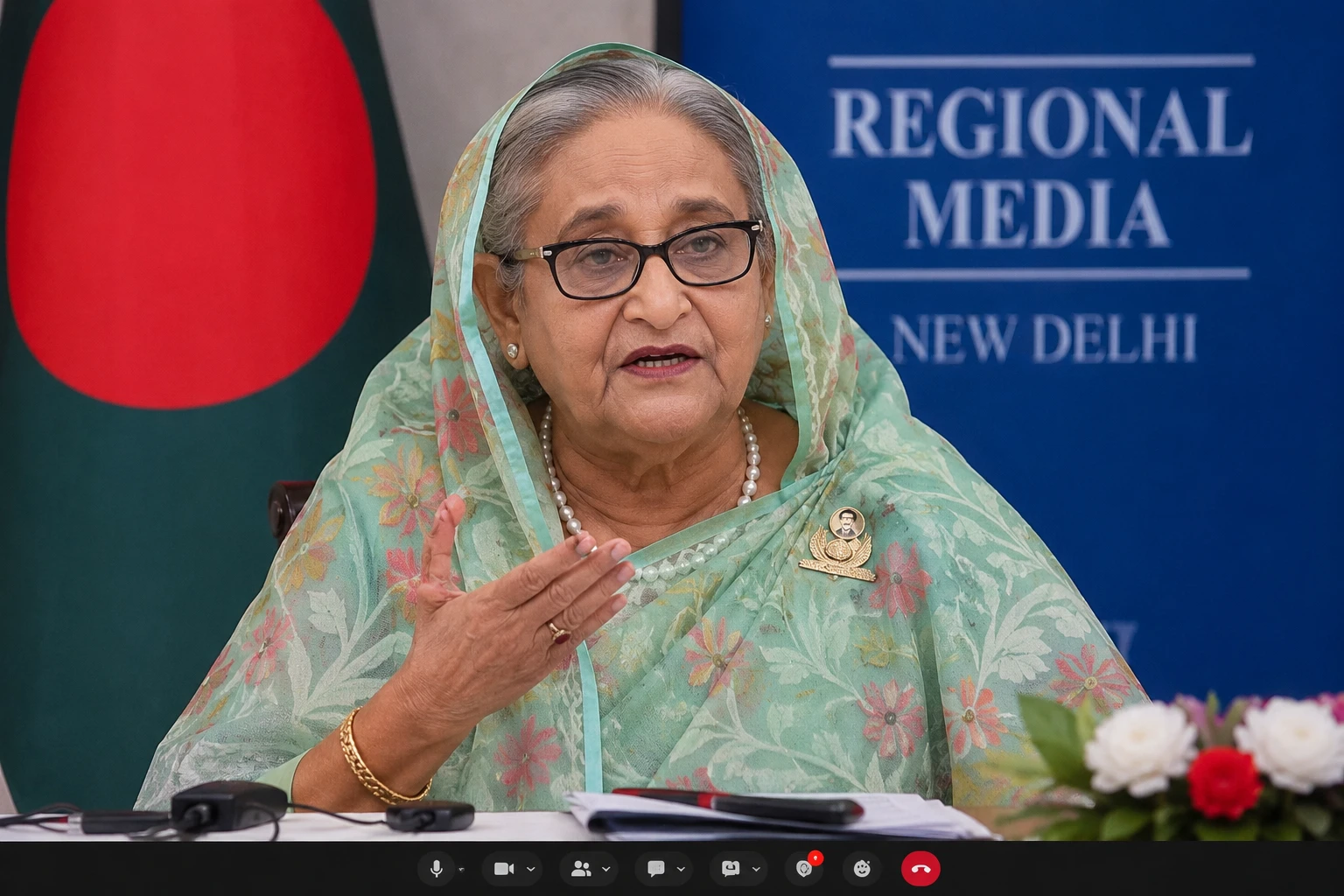
Dhaka – Former Bangladesh Prime Minister Sheikh Hasina has said she intends to return to Bangladesh by December, insisting that her planned homecoming is “not about power” but about standing beside the people amid what she described as a deepening political, economic and security crisis.
In her telephonic interview with Indian media, published by Hindustan Times, Hasina questioned the Bangladesh Nationalist Party (BNP) government’s decision to make her extradition from India a condition for Prime Minister Tarique Rahman’s proposed visit to New Delhi.
“I am going back to my own country,” Hasina said, according to the report. “I want to go back on my own to my country. I will go back. Can I stay abroad my whole life?”
Hasina said she plans to announce the specific date, time and point of entry for her return at a later stage. She also expressed concern over the treatment of Awami League leaders and supporters, alleging that political opponents were being arrested, attacked and subjected to legal cases.
She argued that Bangladesh’s relations with India should not be affected by political statements, saying that regional stability depends on a “stable, democratic, secular and development-oriented Bangladesh.”
The former prime minister also criticised the BNP government’s reported plan to acquire Chinese J-10CE fighter aircraft under a deal worth around $2.3 billion. She questioned the priority of spending on combat aircraft while the country is facing electricity and gas shortages, fertiliser production problems and rising prices.
Hasina said that during her government, electricity generation increased substantially and access to electricity was expanded nationwide. She argued that the government should instead focus on addressing shortages and supporting industries and agriculture.
On the Teesta river project, Hasina said her government had discussed cooperation with India and declined to comment on the current government’s engagement with China over the project.
Warning over extremism and regional security
Hasina also echoed concerns raised by her son, Sajeeb Wazed Joy, about Bangladesh potentially becoming “another Pakistan.” She said the phrase referred not to ordinary citizens but to the growth of extremism, communal politics, militant networks, political patronage and weakened state institutions.
She claimed that international and domestic security concerns indicate that extremist groups could attempt to establish networks in Bangladesh. She also alleged that attacks on shrines, cultural sites and secular symbols have increased and warned against weakening Bangladesh’s counterterrorism capabilities.
According to Hasina, a deterioration in Bangladesh’s security environment could have consequences beyond its borders, affecting India, Myanmar, the Bay of Bengal, regional trade, migration and maritime security.
Defence of the Awami League
Hasina strongly defended the Awami League, which she said remains a political institution rooted in Bangladesh’s history and people. She questioned the decision to ban the party and argued that its future should ultimately be determined through elections.
She also rejected allegations that she had reached any political understanding with the current government in Dhaka, saying her decision to return was her own and that political discussions about the Awami League’s future would take place within the party.
Hasina said she remains in regular contact with party leaders and workers despite being outside Bangladesh. She alleged that large numbers of Awami League supporters have been displaced or forced into hiding.
My mind remains in Bangladesh
Describing her time in India, Hasina said that remaining away from her people was the most difficult aspect of her life in exile.
She expressed gratitude to India for allowing her to stay with “dignity and respect” but said she continues to closely monitor developments in Bangladesh, including the political situation, economy, law and order, minority safety and the concerns of young people.
“My return is not about power. It is about standing beside the people,” Hasina said.
Source: Hindustan Times, report by Rezaul H Laskar, published September 2, 2026


COMMENTS