
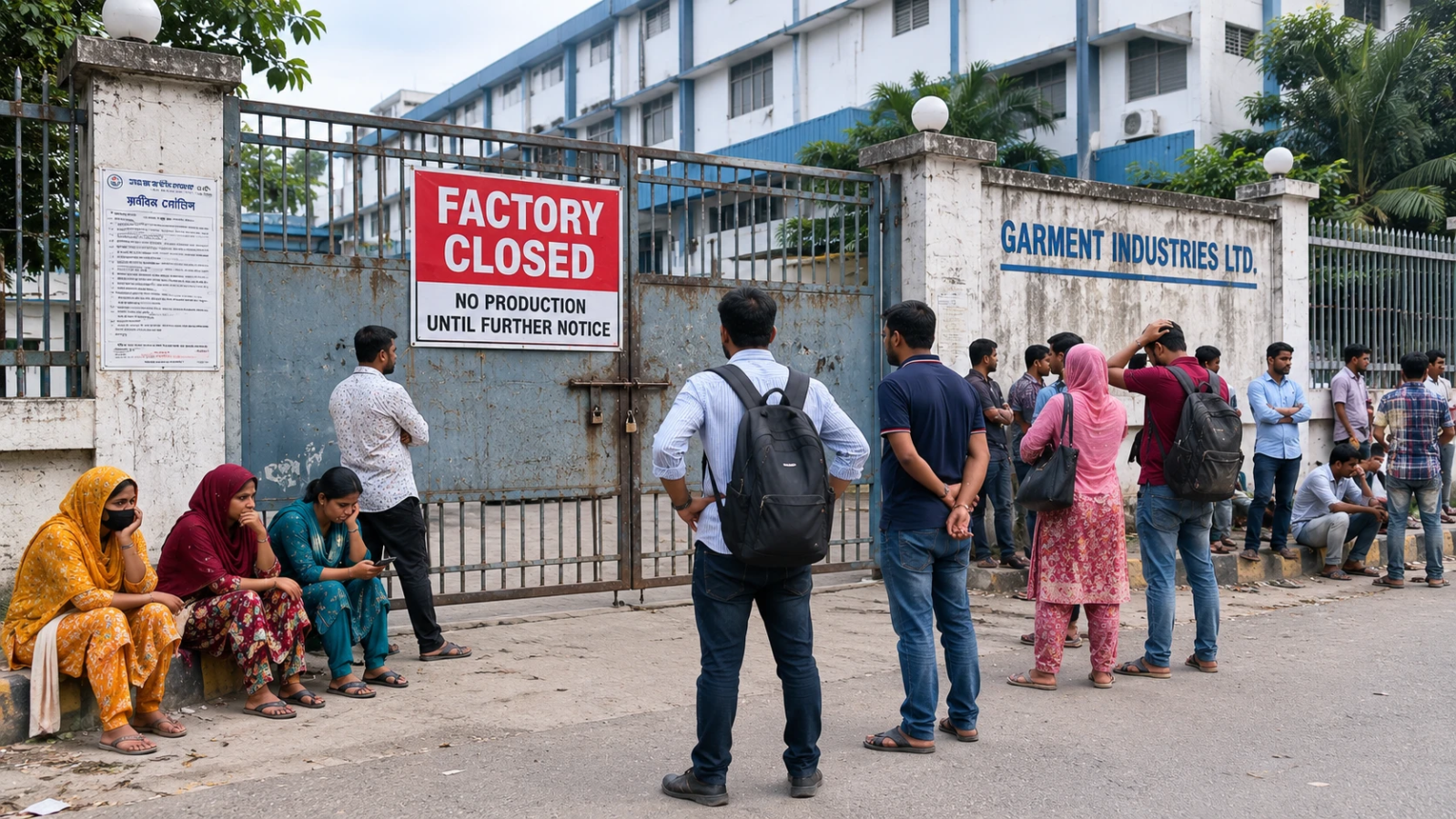
DHAKA – Bangladesh’s economic recovery remains fragile, with 95 factories permanently shutting down and 61,881 workers losing their jobs in the country’s three major industrial belts between January and August, according to the Centre for Policy Dialogue (CPD).
The findings were presented Monday at a CPD media dialogue reviewing the first six months of the new government.
CPD Distinguished Fellow Debapriya Bhattacharya said the government had inherited significant structural weaknesses and taken office amid an unfavourable global economic environment. But he criticised the administration for failing to establish a comprehensive, data-driven baseline of the economy it inherited, making it difficult to measure subsequent progress.
Industrial slowdown raises concerns
The CPD said the closures in Gazipur, Savar-Ashulia and Narayanganj-Narsingdi highlight growing pressure on Bangladesh’s industrial sector.
Industrial production growth has fallen from 3.4% to virtually zero, while manufacturing growth has similarly dropped from 3.5% to zero.
Private-sector credit growth declined from 6% to 4.5%, while net foreign direct investment fell from $662 million to $594 million.
Capital machinery import letters of credit also deteriorated sharply, moving from 14.6% growth to a contraction of 13.6%.
The CPD attributed part of the industrial weakness to prolonged gas shortages linked to technical problems at the Maheshkhali LNG terminal, difficulties in LNG procurement and cargo-receiving disruptions.
Gas-dependent sectors including textiles, steel, paper, particleboard and ceramics have been affected, the research organisation said.
Revenue gap could reach $11 billion
The CPD estimates that the government could face a revenue shortfall of Tk 1.3 trillion to Tk 1.4 trillion during the current fiscal year.
The government has set a revenue target of Tk 695,000 crore, meaning revenue would need to grow by about 42% to meet the target.
NBR revenue growth has slowed from 12.4% to 11.1%, while overall tax revenue growth has fallen from 12.3% to just 4.9%.
At the same time, the government’s reliance on bank borrowing has increased, with its share rising from 48% to 53.8%.
Inflation eases, but households remain under pressure
The CPD said inflation has moderated but remains a major concern for households.
Headline inflation declined from 9.1% to 8.3%, while food inflation fell from 9.3% to 7.2%.
However, wage growth of 8.2% remains below the rate required to offset the cost of living, leaving real wage growth negative.
External sector shows mixed picture
Bangladesh’s export growth improved from a contraction of 3.2% to growth of 3.5%. Imports, however, surged, with growth accelerating from 5.6% to 18.1%.
Remittance growth slowed from 21.4% to 11.8%.
Average monthly overseas employment fell sharply from 95,521 to 51,235 workers, according to the CPD.
The trade deficit widened from $6.7 billion to $10.4 billion, while the current account moved from a $1.3 billion surplus to a $600 million deficit.
CPD credits government with reform steps
It also welcomed moves including the launch of Invest Bangladesh, a startup fund, agricultural loan and interest relief measures, and fare concessions for senior citizens.
Call for coordinated reforms
The CPD urged the government to prepare a core budget covering October 2026 to June 2027 and implement a coordinated reform programme covering energy, banking, taxation, public spending, development projects, logistics, digitalisation and public-sector pay.
It also recommended stronger coordination across government agencies and measures to improve energy security through domestic exploration, strategic reserves and diversification of supply.
The organisation called for detailed action plans to be presented to parliament in September on reforms to the pay structure, banking and power sectors, as well as broader institutional reforms.



COMMENTS