
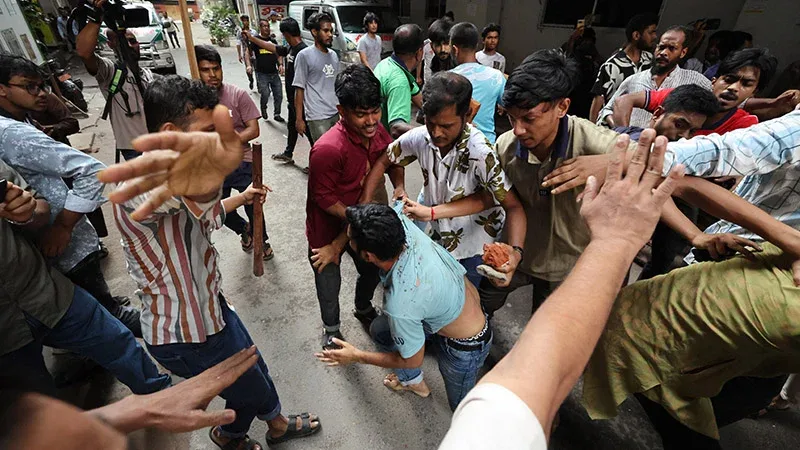
DHAKA — More than 100 people have been injured in a widening wave of campus violence across Bangladesh, as clashes involving rival student organizations erupted at educational institutions in Dhaka and elsewhere, renewing concerns over political confrontation and security at universities and colleges.
The most serious violence Tuesday was reported at Jagannath University, Dhaka College and Government Madrasah-e-Alia in the capital. Tensions also remained high at Begum Rokeya University in Rangpur after hours of clashes between activists of Jatiyatabadi Chhatra Dal and Islami Chhatra Shibir the previous night. Unrest was also reported at Government Brojomohun College in Barishal.
Police deployed additional personnel at affected campuses. By Tuesday evening, officers remained on alert outside Dhaka National Medical Institute Hospital near Jagannath University, while Chhatra Dal, Jubo Dal and BNP activists were seen gathering around Kabi Nazrul Government College and Jagannath University. Shibir activists were no longer visible there.
Accounts put the number of injured at more than 100 across five campuses over three days, including at least 80 from Tuesday’s clashes at three Dhaka institutions.
Jagannath University Sees Repeated Clashes
The most extensive violence Tuesday occurred at Jagannath University in Old Dhaka, where repeated clashes erupted around a seminar marking the second anniversary of the July Uprising.
Trouble began around midday over access to the university auditorium and continued intermittently into the afternoon and evening, spreading toward the Shaheed Minar and nearby Dhaka National Medical Institute Hospital.
According to eyewitnesses, leaders of the Jagannath University Central Students’ Union, or JnUCSU, and Jatiya Chhatra Shakti attempted to enter the seminar carrying placards demanding progress on the university’s second campus, temporary residential halls, improved medical facilities and recruitment of doctors and technicians.
University Grants Commission Chairman Mamun Ahmed was attending the event, with Jagannath University Vice Chancellor Professor Md Rais Uddin as a special guest. The students said they wanted to draw the UGC chairman’s attention to their demands.
An altercation began after Chhatra Dal activists allegedly tried to stop them from entering with the placards, eventually escalating into clashes.
The rival sides gave conflicting accounts.
Shahin Mia, president of the Jagannath University unit of Jatiya Chhatra Shakti, accused Chhatra Dal activists of attacking his organization’s members after the seminar. He said Chhatra Shakti General Secretary Ferdous Sheikh and senior JnUCSU officeholders were among those assaulted.
Jagannath University Chhatra Dal Convener Mehedi Hasan Himel rejected that version, alleging that Shibir and allied groups intended to disrupt the program and embarrass the UGC chairman.
“They were politely asked to move aside, but they refused. When they advanced, a clash broke out,” Himel told reporters after the confrontation, adding that Chhatra Dal activists were also injured.
At least 50 people were injured in the Jagannath University violence, including JnUCSU General Secretary Abdul Alim Arif and Chhatra Dal leader Yasin Saif. Other accounts placed the broader casualty figure from confrontations in and around the university higher. Several journalists were also reportedly injured.
Violence Extends to Hospital
The confrontation continued beyond the university campus.
Several seriously injured people were taken to Dhaka National Medical Institute Hospital, where further violence was later reported.
According to accounts of the incident, BNP, Jubo Dal and Chhatra Dal activists from Dhaka South allegedly attacked injured Shibir and Chhatra Shakti activists receiving emergency treatment.
Police later transferred injured activists to other hospitals to defuse tensions.
Kotwali Police Station Officer-in-Charge Rabiul Islam said the situation had become calm by evening after the injured were moved from National Medical College to other facilities.
The spread of political violence to the vicinity of a hospital heightened concerns because medical facilities are expected to remain safe for injured people regardless of political affiliation.
Jagannath University subsequently formed a four-member committee to investigate the violence and held an emergency news conference. Vice Chancellor Rais Uddin urged the rival sides to remain calm and avoid further confrontation.
The inquiry is expected to examine how the dispute escalated, identify those involved and determine whether outsiders participated.
Chhatra Dal-Shibir Clash at Dhaka College
Violence also erupted at Dhaka College around 3 p.m. Tuesday, where Chhatra Dal and Islami Chhatra Shibir activists clashed, leaving members of both organizations injured.
Each side accused the other of initiating the confrontation.
Chhatra Dal said the violence began after its leader Parvez Mosharraf was assaulted by Shibir activists. Shibir alleged that Chhatra Dal members attacked its activists while they were putting up banners for a discussion titled “Expectations and Achievements of the July Uprising.”
Reports indicated that around 20 Shibir activists and seven Chhatra Dal activists were injured. Shibir Finance Secretary Abdul Malek was admitted to Popular Medical College Hospital.
Clash at Madrasah-e-Alia
Another confrontation broke out at Government Madrasah-e-Alia in Bakshibazar between Chhatra Dal and Shibir activists, reportedly over control of residential halls.
Witnesses said activists were carrying pipes and sticks, while online videos showed chases and counter-chases involving people armed with locally made weapons.
Dhaka Metropolitan Police Assistant Commissioner for Chawkbazar Zone Md Mahfuzar Rahman told The Voice on Tuesday that activists from both sides had taken positions on campus despite the presence of law enforcement personnel. Police eventually intervened and brought the situation under control.
At least seven injured people were taken to Dhaka Medical College Hospital.
They included Madrasah-e-Alia Principal Mahmud Obaidul Haque, 50; former Chhatra Dal senior joint convener Sanaullah; Lalbagh Thana Chhatra Dal Member Secretary and Dhaka South Chhatra Dal Joint General Secretary Nisar Uddin Rabbi; Dhaka South Chhatra Dal President Shamim Mahmud; Samakal multimedia journalist Nazmul Islam; Lalbagh Ward 26 Jubo Dal Convener Jane Alam; and former Chhatra Dal organizing secretary Rubel Hossain Momin.
Rabbi said he was not a student of the institution and had been sitting on campus with friends when Shibir activists suddenly attacked them with sticks and bricks. His allegation could not be independently verified, and the rival side offered a different account of the confrontation.
Doctors said Sanaullah suffered injuries to both legs, his back and other parts of his body. Rabbi was struck by a brick in his left leg and injured his left hand after falling. Journalist Nazmul Islam was hit in the leg by a brick, while Principal Mahmud Obaidul Haque sustained a head injury.
Raisul Islam, 24, vice president of the Dhaka College unit of Islami Chhatra Andolan Bangladesh, also received treatment at Dhaka Medical College Hospital.
Five-Hour Clash at Begum Rokeya University
Tuesday’s violence followed a prolonged confrontation at Begum Rokeya University in Rangpur the previous night.
The dispute began during an Islami Chhatra Shibir exhibition titled “July Against Oppression,” organized at the university’s Swadhinata Smarak to mark the July Uprising.
One display, titled “Judicial Killing,” included photographs of six Jamaat-e-Islami and BNP leaders convicted of crimes against humanity committed during Bangladesh’s 1971 Liberation War.
Chhatra Dal activists objected and demanded its removal. The argument escalated into repeated chases and clashes lasting several hours.
Witnesses reported seeing activists carrying locally made sharp weapons, hockey sticks, iron rods, bamboo and wooden sticks. Traffic outside the university was disrupted.
Chhatra Dal General Secretary Jahir Rayhan said his organization objected because the banner portrayed Jamaat leaders convicted of war crimes as victims of “judicial killing.” He alleged that Shibir activists attacked Chhatra Dal members after they demanded its removal, injuring four activists.
Shibir university President Abdur Rakib disputed that account, alleging that Chhatra Dal activists tried to disrupt an exhibition held with university permission. He said three Shibir activists were injured.
University Proctor Ferdous Rahman said the confrontation began after Chhatra Dal objected to the banner and subsequently escalated. Representatives of both organizations later met university authorities, after which the situation returned to normal, although tension remained across the campus Tuesday.
Growing Pattern of Campus Confrontation
The incidents form part of a broader pattern of rising tensions between Chhatra Dal and Shibir, with rival groups increasingly accusing each other of attempting to establish political dominance on campuses.
The latest wave began with a confrontation at Dhaka University’s Dr Muhammad Shahidullah Hall before spreading to Begum Rokeya University and three Dhaka institutions. More than 100 people were reported injured across five campuses over three days.
The timing has drawn particular attention because some clashes occurred during events commemorating the second anniversary of the July Uprising, which itself was driven substantially by student mobilization.
The violence raises renewed questions about whether campuses can remain spaces for academic activity, political debate and peaceful student organizing without disputes escalating into physical confrontation.
Conflicting narratives surrounding nearly every clash also underline the importance of independent investigations. At Jagannath University, the newly formed inquiry committee will be tasked with reconstructing Tuesday’s events and identifying responsibility.
For students unaffiliated with political organizations, however, the concern is more immediate: whether they can attend classes, use libraries, live in residential halls and move around their campuses without becoming caught in clashes between rival political groups.
COMMENTS