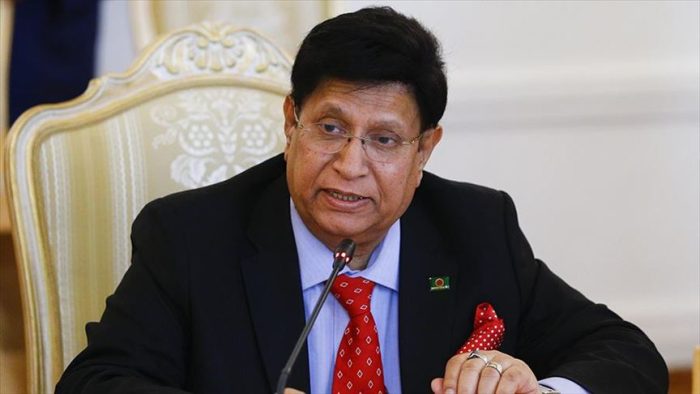

The Asia Times published a report titled “Khalilur Rahman is the Bangladesh’s Master of Ambiguity”. No one knows where it is heading or what is its goals. Is there any ambiguity or deception?
Dr. Khalilur Rahman who was the National Security Advisor of the past government of Dr. Muhammed Yunus is at present the Foreign Minister of newly elected government of BNP. This itself is historic as such never happened before in Bangladesh. Those who were the advisors of the past non-political government of Yunus are not normally expected to be a part of the new administration as it violates the principle of neutrality. But those long-cherished practice, ethics and principle appear to be absent in present day Bangladesh. Nowadays principle, preaching and practice hardly matches.
Is this a new trend?
These are new trends—a sharp departure from the past practice. During the past government of Sheikh Hasina principle and practice always had a strong relationship.
After the abrupt departure of Sheikh Hasina, Muhammed Yunus usurped power and his was a government of mob culture, a government of false assurances and hopes, a government of propaganda. It gave hopes to 1.2 million Rohingya that would return home soon. Instead an additional 1.0 million added to the existing plight. It gave hopes that people would get more decent jobs but large-scale lay off and closure job opportunities abound became a reality. While he assured that poverty will be a thing of the past and will only be in museums, it has doubled in Bangladesh under his watch.
Let’s examine Hasina’s foreign policy. Was there ambiguity? No.
Her father Bangabandhu Sheikh Mujibur Rahman, the founder of the country designed its foreign policy and its cardinal principle was “friendship to all, malice towards none”. Given Bangladesh’s geo-strategic location he maintained a balanced foreign policy. He did not joined any alliances, neither Soviet nor Western blocks on those days of Cold War. He maintained a balanced foreign policy. There was no deception.
Sheikh Hasina followed her father’s policy. However, she added a supplemental to it and it was “support your neighborhs”. Her policy was transparent and unambiguous.
She advanced $200 million to Sri Lanka when it was facing financial hardship. She stood firmly behind Maldives when it was finding difficulty. She helped all her neighbors; Bhutan, Nepal, even Myanmar with Covid vaccines when they needed it frantically.
To make best use of her manpower resources, her administration developed three foreign policy strategies and these were (1) Economic Diplomacy, (2) Public Diplomacy and (3) Regional Peace and Stability doctrine.
She aimed at turning Bangladesh into a global manufacturing hub and therefore she emphasized in her Economic Diplomacy 5 elements; (a) more investment both domestic and FDI, (b) increase and diversify exports, (c) jobs creation both home and abroad, (d) technology transfer, and (e) render quality services to all.
These policies attracted record high FDI, stabilized the economy, recruitment increased manyfold, and achieved near food autarky. Her policies were transparent, unambiguous and balanced and therefore both investors as well as foreign governments did have confidence and trust on her commitments.
Hasina-economics had two objectives
Apart from her foreign policy, her overall state policies had two objectives— first, to help improve country’s economy and turn it into a ‘Sonar Bangla’—a stable, prosperous and sustainable economy by 2041 where no one would be without food, shelter, clothes, education and essential healthcare. She planned to have hunger-free Bangladesh by 2030. And secondly, improve the wellbeing of her people — uplift them out of poverty and guarantee them a decent living condition. This was known as ‘Hasinaeconomics’. She was largely successful in achieving both of her goals.
Hasina was successful in achieving her twin goals
During her tenure, the country achieved 6.8% GDP growth rate on average and it reduced poverty from 42% in 2006 to 18% and extreme poverty to below 5.6% in 2023. In fact, Bangladesh became one of the top three best performing economies in the world. She upgraded Bangladesh from a low income country to a middle income country, raised per capita income from $543 in 2006 to $2932 in 2023 and it’s GDP from $90 billion to $478 billion. No wonder, UN termed Bangladesh as a ‘model of economic development’ while the Wall Street Journal called it “a standard bearer of the South”.
Hasina followed Japan and South Korean models
In order to achieve her goals, she followed two strategies. For rapid economic growth, she followed the development models of Japan and South Korea. Like Bangladesh these countries do not have much proven mineral resources like oil and gas. Efficient and effective utilization of their human resources made them successful.
Both these countries encouraged and supported their private sector enterprises. Japan created big conglomerates like Mitsubishi, Panasonic, Toyota, while South Korea created Hyundai, Samsung, Kia, SK, LG, etc. These conglomerates became their engine of growth. Sheikh Hasina also promoted private sector and created big conglomerates like BEXIMCO. Bashundora, Walton, Pran, BRAC, Summit, Ha-Meen, SAlam, etc. They created jobs and helped increasing 6-fold exports.
Her policy worked in achieving her twin objectives but created pockets of corruption. She planned to reduce corruption through introduction of digital technology at every labels of her administration. Before she could introduce it fully, she was removed through a meticulous design.
New state policy: full of contradictions and ambiguity
Apparently the new government of Tariq Rahman is trying to develop a very strong relationship with Pakistan and China. He is buying more weapons from Pakistan and China and allowing them to strengthen their foothold in Bangladesh. Reportedly, Pakistan is building new military airfields in Bangladesh in the bordering districts being financed by China. China has been approached to build its billion dollar Teesta project. India wished to be a technical partner in this project as the waters flow from India. Rahman ignored India’s request.
Earlier. Hasina’s administration was buying time to start Teesta project after the renewal of the 30-year old water sharing agreement of the Ganges by October 2026. Will granting of the Teesta project to China unilaterally derail the renewal of the Ganges Water Sharing agreement?
What is the message?
Recently, a powerful high profile BNP leadership led by its Secretary General visited Beijing and its Foreign Minister Dr. Khalilur Rahman also made his first maiden bilateral official visit to China and offered them lucrative opportunities.
At the behest of Pakistan, the BNP government is also trying hard to revive the South Asia Association of Regional Cooperation (SAARC), which failed to achieve its goals due to hostility and mistrust between Pakistan and India.
While Bangladesh is buying more weapons from China, it also signed non-disclosure agreements with the United States to buy more merchandize including weapons from USA. To prove its sincerity it signed an agreement with the US to buy 14 Boeing aircrafts this week and also to buy $15 billion worth of energy from the US. It also offered lucrative deals to India. Given the current state of its economy and hostility towards USA and India, critics are not sure of its commitment. Since details of these offerings are undisclosed, suspicions intensified.
As per media reports. it agreed to purchase many more merchandise from the US and more importantly, agreed not to buy products from a third country without prior permission from the US. Such stories created room for ambiguity and confusion.
Fact of the matter is; on one hand, Bangladesh is trying to be more closer to China and Pakistan while at the same time, it has agreed to be more friendly to USA and India. Is it playing games with its important stakeholders? In one hand, USA and China, and on the other, Pakistan and India, the arch rivals
It’s a fact that the BNP leaderships are inherently pro-Chinese and Prime Minister Begum Khaleda Zia developed their “Look East” foreign policy to buy more weapons and training from China. Will the recent Trade Agreement with the USA change this age-old relationship?
The big question is, will they win in this game of managing four opposing countries?
Writer: Dr. A K Abdul Momen, Professor Emeritus; Former Foreign Minister of Bangladesh (2019-2024) and ex-Permanent Representative of Babngladesh to the UN (2009-2015).