
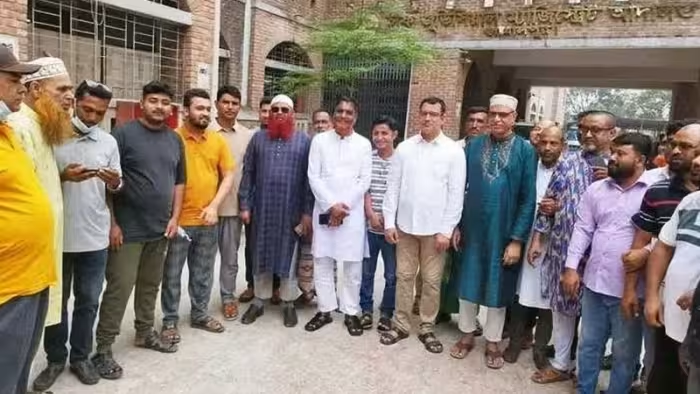
Authorities in Bangladesh have sent 31 leaders and activists affiliated with the Awami League and its associated organizations to jail following court proceedings in Jamalpur.
The order was issued on Monday, March 30, by the Jamalpur Chief Judicial Magistrate Court after the accused voluntarily surrendered and sought bail in multiple cases filed over allegations of sabotage and violence in Madarganj and Bakshiganj upazilas.
According to court sources, 27 leaders and activists from Madarganj upazila appeared before the court in connection with four separate cases, while four others from Bakshiganj sought bail in two additional cases. After what was described as a lengthy hearing, the court rejected their bail petitions and ordered all 31 individuals to be sent to jail custody.
Those sent to jail include several prominent local political figures: Obaidur Rahman Belal, former chairman of Madarganj Upazila Parishad; Daulatuzzaman Dulal, a district Awami League member; former Union Parishad chairman Zainal Abedin Ayna; Awami League leaders Shahidul Islam and Rashedul Islam Laju; and multiple leaders from the Jubo League and Chhatra League, including Shafiqul Islam, Tofayel Ahmed Bahadur, Md Chhala Mia, Shahinur Rahman, SD Jewel, and Md Salman.
From Bakshiganj, those detained include Jalal Uddin, convener of the municipal Awami League unit; joint convener Jewel Hazari; and Merurchar union Awami League general secretary Elias Ali.
Confirming the court’s decision, Court Inspector Md Abul Hossain said on Monday at the Jamalpur court premises, “The court rejected their bail petitions as the charges brought against them are non-bailable. They have been sent to the district jail accordingly.”
The arrests come at a time when Bangladesh’s political climate remains highly polarized following the dramatic political transition of August 2024, which saw the removal of the Awami League-led government and the installation of an interim administration under Nobel laureate Dr. Muhammad Yunus, backed by the military.
Since then, numerous reports from rights organizations and political observers have raised concerns over what they describe as a pattern of politically motivated cases, particularly targeting leaders and activists associated with the former ruling party. Critics argue that such cases—often framed around allegations of sabotage or violence—have been used as instruments to suppress opposition voices and dismantle grassroots political networks.
Legal experts note that the designation of charges as “non-bailable” significantly limits judicial discretion at the lower court level, often resulting in immediate detention pending further proceedings. However, they also emphasize that the higher judiciary retains the authority to review such decisions upon appeal.
Abul Hossain, a lawyer familiar with the fabricated cases said on Monday in Dhaka, “The increasing number of similar cases across districts raises serious questions about due process and equal application of the law. Courts must ensure that justice is not only done but seen to be done.”
Human rights organizations have also documented a broader pattern of arrests, raids, and legal actions against individuals perceived to be aligned with the Awami League since the political transition. Reports indicate that homes of party supporters have been targeted, and in some instances, violence has occurred in the presence of law enforcement.
Observers warn that such developments could have long-term implications for Bangladesh’s democratic institutions, particularly if legal processes are perceived as being influenced by political considerations.
At the same time, government-aligned voices maintain that the cases are based on credible allegations of unrest and violence, arguing that law enforcement agencies are acting within the bounds of the law to maintain order and accountability.
The detained leaders are expected to seek bail from higher courts in the coming days, as their legal teams prepare to challenge the lower court’s decision.
The situation in Jamalpur reflects a broader national trend, where legal battles and political contestation continue to shape Bangladesh’s evolving political landscape ahead of anticipated future electoral processes.
COMMENTS