
Bangladesh Perspective, a social platform, has warned that Bangladesh is facing a deepening sexual violence crisis, with women and children increasingly exposed to rape, gang rape, murder after rape, and other forms of abuse amid what the group describes as a collapse of public safety and accountability.
The recently published study report, titled “Bangladesh’s Rape Epidemic: A Government Failed Its Women and Children Amid Soaring Rape Crisis,” says sexual violence has moved beyond isolated incidents and become a national emergency. The report argues that the state’s repeated promises of “zero tolerance” have failed to produce protection for victims or consequences for perpetrators.
The report says no space now feels fully safe for many women and children in Bangladesh — not streets, villages, homes, schools or religious institutions. It warns that the sharp increase in reported rape and gang rape cases reflects not only criminality, but also deeper failures in policing, prosecution, social protection and governance.
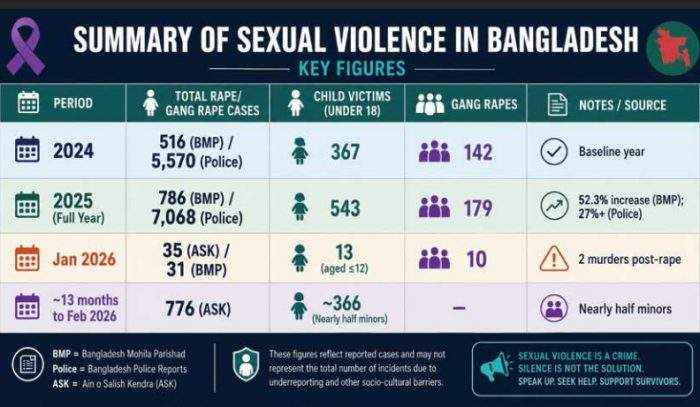
Data cited in the report show that Bangladesh Mahila Parishad documented 786 rape and gang rape victims in 2025, up from 516 in 2024, a 52.3 percent increase. Of the 2025 victims, 543 were girls under 18, meaning minors accounted for nearly 70 percent of the reported victims. Dhaka Tribune, citing BMP’s annual report, reported the same figures and said the findings showed a “disturbing escalation” in sexual violence, particularly against minors.
The report also cites police headquarters data showing 7,068 rape cases filed in 2025, compared with 5,570 in 2024, a rise of more than 27 percent. New Age reported the same police figures in January 2026, adding that more than 9,000 rape cases had been filed since August 2024.
The crisis appears to have continued into 2026. Ain o Salish Kendra reported 35 rape cases in January 2026 alone, including 25 single rape cases and 10 gang rape cases. Thirteen victims were aged 12 or younger, and two victims were murdered after rape, according to ASK’s January documentation.
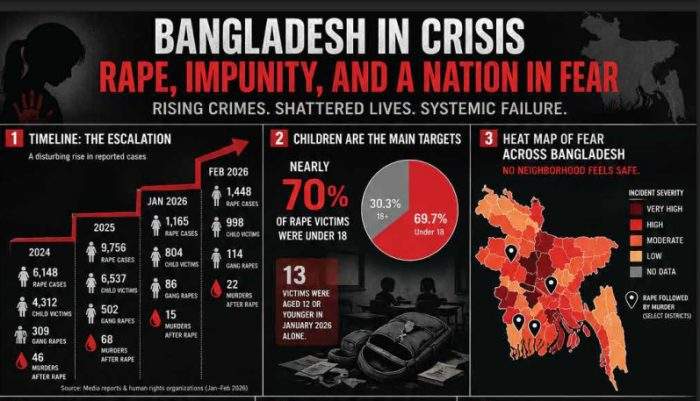
Bangladesh Perspective says the official numbers likely understate the real scale of abuse because many survivors and families do not report rape due to stigma, fear of retaliation, distrust of police, social pressure and pressure from local power brokers. The report says the gap between official rhetoric and lived reality has widened as perpetrators become bolder and survivors remain without adequate protection.
The most alarming part of the report is its focus on children. It says the majority of victims in recent reported cases are minors, with girls under 18 bearing the highest burden. It also notes that boys are also abused, though such cases receive less attention. The report warns that homes, schools, madrasas and other places meant to protect children have, in some cases, become sites of abuse.
UNICEF had issued a similar warning in Dhaka on March 23, 2025, after a series of violent cases involving children. Rana Flowers, UNICEF representative to Bangladesh, said in a public statement that she was “profoundly horrified by the alarming rise in reported cases of sexual violence against children, especially girls, in Bangladesh.” She said the surge included violence “in places meant to protect and nurture children like educational institutions.”
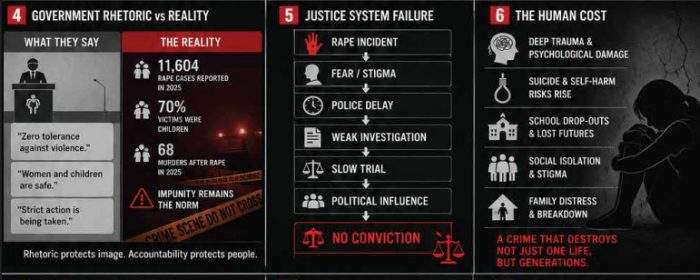
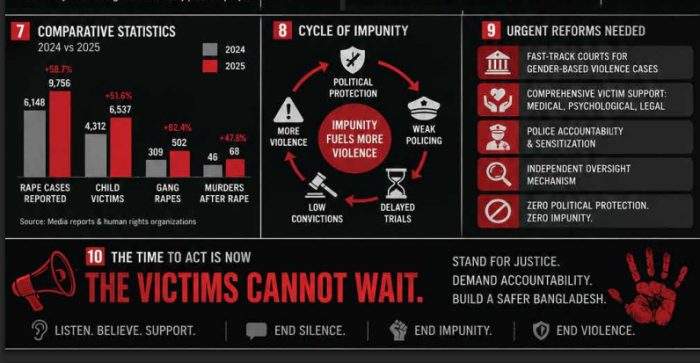
The Bangladesh Perspective report also highlights institutional delays. It argues that cases are often slowed by weak investigations, trial delays, intimidation of survivors, social arbitration and political protection for perpetrators. It says these delays create a cycle of impunity: weak policing leads to delayed trials, delayed trials lead to low conviction expectations, and low expectations encourage more violence.
At a Daily Star roundtable on violence against women and children, UNICEF Bangladesh child protection specialist Shabnaaz Zahereen said Bangladesh’s systems had failed an 11-year-old rape victim in Magura. Speaking at the dialogue, she said critical gaps included weak family sensitization, nonfunctional community protection mechanisms and the absence of mandated social workers for protection. She also noted that among more than 5,600 sexual violence cases from 2013 to 2024, only 2 percent reached a verdict.
Rights activists have also linked the crisis to a broader culture of impunity. Naripokkho member Kamrun Nahar told New Age on March 5, 2026, that “the prevailing culture of impunity, social attitude towards girls and women, and victim-blaming are main reasons for the menace.” She urged the government to establish rule of law and ensure justice to stop violence against women and girls.
Manusher Jonno Foundation raised similar concerns in March 2026 after the rape of a 10-year-old child at a madrasa in Kushtia. In a statement issued on March 18, MJF said the case exposed a serious lack of monitoring in educational institutions. Its executive director, Shaheen Anam, said offenders “hide behind institutions” that protect them, while children are prevented from speaking out.
Bangladesh Perspective frames the crisis as a governance failure, not merely a law-and-order problem. The report says strong statements from authorities often come only after major public outrage or social media pressure, while survivors continue to face harassment, family pressure, social exclusion and delays in justice.
The study calls for independent oversight of rape and sexual violence cases, fast-track courts, stronger victim support, trauma-sensitive police investigations, accountability for law enforcement failures and an end to political protection for offenders. It also urges broader cultural campaigns against misogyny, victim-blaming and impunity.
The report concludes that Bangladesh’s crisis of sexual violence is no longer only a women’s rights issue. It is a test of justice, governance and national character. Unless the state can protect children walking to school, women traveling to work, and survivors seeking justice, Bangladesh Perspective warns, the promise of governance will remain hollow.