

Bangladesh is facing a critical moment in its development trajectory. The sharp slowdown in the Annual Development Programme (ADP)—the government’s primary vehicle for public investment—has revealed not only fiscal strain but also deeper disruptions in governance, institutional capacity, and economic direction.
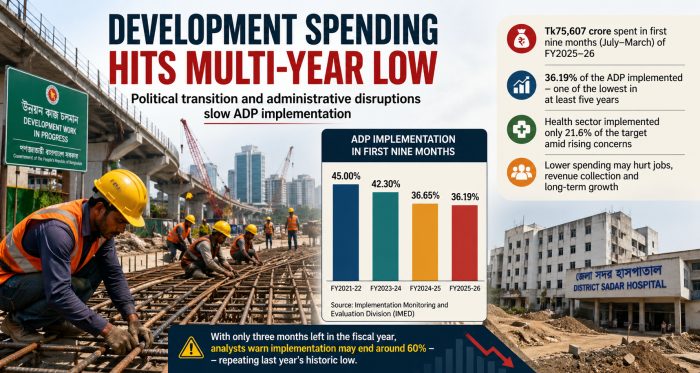
With just 36.19 percent of the ADP implemented in the first nine months of FY2025–26—the lowest such rate in at least two decades—the consequences are no longer abstract. They are visible in stalled projects, shrinking employment, and growing uncertainty for millions of citizens already living close to the economic edge.
A break from the trajectory of expansion

For more than a decade, Bangladesh’s development strategy was anchored in sustained public investment. Large-scale infrastructure, energy expansion, and rural connectivity projects drove growth and helped lift millions out of poverty. While implementation challenges existed, the overall trajectory was one of expansion.
That trajectory has now been disrupted.
The current slowdown follows a period of political upheaval in 2024 and the subsequent transition to an interim administration led by Muhammad Yunus, followed by a new government installed through a one-sided election that excluded nearly half the electorate. Analysts note that the shift introduced uncertainty at multiple levels—administrative, fiscal, and institutional.
Project directors left their posts. Procurement slowed. Ongoing initiatives were paused for review. The cumulative effect has been a visible contraction in development activity.
The economic chain reaction
Public investment in Bangladesh has a multiplier effect that extends far beyond infrastructure.
When ADP spending slows, the immediate impact is felt by:
- Construction workers and day laborers
- Small contractors and suppliers
- Transport operators and logistics workers
- Local service providers in project areas
A stalled project means lost wages. Lost wages mean reduced consumption. Reduced consumption weakens local markets.
This chain reaction disproportionately affects low-income households. For many families, development projects are not just state initiatives—they are a primary source of income.
Reduced project activity creates a multiplier effect across the economy, amplifying the initial shock.
Health sector delays: a long-term social cost
The slowdown is particularly severe in the health sector, where implementation has remained critically low.
This is not just a budgetary concern. It is a structural risk.
Bangladesh already has one of the highest out-of-pocket healthcare expenditure rates in the region. Delays in hospital construction, equipment procurement, and workforce expansion directly translate into reduced access to care.
Ecnomists have pointed to governance-related hesitation in decision-making. When officials delay approvals due to fear of scrutiny, implementation slows—and the system as a whole suffers.
The long-term consequences are significant: rising inequality, increased vulnerability, and greater pressure on already fragile households.
Documented instability and its economic impact
The slowdown in development spending has coincided with a broader period of instability that has affected business activity and investor confidence.
Rights organizations and media reports documented widespread violence and disruption following the 2024 political transition. According to figures cited by groups such as Ain o Salish Kendra and the Bangladesh Hindu Buddhist Christian Unity Council, hundreds of incidents of violence occurred in the weeks surrounding the transition, including attacks on homes, commercial establishments, and community infrastructure.
Independent reporting during this period also described:
- Looting and vandalism of small businesses in several districts
- Destruction of shops and market stalls linked to political or minority affiliations
- Disruptions to transport networks and supply chains
- Temporary shutdowns of local commercial hubs due to security concerns
In parallel, institutional disruptions—such as strikes within revenue and customs administration—affected trade flows and port operations, with business groups warning of supply chain breakdowns and export delays.
While the scale and attribution of individual incidents remain contested in political discourse, the overall economic effect is clearer: uncertainty increased, risk perception rose, and business activity slowed.
Investor confidence and governance signals
Economic growth depends not only on spending but also on confidence.
When development projects stall and reports of instability increase, investors—both domestic and foreign—become cautious. Delayed decisions, inconsistent policies, and perceived risks reduce investment appetite.
The National Board of Revenue is also affected. Lower development activity means fewer transactions, weaker tax flows, and additional fiscal pressure.
Ashikur Rahman of the Policy Research Institute has noted that multiple disruptions—political transition, global volatility, and administrative challenges—have collectively slowed development spending.
The policy dilemma: review versus paralysis
The current administration has initiated reviews of around 1,300 ongoing projects. While reassessment is a normal part of governance transitions, the scale of the exercise has contributed to delays.
Economist Dr Mustafa K Mujeri has reportedly cautioned that while project evaluation is necessary, excessive delay can undermine development momentum.
This highlights a broader dilemma: how to balance accountability and continuity.
Too little oversight risks inefficiency. Too much delay risks stagnation.
At present, the balance appears to be tilting toward the latter.
A widening gap between policy and people
At the macro level, reduced ADP spending may help contain fiscal deficits and limit borrowing. But at the micro level, the costs are immediate.
For the poor, the impact is not measured in percentages—it is measured in:
- Days without work
- Rising healthcare expenses
- Delayed access to basic services
Bangladesh’s progress in poverty reduction has long been one of its defining achievements. But that progress is fragile. Many households remain just above the poverty line, vulnerable to shocks.
The current slowdown risks pushing them backward.
The road ahead
With only a few months left in the fiscal year, a significant recovery in ADP implementation is unlikely.
The challenge now is not just to increase spending, but to restore confidence, rebuild administrative capacity, and ensure continuity in development planning.
Without that, the consequences will extend beyond one fiscal year.
They will shape the country’s development path for years to come.
Writer:Pulack Ghatack, Journalist