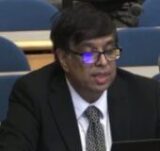

Dastagir Jahangir, Editor,
TheVoice.news
Washington, D.C., June 20, 2025As Bangladesh moves toward a high-stakes national election under an unelected interim government, questions are mounting about the country’s democratic future—and whether the United States will take a clear stance on the growing crisis.Earlier this year, the U.S. State Department emphasized its desire to see Bangladesh uphold the democratic values enshrined in its constitution. These include the protection of free political expression, safeguarding press freedom, and ensuring an independent judiciary. But with elections drawing near, recent developments in Dhaka suggest a sharp departure from these ideals.The matter was brought to the forefront during the State Department’s press briefing on June 20, 2025, where TheVoice.news closely followed the session. Editor Dastagir Jahangir raised concerns stemming from statements by UN Human Rights Commissioner Volker Türk, who warned against the banning of political parties, and a Human Rights Watch report accusing the Yunus-led interim government of arbitrarily targeting Awami League supporters.When asked whether the U.S. considers these developments a violation of democratic principles and whether it would condemn such actions, State Department Spokesperson Tammy Bruce differed. “When it comes to a White House reaction to what is occurring in another country, I would suggest you contact the White House,” Bruce said. “But when it comes to the Secretary of State and the State Department, let’s take that back and we’ll get an answer for you in that regard.”She said, “Deputy Secretary Christopher Landau met with Bangladesh National Security Advisor Khalilur Rahman on Wednesday. They discussed the interim government’s efforts ahead of the national elections, as well as expanding U.S.-Bangladesh trade and commercial ties. The United States is committed to working with Bangladesh to promote peace and stability in the region.”In a follow-up question, TheVoice.news pressed further on allegations that the interim government had filed fabricated charges against former Prime Minister Sheikh Hasina, presided over a surge in mob violence, and detained hundreds of journalists without trial.Once again, Bruce withheld judgment:“We will take that back and I’ll get you an answer as soon as we can get one for you.”With the election expected later this year, many question whether a free and fair electoral process is even possible under the current conditions. The interim regime, lacking a public mandate, has already banned key political parties, restricted press freedom, and used state mechanisms to sideline opposition voices—moves widely seen as attempts to consolidate power.Analysts warn that unless international actors—particularly the United States—apply diplomatic pressure, Bangladesh risks sliding further away from its democratic foundations.As the countdown to the polls accelerates, the world watches closely to see whether the Biden administration will stand up for democratic values in Bangladesh—or remain on the sidelines during one of the most consequential elections in the country’s recent history.