Home Blog

32 Dhanmondi Will Rise Again

Out of the ashes 32 Dhanmondi will rise again. Out of the ghostly silence those vicious agents of the nocturnal put it to, 32 Dhanmondi will arise anew. For it is and always will be the embodiment of history.

Every time the Ayub Khan regime decided to take Bangabandhu Sheikh Mujibur Rahman into custody in the 1960s, its soldiers turned up at 32 Dhanmondi and took him away. They did nothing that would damage his home.

When Pakistan’s soldiers turned up at 32 Dhanmondi as March 25 gave way to March 26 in 1971, they seized the Father of the Nation and took him away. His family was not touched and neither was his home.

On 15 August 1975, assassins shot their way into 32 Dhanmondi, murdered the founder of the Bengali nation and his family and left the residence drenched in a sea of blood. The eerie silence across the residence was loud enough for the world to hear.

It would stay that way for six years, until Sheikh Hasina came home from exile to reclaim the legacy of the Father of the Nation. In time, it would be transformed into a symbol of history, a place of pilgrimage for a nation in grief, wounded through the murder of its founding father.

I have been to 32 Dhanmondi times aplenty. I have recalled and reconnected with the history of our Bengali nationalism on its premises. I have spent days there, back in 1994, contributing my humble bit in informing the world that the greatest man in our country lived and died there, that his legacy defined the power of the place even as he slept eternally in Tungipara.
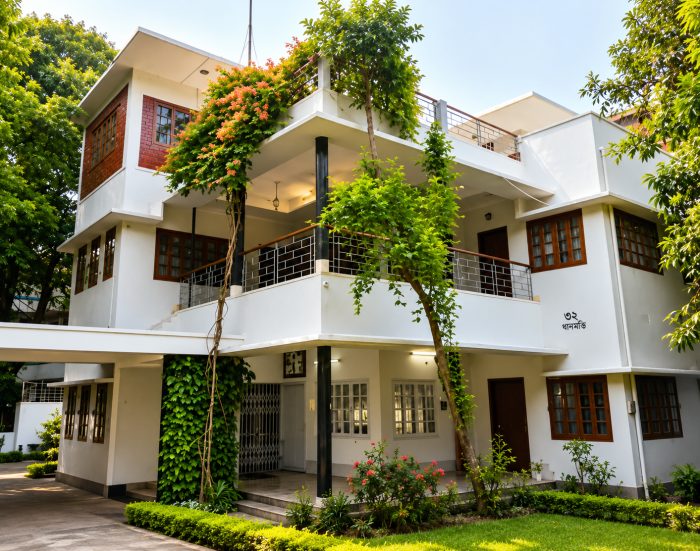
More than a house, Dhanmondi 32 embodies the memories, sacrifices, and aspirations that shaped Bangladesh’s journey to independence.

As Sheikh Hasina, at the time leader of the opposition in the Jatiya Sangsad, turned up and engaged in conversation with me, I indulged in what one might today call multi-tasking. I wrote the English captions for all the photographs, images from the history that was Bangabandhu’s life, that would be on display in the museum.

On the landing where the Father of the Nation fell, there where was inscribed the tragic poetry related to his end, it was the English segment of it, as instructed by Sheikh Hasina, that I penned. In the large room on the ground floor, among all those framed photographs was a larger one, that of the truck on which Bangabandhu was accompanied by a grateful nation to the Race Course from Tejgaon airport on 10 January 1972.

I was part of that crowd, I told Sheikh Hasina. I could not be seen because I was hanging on to the truck at its rear end.

It was at 32 Dhanmondi that I spent time on a rainy morning in the later 1980s, in Sheikh Hasina’s company, conversing on politics and my writings on Bangabandhu. In the early 1990s, in Bangabandhu’s library, I briefed Sheikh Hasina on her probable responses to questions the western media would put to her as they sought her views on the issues in the run-up to the forthcoming general election.

In June 1996, I was part of the cheering crowd welcoming Sheikh Hasina, our new prime minister, to 32 Dhanmondi following her swearing-in at Bangabhaban. The long darkness of twenty-one years had lifted. We bathed in the light of the stars.

32 Dhanmondi is a place suffused in history

The home of Bangabandhu Sheikh Mujibur Rahman has been a hallowed spot, testimony to the supreme struggle and equally supreme sacrifices which are the legacy of the Father of the Nation and his family.

It was from this home that Bangabandhu directed the non-cooperation movement in March 1971.

It was in the sitting room on the ground floor that he met visitors, among whom were Khan Abdul Wali Khan, Air Marshal Asghar Khan, Ghaus Bux Bizenjo and so many others. It was also, in those days of creative tumult, the spot where tens of thousands of Bengalis converged day after day, to let the future founding father of the country know that they were behind him in his mission of attaining liberty for the nation.

In the 1960s, it was here that Pakistan’s police turned up with warrants for Sheikh Mujibur Rahman’s arrest. And those warrants kept coming, one after another. On 8 May 1966, Bangabandhu got into a police van and was taken away to Dhaka Central Jail under the Defence of Pakistan Rules. He was now in detention over his recently announced Six Point Programme of regional autonomy for the federating units of the state of Pakistan.

In early 1968, he was transferred to Dhaka cantonment as the leading accused in the Agartala Conspiracy Case initiated by the Ayub Khan regime. On 22 February 1969, free of the case by the force of a mass movement and ready to provide leadership to the nation in the aftermath of the popular triumph against the regime, Mujib returned to 32 Dhanmondi from captivity in the Dhaka cantonment. He would be anointed Bangabandhu by a loving nation the next day.

In the early minutes of 26 March 1971, 32 Dhanmondi came under assault from the Pakistan army. A hail of bullets left holes through the gate. Other bullets went flying up and across, to pierce the doors and windowpanes of the building. At that point Bangabandhu emerged on the balcony and, raising his voice, asked the soldiers to stop firing. “I am here”, he told them.

Minutes later, he was in an army van. The soldiers whisked him off to the cantonment as Dhaka lit up in the murderous glow of tracer fire. Detained in Adamjee Cantonment College for a few days, Bangabandhu was flown to solitary imprisonment — with no contact with the outside world, no radio and no newspapers — in Mianwali in West Pakistan. His family, in detention, was soon moved to Road 18. The army kept 32 Dhanmondi under its control.
Syed Badrul Ahsan

Life and all the vibrancy and energy symbolized by it returned to 32 Dhanmondi days after Bangabandhu Sheikh Mujibur Rahman, freed by a Pakistan defeated in war and now leader of a newly-independent Bangladesh, came home to a free homeland on 10 January 1972. And 32 Dhanmondi would once more be home, the abode to which the Father of the Nation went back every evening after his day’s work had been done at Ganobhaban.

On his final day alive, Bangabandhu welcomed a special representative of South Korean President Park Chung-hee at Ganobhaban. Before going home, he saw to it that arrangements for a farewell for Mohammad Farashuddin, a bright and trusted officer on his staff preparing to go abroad for higher studies, were in place.

He was also briefed by officials about his planned visit to Dhaka University the following morning. As the afternoon began to give way to twilight, Bangabandhu sat on the steps to the lake at Ganobhaban, in the company of Prime Minister M. Mansoor Ali. He was serene, relaxed. So was Mansoor Ali.

And then Bangabandhu went home.
In the pre-dawn hours of the next day, at 32 Dhanmondi, he and his family would die. A bunch of assassins, fortified by conspiracy fomented at home and abroad, thus plunged a nation into darkness thick and intense.

And we his people cowered in fear. Not a single minister, till the other day in genuflection before Bangabandhu for favours, went to 32 Dhanmondi to pay respects to their assassinated leader.

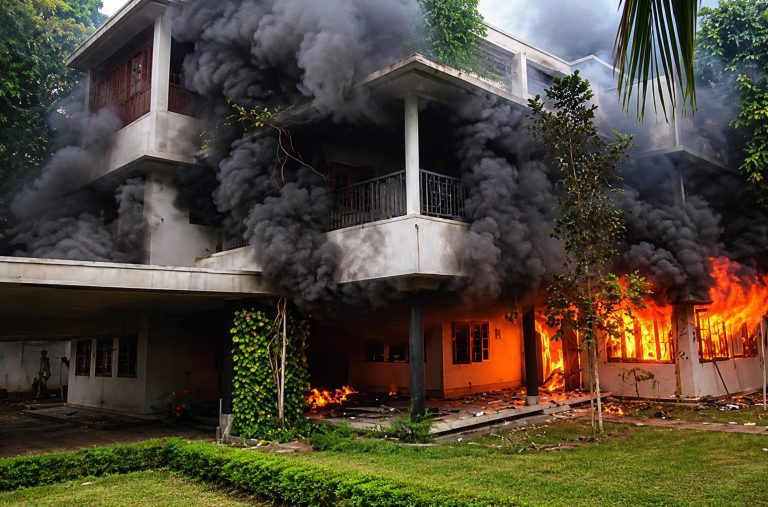
And today, in an era of growing intolerance, deepening darkness and unbridled hate, ready and willing to put national history to the sword, the merchants of darkness have left 32 Dhanmondi a mountain of rubble, a sad memory of what it used to be. These vandals have walked away with every item of priceless note, every piece of memorabilia, from this monument to history. They have felt no shame.

The men and women who were foisted in power in August 2024 have said not a word, have expressed no regret or contrition. The rubble at 32 Dhanmondi speaks loudly of the treason which keeps Bangladesh in its malevolent grip. Sedition has seized the land.

It is our moment of collective shame. We live in the shadow of our shame. And yet we know we will reclaim history again, will be witness to the rise of 32 Dhanmondi again.
For 32 Dhanmondi remains, as it will always remain, our claim on the glory that was Bangabandhu’s politics, on the history which Bengalis forged for themselves in the defining era of the 1960s stretching into the 1970s.

We will build 32 Dhanmondi again. 32 Dhanmondi will rise and shine again. Bangladesh will be ours again.

Author: Syed Badrul Ahsan is a senior Bangladeshi journalist, columnist and author of several books on Bangladesh history and politics.
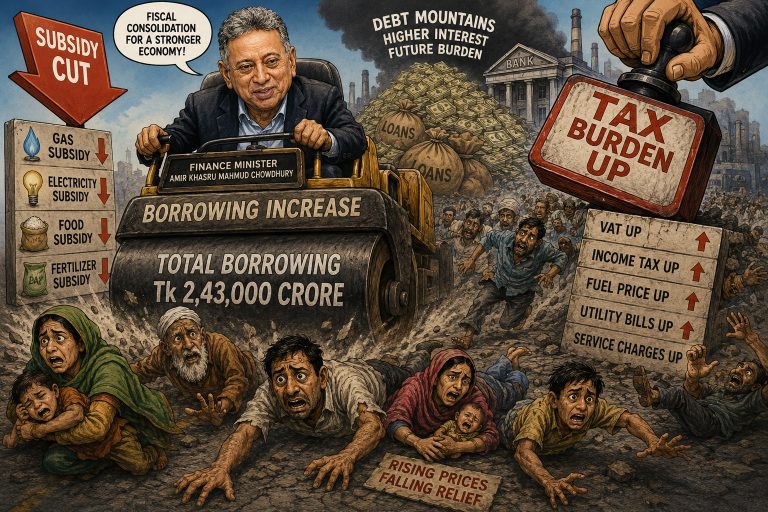

Bangladesh Eyes Welfare Cuts, Higher Borrowing

The government is set to reduce spending on public welfare programs in its FY2026-27 budget, to be presented in Parliament today, by scaling back subsidies that have long helped shield households from rising living costs. At the same time, it plans to expand incentives for exporters and remittance earners while relying on increased borrowing and a heavier tax burden to manage a widening fiscal deficit.

The move comes as the BNP government led by Tarique Rahman struggles to accelerate economic activity and improve revenue collection. Critics argue that the proposed budget shifts the burden of fiscal adjustment onto ordinary citizens while continuing to provide generous support to business-oriented sectors.

Officials familiar with the budget process say allocations for subsidies will be significantly reduced in the coming fiscal year, even as incentives for exports and remittance inflows are set to increase. The result could be less direct government support for consumers alongside greater benefits for exporters and businesses.

According to preliminary Finance Ministry estimates, subsidy allocations may fall to Tk 89,538 crore in FY2026-27, down from Tk 95,031 crore in the revised budget for the current fiscal year. Compared with the actual subsidy expenditure of Tk 108,673 crore in FY2024-25, the proposed allocation represents a reduction of nearly Tk 19,000 crore.

Government officials say the decision is based largely on expectations that global prices of fuel, fertilizer and other commodities will stabilize in the coming months. Policymakers are also considering further adjustments to gas and electricity prices as part of a broader effort to reduce subsidy costs.

Many economists, however, caution against building budget assumptions around uncertain developments in international markets. They warn that any renewed geopolitical crisis or supply disruption could quickly push energy and fertilizer prices higher again, increasing pressure on both consumers and government finances.

Export and Remittance Incentives Set to Rise

While subsidy spending is expected to decline, allocations for export and remittance incentives are likely to increase.

The government is considering a combined allocation of Tk 16,025 crore for export incentives, jute export support and remittance incentives in FY2026-27. The figure is higher than the Tk 15,225 crore allocated for the same programs in the current fiscal year.

Officials argue that stronger incentives are needed to support foreign exchange earnings at a time of economic uncertainty. Yet critics question whether reducing support for consumers while increasing benefits for exporters creates an imbalance in budget priorities.

A Tk 243,000 Crore Deficit

The proposed national budget is expected to total Tk 938,000 crore, with revenue collection targeted at Tk 695,000 crore.

That leaves a projected deficit of Tk 243,000 crore.

To bridge the gap, the government plans to borrow Tk 112,000 crore from the banking sector, Tk 15,000 crore from non-bank sources and Tk 116,000 crore from foreign lenders. It is also expected to spend roughly Tk 46,000 crore on servicing foreign debt during the fiscal year.

Economists say such heavy dependence on borrowing could create long-term vulnerabilities, particularly when revenue collection remains weak and private-sector investment is already under pressure.

Private Sector Could Face a Credit Squeeze

Dr. A.K.M. Waresul Karim, Dean of the School of Business and Economics at North South University, warned that implementing such a large budget would be challenging.

“Implementing a budget of this size will be difficult for the government,” he told The Voice.

He said excessive reliance on borrowing sends a troubling signal to investors.

“When the government borrows heavily from banks, access to credit for businesses declines. That can discourage investment and slow job creation rather than support economic expansion,” he said.

Karim also stressed the importance of improving revenue collection and controlling expenditures.

“If the government continues to increase debt without addressing longstanding weaknesses in revenue collection and spending efficiency, it could ultimately harm the economy,” he added.

Government Borrowing Already Exceeds Target

The government’s borrowing trend has already raised concerns.

For FY2025-26, authorities had set a target of borrowing Tk 104,000 crore from the banking system. However, between July and May 10 alone, net borrowing had already reached Tk 109,568 crore, exceeding the annual target before the fiscal year ended.

Bangladesh Bank data show that outstanding government borrowing from banks rose from Tk 550,905 crore at the start of the fiscal year to Tk 660,473 crore within ten months.

Revenue Shortfall Reaches Record Levels

At the same time, revenue collection continues to lag behind expectations.

According to National Board of Revenue (NBR) figures, the revenue shortfall during the first ten months of the fiscal year reached Tk 104,533 crore.

Against a target of Tk 431,461 crore, the government collected only Tk 326,928 crore. Revenue growth stood at just 10.6 percent.

Officials attribute the weak performance to sluggish business activity, lower imports and slower-than-expected economic expansion.

Private Credit Growth Falls to Historic Low

Bangladesh Bank’s latest data show private-sector credit growth has fallen to just 4.7 percent, one of the lowest levels in recent history.

Economists view the decline as a clear sign of weak investment demand.

They warn that continued government borrowing from banks could make financing even harder to obtain for businesses, potentially slowing investment, industrial expansion and employment generation.

Finance Minister Points to Middle East Tensions

Finance Minister Amir Khasru Mahmud Chowdhury says external factors have significantly increased the government’s subsidy burden.

Responding to a question from Dhaka-18 lawmaker S.M. Jahangir Hossain during a parliamentary session on Tuesday, the minister said instability in the Middle East, particularly involving Iran, has pushed up costs in several key sectors.

“Recent conflicts involving Iran and broader instability in the Middle East have created additional pressure on government subsidy expenditures in the oil, gas, electricity and fertilizer sectors,” he told Parliament.

According to the minister, the government may require an additional Tk 42,600 crore in subsidies by June 2026 for those four sectors alone.

The projected additional requirement includes Tk 10,258 crore for fuel, Tk 11,170 crore for gas, Tk 19,821 crore for electricity and nearly Tk 1,350 crore for fertilizer support.

The finance minister also warned that continued instability in the region poses both immediate and long-term risks to Bangladesh’s economy.

“The impact is already visible in energy prices, fertilizer costs, import expenses, transportation costs, inflation, foreign exchange management, remittance flows and overseas employment,” he said.

What Does It Mean for Ordinary Citizens?

The government argues that reducing subsidies, boosting export and remittance incentives and controlling the budget deficit are necessary steps to maintain economic stability.

But economists question whether cutting welfare-related spending is the right approach at a time when revenue collection is falling short, private investment remains sluggish and public debt continues to rise.

They warn that a combination of higher utility prices, new taxes or expanded taxation measures, and reduced subsidies could further increase the cost of living for millions of households.

As debate over the FY2026-27 budget intensifies, one question is likely to dominate public discussion: how much of the burden of fiscal adjustment will ultimately be carried by ordinary citizens.

Iran Cleared to Enter United States a Day Before World Cup Matches

Los Angeles, June 10, 2026 — Iran’s national football team has been granted permission to enter the United States one day before each of its FIFA World Cup 2026 matches, bringing relief amid uncertainty surrounding visa arrangements and travel restrictions.

The announcement came from the U.S. Department of Homeland Security (DHS), which rejected media reports suggesting that the Iranian team would be required to enter the United States on match days and leave immediately after each game.

Iran is currently training in Tijuana, Mexico, ahead of its World Cup campaign. Reports published over the weekend had raised concerns that strict travel requirements could force the team to commute on match days, potentially affecting player performance due to fatigue and logistical challenges.

In a statement issued on Tuesday, a DHS spokesperson denied those claims, saying, “These reports are not true. Thanks to the goodwill of President Donald Trump, the Iranian team will be allowed to enter the United States the day before their matches.”

Speaking to Reuters in Tijuana on Monday, Iranian Ambassador Pasandideh acknowledged that several officials from Iran’s Football Federation had not received visas. However, he noted that those who were granted visas faced no restrictions on overnight stays or the duration of their presence in the United States.

“There is nothing in their visas requiring them to leave the country within a specific time frame,” Pasandideh said.

Iran will begin its World Cup campaign against New Zealand in Los Angeles on June 15. The team will then face Belgium in the same city on June 21 before concluding the group stage against Egypt in Seattle on June 26.

The clarification from U.S. authorities removes a major source of uncertainty for the Iranian squad as it prepares for one of the world’s biggest sporting events.

Trump Warns Iran Will Pay a “Heavy Price” Amid Escalating Tensions

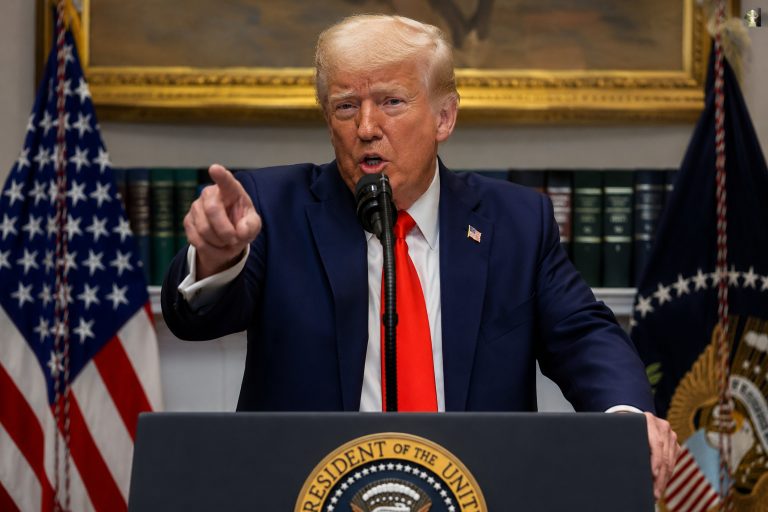
Washington, June 10, 2026 — U.S. President Donald Trump has issued a stern warning to Iran, saying the country will have to pay a “heavy price” while claiming that its military forces have been left in complete disarray.

In a post published on his social media platform, Trump asserted that Iran’s military had been decisively defeated. He claimed that the country’s air force and navy had effectively ceased to exist and described Iran as a power that “talks big” but fails to deliver meaningful action.

“They have been totally defeated,” Trump wrote, adding that what he called the “bully of the Middle East” had been brought to an end.

Trump also criticized Tehran for what he described as excessive delays in negotiations over a possible agreement with the United States. According to the president, Iran had wasted valuable time pursuing a deal that could have been beneficial to the country.

“They have taken far too long to make a deal that would have been great for them. Now they will pay a big price for it,” Trump said.

However, the U.S. president did not specify what consequences Iran might face or what measures the American administration could take in response.

The remarks come amid heightened tensions between Washington and Tehran, with uncertainty continuing over the future of diplomatic efforts and regional security in the Middle East.

US Uses Unmanned Sea Drone to Rescue Apache Crew in Strait of Hormuz

Washington, June 10, 2026 — The United States military has successfully used an unmanned surface vessel to rescue two crew members from a downed Apache helicopter near the Strait of Hormuz, marking what could be the first known operational use of a sea drone in a real-world rescue mission.

According to the U.S. military, the two crew members were recovered after their AH-64 Apache helicopter crashed while conducting a patrol mission in regional waters near Oman. The incident later escalated tensions in the region, with Washington accusing Iran of responsibility and launching retaliatory strikes on Iranian targets.

The rescue operation was carried out by the U.S. Navy’s autonomous vessel, known as the Corsair, or “Sea Drone.” The 24-foot-long unmanned craft, developed by Texas-based defense company Saronic Technologies, is assigned to the Navy’s Task Force 59, a Bahrain-based unit specializing in the integration of unmanned systems into maritime operations.

U.S. Central Command (CENTCOM) said the two crew members spent nearly two hours in the water before the autonomous vessel located and assisted in their recovery.

Sea drones are unmanned maritime vehicles capable of operating on the water’s surface or underwater without a human crew onboard. They can be remotely controlled or function autonomously using sensors, cameras, artificial intelligence, and satellite communications.

The United States has increased investment in such technologies as part of broader efforts to modernize military capabilities and reduce risks to personnel operating in dangerous environments.

Task Force 59, established in 2021, was the first U.S. naval unit dedicated to integrating unmanned systems into maritime missions. The Corsair has been deployed across Middle Eastern waterways since earlier this year amid rising regional tensions.

The vessel is capable of carrying payloads of up to 1,000 pounds (453.5 kilograms) and can travel distances of up to 1,000 nautical miles. It has a top speed of 35 knots.

Beyond search-and-rescue operations, the Corsair is designed for maritime surveillance, vessel tracking, intelligence gathering, mine detection, and monitoring shipping lanes. While the U.S. military has primarily used such systems for surveillance and security missions, recent conflicts have highlighted the growing offensive potential of unmanned maritime platforms.

Military analysts view the successful rescue near the Strait of Hormuz as a significant milestone in the development and operational use of autonomous naval technologies.

Wrestling Action Brings Unexpected Excitement to Quiet California Library

Benicia, California, June 10, 2026 — A public library in Northern California transformed its usually quiet reading room into an energetic wrestling arena as professional wrestlers entertained visitors in an unusual effort to promote reading and literacy.

The event took place at the Benicia Public Library, where visitors had been warned in advance that the library might be louder than usual. However, few expected wrestlers to enter the reading room to loud music and perform high-flying moves inside a wrestling ring set up among the bookshelves.

Children and adults cheered as the performers delivered body slams and aerial kicks while blending entertainment with storytelling. One of the featured wrestlers, known as Llama Jack, appeared wearing a black mask with furry ears and began reading the children’s book Llama Llama Time to Share. The story was briefly interrupted when rival wrestlers entered the ring, leading to a playful match before Llama Jack calmly resumed reading to the audience.

The event is part of “Lucha Libro,” a literacy initiative launched in 2024 that combines professional wrestling with book promotion. The name is inspired by Mexico’s famous wrestling tradition, Lucha Libre, while “libro” means “book” in Spanish.

Organizers plan to hold more than 40 similar events this year in libraries across the United States, from California to New Jersey. One of the circuit’s most popular performers is Richard Schinary, who also works as a librarian.

Lucha Libro Chief Executive Officer Jerry Rocha said the idea originated when a local library approached him and co-founder Victor Dwight in 2024 with a proposal to stage a wrestling show. Dwight also performs as wrestler Victor Von Richter.

Reflecting on the program’s success, Rocha said two worlds that were never expected to meet—libraries and professional wrestling—have come together in a surprisingly effective way, helping attract new audiences to books and reading.

Global Condemnation Over Interference in Bangladesh Bar Elections

The Commonwealth Lawyers Association (CLA) and LAWASIA have expressed serious concern over reports of interference in the elections of the Supreme Court Bar Association (SCBA) of Bangladesh, warning that such developments threaten the independence of the legal profession and the rule of law.

In a joint statement, the two organizations said they had received reports that several qualified lawyers were prevented from contesting SCBA elections despite fulfilling the eligibility requirements set out in the association’s constitution. According to the statement, nominations were allegedly rejected without hearings, written explanations, formal decisions, or any effective avenue for appeal.

CLA and LAWASIA also highlighted allegations that some lawyers were denied nominations because of their perceived political affiliations, with certain candidates reportedly labeled as “collaborators of fascists.”

The statement further referred to reports indicating that approximately 200 lawyers associated with a political party currently banned under Bangladesh’s Anti-Terrorism Act have been unable to participate in at least 13 bar association elections since January 2026.

The organizations additionally raised concerns over reports that former judges of Bangladesh’s Supreme Court and practicing lawyers have been named in multiple criminal cases involving serious allegations. Some of these cases, according to reports received by the organizations, are alleged to be fictitious and politically motivated. CLA and LAWASIA also cited claims of criminal intimidation and threats against members of the legal profession.

Recalling the United Nations Basic Principles on the Role of Lawyers (1990), the organizations stressed that lawyers must be able to perform their professional duties free from intimidation, harassment, and improper interference, while enjoying the rights to freedom of expression, association, and participation in public affairs.

The joint statement called on the Government of Bangladesh, the Supreme Court Bar Association, the Bangladesh Bar Council, and other relevant authorities to ensure the immediate cessation of any interference in bar association elections and to guarantee that all elections are conducted freely, fairly, and in accordance with applicable constitutional rules.

The organizations also urged authorities to ensure that all qualified lawyers can stand for election without discrimination, provide written reasons and appeal mechanisms for rejected nominations, and review criminal cases alleged to have been filed for political purposes or professional intimidation.

Reaffirming the importance of an independent legal profession, CLA and LAWASIA said such independence remains essential to the rule of law, access to justice, and the protection of human rights.

The statement was jointly signed by CLA President Steven Thiru and LAWASIA President Yap Teong Liang. Both organizations said they would continue monitoring developments in Bangladesh and called on the international legal community to support efforts aimed at protecting judicial independence and professional freedoms.

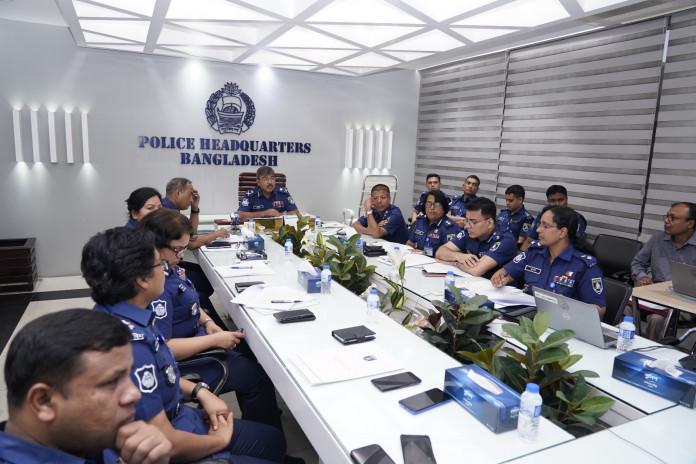
Murder Rate Remains Within Average Trend, Says Bangladesh Police

Police authorities in Bangladesh have stated that the country’s murder figures remain within the average long-term trend, responding to recent data released by Transparency International Bangladesh (TIB).

According to TIB, a total of 605 murders, 196 kidnappings, 294 robberies, and 90 dacoity cases were reported in Bangladesh during March and April.

However, in a statement issued on Monday, police said the presentation of the data lacks important contextual details and may lead to misinterpretation of the overall crime situation.

Most Cases Driven by Personal Disputes

Police reported that out of the 605 registered murder cases, 336 were linked to long-standing personal enmity, 146 to family disputes, and 69 to property or financial conflicts. Only three cases were categorized as politically motivated killings, accounting for just 0.5 percent of the total.

Authorities further noted that Bangladesh records between 3,000 and 4,500 murder cases annually over the past decade. When the recent two-month figure is extrapolated to an annual rate, it translates to approximately 3,630 cases — which, they argue, falls within the historical average.

Police Defend Statistical Interpretation

Officials also highlighted that, given Bangladesh’s population of nearly 180 million, the homicide rate over the two-month period stands at approximately 0.34 per 100,000 people, which they say is not high by global standards.

They warned that presenting raw numbers without context could create public misunderstanding about the actual crime situation. According to police, most incidents are driven by interpersonal disputes, family conflicts, or economic disagreements, while broader categorization is necessary to understand the true pattern of violence.

US Not Prioritizing Israel’s Preferences in Iran Deal, Says Vance

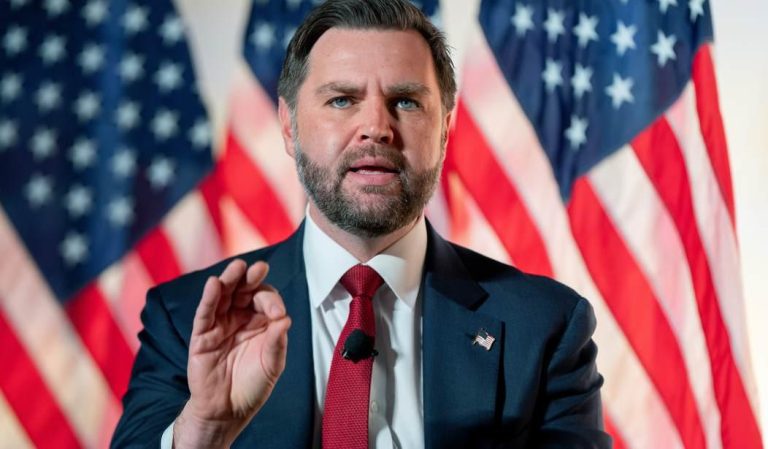
Washington, June 9, 2026 — U.S. Vice President JD Vance has described a potential peace and nuclear agreement between Washington and Tehran as a major victory for the American people, stressing that the United States is focused on its own national interests rather than Israel’s preferences regarding the deal.

In an interview with Fox News on Tuesday, Vance acknowledged that the United States and Israel share many strategic interests, but noted that their objectives do not always fully align.

“Our primary objective concerning Iran is to ensure that it never develops a nuclear weapon,” Vance said, emphasizing that the administration’s approach is centered on U.S. security interests.

He argued that since President Donald Trump returned to office, the White House has created conditions for negotiating a new nuclear agreement that would be stronger and more effective than the 2015 accord negotiated under former President Barack Obama.

Vance said the proposed deal would benefit the United States regardless of whether Israel supports it.
“Israel may like it or may not like it, but fundamentally we believe it serves America’s best interests,” he said.

The vice president also suggested that Tehran is motivated to pursue negotiations because continued conflict would be detrimental to its own interests.

“The Iranians do not want this war to continue because it is against their interests as well,” Vance said. “That is why I believe they are coming to the negotiating table and presenting proposals.”

The remarks come amid ongoing diplomatic efforts to reduce tensions between the United States and Iran and to establish a framework aimed at preventing Iran from developing nuclear weapons while avoiding further regional escalation.

Source: The Times of Israel.

Sheikh Hasina Dismisses Retirement Rumours

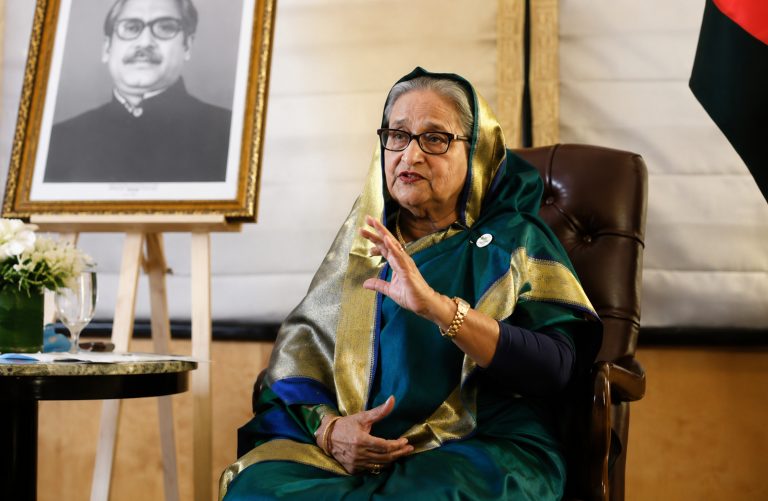
Former Bangladesh Prime Minister and Awami League President Sheikh Hasina has firmly rejected speculation that she is preparing to retire from politics, saying she cannot abandon her party at a time when its leaders and activists are facing what she described as political persecution.

In an interview with the Indian newspaper Ei Samay, the first part of which was published on Tuesday, Hasina dismissed suggestions that she intends to step away from political life. The speculation dates back to August 2024, when her son, Sajeeb Wazed Joy, said she had become deeply disappointed by recent developments in Bangladesh and had decided not to continue in politics.

Responding to a question about whether she still stood by that reported decision, Hasina rejected the claim outright.

“How can I say I am going to rest at a time when democracy is under attack and our party leaders and activists are suffering?” she said.

Hasina stated that she would only consider retirement after ensuring the emergence of a new generation of Awami League leadership capable of carrying forward the spirit of Bangladesh’s Liberation War and securing the country’s future progress.

Asked who might succeed her, the Awami League chief emphasized that leadership would be determined democratically through the party’s council process and the opinions of grassroots members.

“This is a democratic party. Leadership will be elected through the council and based on the views of party workers,” she said.

At the same time, Hasina acknowledged that the Awami League is currently undergoing what she described as a process of “natural purification.”

Since the fall of the Awami League government following the July-August 2024 mass uprising, Hasina has been residing in India. Bangladeshi authorities have stated that diplomatic efforts are underway to bring her back to face legal proceedings.

During the interview, Hasina reiterated her intention to return to Bangladesh.

“I will return empowered by the strength of the people, with the pride of restoring democracy and the determination to rebuild the country,” she said.