
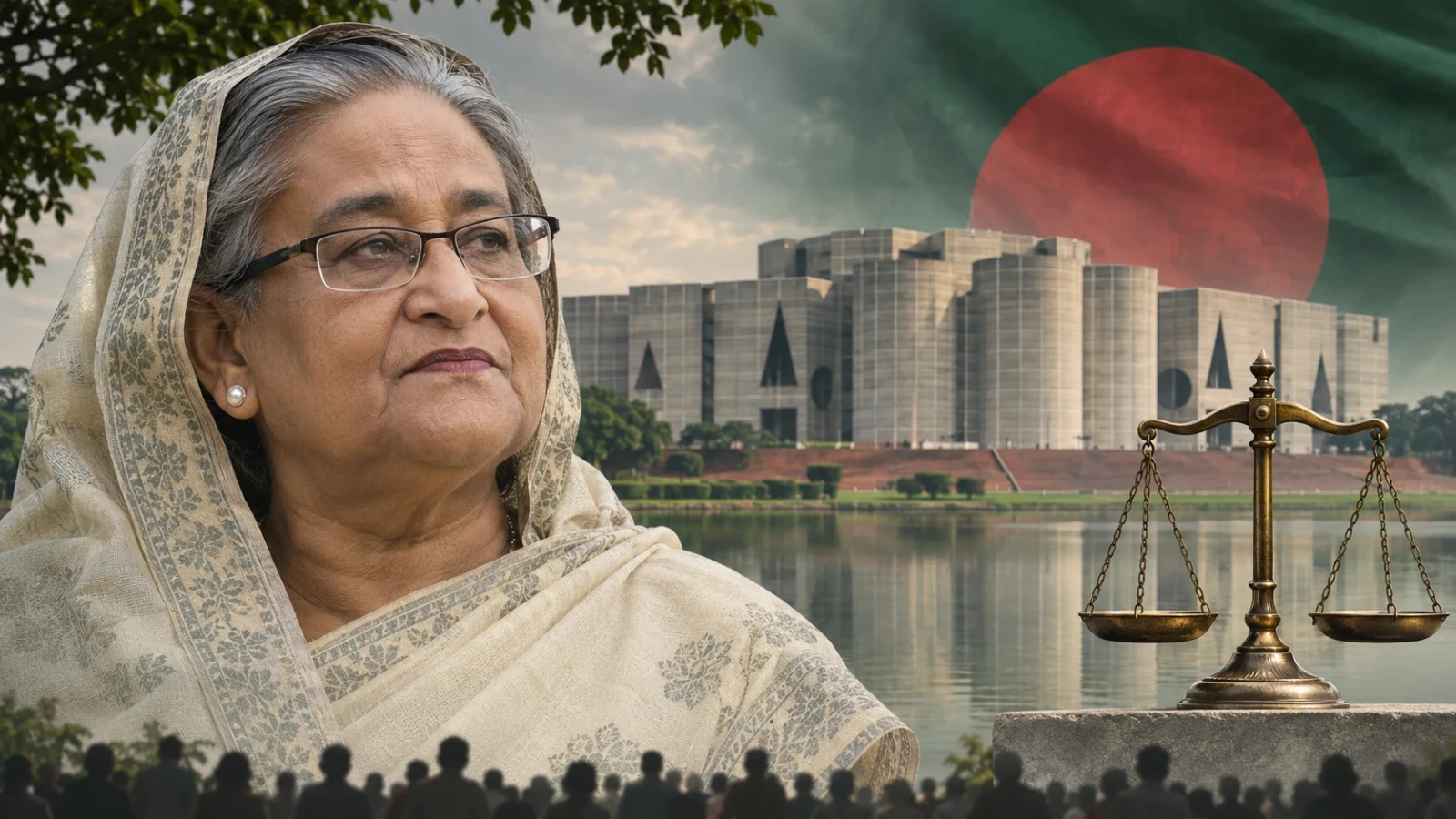
Journalist David Bergman has argued that Sheikh Hasina’s voluntary return to Bangladesh could put the BNP-led government in an extremely difficult political position, potentially creating a crisis that would be difficult for the ruling party to manage.
In an analysis, Bergman said that although the government officially wants Hasina returned to Bangladesh to face her death sentence, her actual presence in the country could be the last thing it wants.
According to him, Hasina’s return would force the government to confront a difficult choice: allow her execution to proceed or find a way to prevent it through an appeal or presidential clemency.
Bergman noted that there could be enormous public pressure on the government to carry out the execution. People would also draw comparisons with the Awami League government’s execution of five Jamaat-e-Islami leaders and one BNP leader between 2013 and 2016, all of whom were convicted by the same tribunal that has now sentenced Hasina.
However, he argued that the BNP government is also aware that the Awami League retains considerable public support. Executing Hasina could therefore trigger an explosive political situation, with unpredictable consequences for both the country and the ruling party.
Even keeping Hasina in prison could lead to a resurgence of Awami League protests, potentially followed by repression and human rights violations as the government attempts to contain the demonstrations, Bergman observed.
He also highlighted the political and historical significance of Hasina’s identity as the daughter of Sheikh Mujibur Rahman, Bangladesh’s independence leader, whose family was assassinated in 1975.
Bergman questioned whether a BNP government could realistically execute the daughter of the country’s founding leader, particularly in the face of intense international pressure from India and other countries.
He further pointed out that human rights organisations would likely challenge the fairness of imposing a death sentence following a trial in which Hasina did not participate and which may not provide her with an effective right of appeal.
However, sparing her from execution would also carry significant political risks. Bergman warned of the possibility of a massive public movement, describing it as a potential “Shahbagh on steroids”, with tens of thousands taking to the streets demanding her execution and creating serious instability for the government.
He argued that by announcing her willingness to return, Hasina has made herself politically relevant again and placed the BNP government in a dilemma that could be difficult to resolve.
Why Hasina’s return concerns the BNP
Bergman said the situation explains the apparent contradiction in the government’s response to Hasina’s announcement.
For the past year, since her conviction, the Bangladesh government has repeatedly demanded that India extradite her so that she can face her sentence. But now that Hasina has expressed her willingness to return voluntarily, the government appears reluctant to facilitate her return.
According to Bergman, the explanation is straightforward: “Hasina inside Bangladesh is far more dangerous to the government than Hasina in Delhi.”
He argued that Hasina’s return could create a political crisis for the BNP regardless of whether the government carries out the sentence or attempts to spare her.
The development also puts India in a difficult position. Her voluntary return could seemingly resolve New Delhi’s extradition dilemma by removing the need for India to formally hand over its long-time ally.
However, Bergman noted that Dhaka could still accuse India of facilitating her return outside the extradition treaty framework, potentially creating fresh tensions between the two countries.
India, meanwhile, may be reluctant to be seen as allowing a long-standing political ally to return to Bangladesh and face possible execution, even if the decision is presented as Hasina’s own.
Bergman also pointed to the diplomatic cost of Hasina’s continued presence in India. He said her August 2026 press conference in Delhi, where she and Awami League leaders made what he described as false claims and spread disinformation, disrupted preparations for BNP Chairman Tarique Rahman’s first visit to India.
He argued that this was particularly damaging at a time when Indian Prime Minister Narendra Modi was seeking to repair relations with Bangladesh and prevent Dhaka from moving closer to Pakistan and China.
Concluding his analysis, Bergman highlighted what he described as an irony in the current situation: both Dhaka and Delhi may now have reasons to prefer that Hasina remain outside Bangladesh.
He suggested that the Bangladesh government’s apparent reluctance to issue her a passport or travel documents could allow India to continue hosting her without openly acknowledging that it is doing so.
Dhaka, 13 November


COMMENTS