
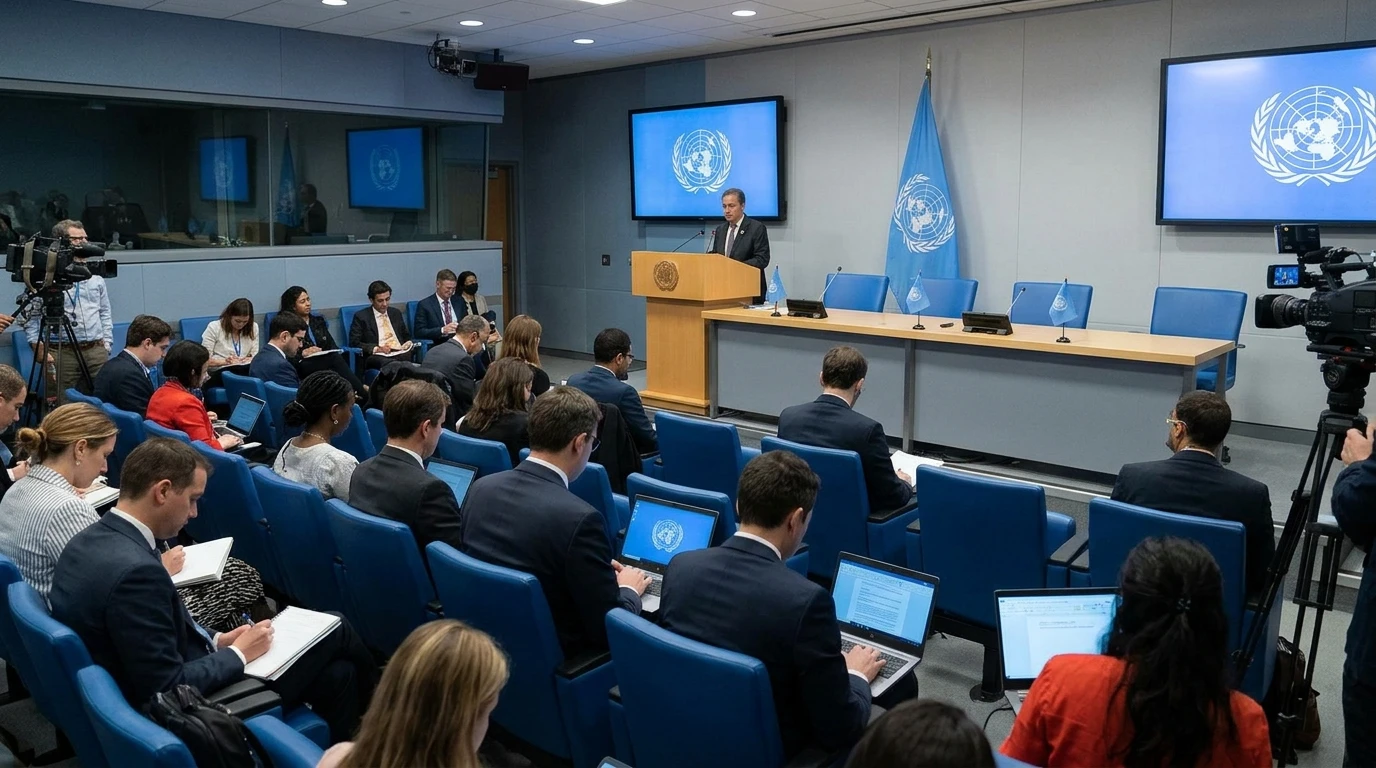
The United Nations has said that all political parties and political figures in Bangladesh should have the freedom to participate in political activities, a position that could put renewed international scrutiny on the government’s stance towards the Awami League.
Farhan Haq, Deputy Spokesperson for UN Secretary-General António Guterres, made the remarks during the UN’s regular press briefing in New York on Tuesday, November 10, in response to a journalist’s question about the possibility of former prime minister Sheikh Hasina returning to Bangladesh.
“In terms of political activities, we believe that all political parties and political figures should have the freedom to participate,” Haq said.
He also stressed the importance of ensuring accountability for crimes committed in Bangladesh, including those documented by the UN Fact-Finding Mission.
The remarks appeared to draw a distinction between accountability for alleged crimes and the right to political participation. They did not endorse Hasina or dismiss the allegations against her, but underscored the importance of protecting political rights alongside credible accountability processes.
The statement comes amid growing tensions over the future of the Awami League, which the government has repeatedly indicated it wants to keep out of politics.
The issue has also gained prominence following reports that Hasina sought a new passport and national identity card through Bangladesh’s diplomatic mission in New Delhi, saying she wanted to return home and surrender before a court. The government reportedly rejected her application.
State Minister for Foreign Affairs Humayun Kabir said Bangladesh did not issue passports to “terrorists” and argued that Hasina should be returned under the extradition treaty between Bangladesh and India.
Meanwhile, the chief prosecutor of the International Crimes Tribunal has said that Hasina would face execution of the death sentence imposed by the tribunal if she returned to the country.
Political tensions intensified further on Wednesday when Home Minister Salahuddin Ahmed told Parliament that “the Nazis could not return to Germany, nor could they engage in politics”, drawing a parallel with Awami League leaders and activists who left the country following the 2024 mass uprising.
Bangladesh First—or Tarique Rahman’s Politics of Appeasing the Powerful?
He also indicated that those who fled after the uprising would not be allowed to return to Bangladesh.
Haq’s comments could complicate the government’s efforts to justify a blanket political exclusion of the Awami League on international platforms. The UN’s position suggests that individual criminal accountability and the broader political rights of parties and their supporters should be treated as separate issues.
The distinction is particularly significant for individuals who have not been convicted of any criminal offence. Excluding an entire political movement from public life could raise concerns about collective punishment and the application of democratic principles.
The wording of the journalist’s question at the UN briefing also drew attention. The journalist claimed that Hasina had been convicted of genocide and that the UN fact-finding report had established it.
However, the distinction is important: Bangladesh’s International Crimes Tribunal convicted Hasina in absentia of crimes against humanity over the 2024 crackdown. The UN fact-finding report documented serious human rights violations and recommended further investigations to determine whether the violations could amount to crimes against humanity. Neither should be inaccurately described as a conviction for genocide.
Similarly, the claim that Hasina’s supporters are attempting to destabilise Bangladesh was raised by the journalist, not independently endorsed by the UN spokesperson.
The UN’s response therefore places renewed emphasis on two parallel principles: those responsible for serious crimes must face justice through credible legal processes, while political participation should not be denied collectively on the basis of political affiliation.
The government’s challenge will be to reconcile its position on the Awami League with these principles as international attention grows over Bangladesh’s political transition and the protection of democratic rights.

COMMENTS