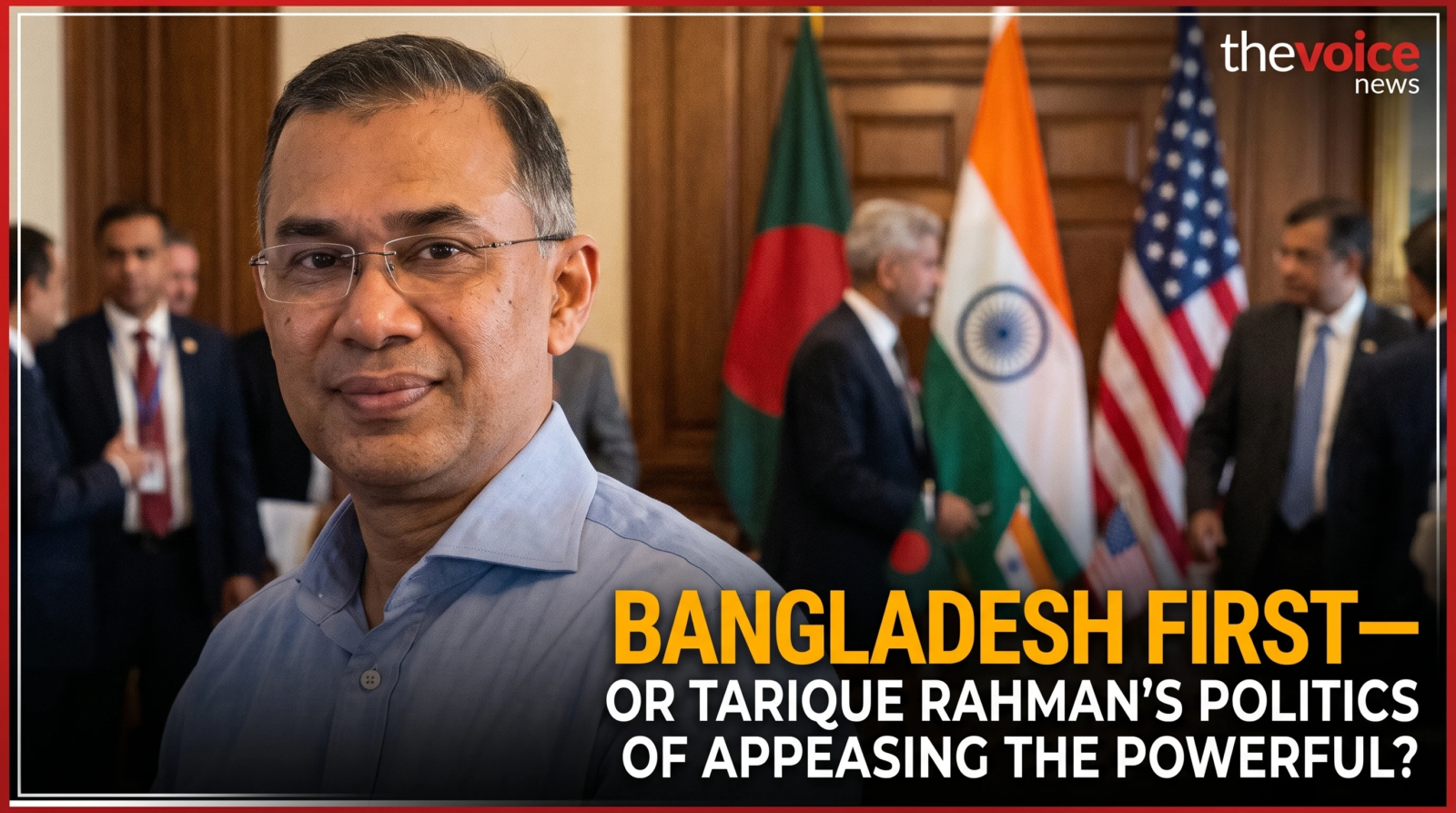
Bangladesh First—or Tarique Rahman’s Politics of Appeasing the Powerful?
By Dr. Anjuman A. Islam
[About the writer: Dr. Anjuman A. Islam blends her rigorous background as a US-trained PhD and Postdoc Researcher with executive leadership experience to deliver unique perspectives on South Asian politics.]Dr. Anjuman Islam
Tarique Rahman came to power promising “I Have a Plan.” Is the plan now to accommodate every powerful player to stay in power?
There is an old lesson in politics: sometimes, in trying so hard to win someone over, you end up making that person more powerful than you intended.
Tarique Rahman returned to Bangladesh promising a new direction—one that would put Bangladesh first, restore its dignity, and protect its independence. But now that he is in government, a fundamental question arises: what exactly is his plan for Bangladesh’s place in the world?
The issue is not whether Bangladesh should maintain relations with India, China, Japan, or the United States. It must. The question is whether these relationships deliver measurable benefits to Bangladesh—or whether the country is simply adjusting to the interests of powerful partners.
A new government need not abandon every policy of its predecessor. But if Tarique’s approach is genuinely different, he must explain what has changed, what remains, and why.
Anti-India Rhetoric, Pro-India Reality: Is Tarique’s Mask Slipping?
One of the strongest political attacks against Sheikh Hasina was that she had compromised Bangladesh’s interests to please India. Both Muhammad Yunus’s interim government and Tarique Rahman’s political camp drew mileage from this charge, portraying Hasina’s relationship with New Delhi as a betrayal of national interests.
But where is the evidence? Which specific treaty or agreement did they establish was harmful to Bangladesh—and then cancel because it undermined the national interest?
Despite the rhetoric, neither administration has demonstrated a clear break with Hasina-era agreements by cancelling major deals on the grounds that they harmed Bangladesh. If those agreements were genuinely detrimental to the country, why retain them? And if they serve Bangladesh’s interests, why continue using them as political weapons against Hasina?
This is where the argument against Hasina becomes particularly questionable. Her record was not simply one of yielding to India. Her government took India to international arbitration over maritime boundaries and secured Bangladesh’s maritime rights in the Bay of Bengal. It also concluded the Land Boundary Agreement, resolving a long-standing territorial dispute through the exchange of enclaves. These were difficult negotiations with a powerful neighbour that produced concrete outcomes for Bangladesh.
Those achievements do not make every decision of Hasina’s government beyond criticism. But they make it wrong to reduce her entire foreign policy to the accusation that she sold out the country.
Tarique’s rise created an opportunity to demonstrate that his approach to India would be different. Yet the real measure of a changed policy is not friendlier meetings, warmer statements, or a more cordial diplomatic atmosphere. It is whether Bangladesh secures tangible gains on the issues that matter to its people.
The Teesta water-sharing dispute remains unresolved, while the Ganges Water Sharing Treaty is due to expire in December 2026. What concrete progress has Bangladesh secured on these issues? What commitments has the government obtained from India? And what conditions, if any, has it established for deeper cooperation?
These are not anti-India questions. They are questions of national interest and political accountability.
A policy does not become a betrayal simply because Hasina introduced it, just as it does not become a success simply because Tarique continues it. If the current government believes these agreements serve Bangladesh, it should defend them openly and explain their benefits. If it believes they do not, it should explain why they remain in force and what it intends to do differently.
The hypocrisy is hard to ignore. Tarique’s camp condemned Hasina for allegedly selling out Bangladesh to India, yet what has fundamentally changed under his government?
A saying is now circulating that Tarique is visiting Japan to sign a Matarbari deep-sea port deal that would give India a corridor. This may be little more than casual talk; it is not an established fact. But given the strategic significance of Matarbari, the government should clarify the matter rather than leave the public guessing.
If the talk is baseless, say so. If an arrangement is being considered, Bangladeshis deserve to know its terms and what their country would gain in return.
Tarique cannot build his political standing by accusing Hasina of compromising national interests and then expect immunity from the same scrutiny. If his government is prepared to accommodate powerful neighbours without securing comparable benefits for Bangladesh, the question is unavoidable: was the anti-India rhetoric ever about defending the country—or was it simply a convenient weapon for gaining power?
Matarbari, Japan, and China’s Competing Interests
Matarbari illustrates the need for consistency in foreign policy—and the danger of confusing political slogans with national strategy.
Developed under Hasina as part of Japan’s broader Bay of Bengal Industrial Growth Belt vision, Matarbari was intended to strengthen Bangladesh’s industrial capacity, improve connectivity, and attract investment.
Meanwhile, China had pursued a competing deep-sea port proposal at Sonadia. Bangladesh cancelled that project in 2016 as the Japanese-backed Matarbari project advanced. The two projects became part of a wider contest involving major powers seeking economic and strategic influence in the Bay of Bengal.
This history matters because Bangladesh must now navigate many of the same competing interests. Japan wants to advance its regional economic vision; China has its own ambitions for connectivity and investment; and India has a strong interest in regional transport routes and access to its northeastern states.
There is nothing wrong with continuing a worthwhile project initiated by a previous government. Abandoning valuable infrastructure merely to distance oneself from a political predecessor would be irresponsible.
But Tarique’s administration should explain how Matarbari fits its own national strategy and how Bangladesh will ensure that the project serves its interests—not merely those of Japan or other regional powers.
The same principle applies to China. Bangladesh can pursue Chinese assistance for the Teesta River project while continuing cooperation with Japan. But it must assess the financial, environmental, and strategic implications of each decision rather than assume that the interests of Beijing and Tokyo will always align.
The real question is whether Dhaka has a coherent strategy for managing these competing relationships—or is making decisions first and dealing with the diplomatic consequences afterwards.
Teesta: Strategic Independence or Diplomatic Retreat?
The Teesta River is vital to agriculture and livelihoods in northern Bangladesh. With a comprehensive water-sharing agreement with India still absent, Bangladesh has legitimate reasons to explore Chinese financing and technical assistance for river management.
But the project’s proximity to India’s strategically sensitive Siliguri Corridor means that Chinese involvement carries regional implications. India’s concerns cannot simply be dismissed, just as Bangladesh’s development needs cannot be sacrificed to satisfy them.
The test is not whether Bangladesh should automatically choose China over India. It is whether Bangladesh can make decisions on the basis of its own needs, supported by sound technical, financial, environmental, and security assessments.
If the government is reassessing its approach to China’s involvement, is it making a responsible decision based on those assessments? Or does the reassessment reflect inadequate planning or pressure from a powerful neighbour?
The evidence behind the government’s decisions matters. A change of approach does not automatically prove that Tarique has bowed to India. Equally, abandoning or weakening a beneficial project simply to avoid Indian displeasure would raise legitimate concerns.
Bangladesh has every right to seek a workable solution to the Teesta problem. It should neither surrender that right to satisfy India nor assume that Chinese involvement will solve every problem without creating new ones.
Bangladesh needs a strategy that can withstand pressure from both sides. Otherwise, what does “Bangladesh First” actually mean?
The United States: What Is Bangladesh Getting in Return?
The relationship with Washington raises similar questions.
The US–Bangladesh reciprocal trade agreement signed in February 2026 established a 19% tariff rate for most originating Bangladeshi goods, with specified products potentially eligible for zero tariffs. It also included commitments involving market access, labour, regulatory barriers, and digital trade.
The government must demonstrate whether the agreement’s benefits justify its obligations. Will Bangladeshi exporters gain meaningful advantages? What will compliance cost manufacturers, particularly the garment industry that supports millions of livelihoods?
Major commitments involving American agricultural products, energy, and aircraft also require transparent evaluation of price, financing, demand, and long-term affordability.
Commercial agreements and foreign purchases can serve legitimate national interests. But if Bangladesh accepts costly commitments in the hope of securing political goodwill, the government must show that the expected benefits are real.
Bangladesh cannot afford to pay for diplomatic approval while struggling to finance domestic priorities.
The question is not whether Washington should be a partner. It is whether the relationship produces benefits proportionate to Bangladesh’s commitments. The same standard must apply to every powerful country, without exception.
Foreign Debt and the Cost of Continuing Old Projects
The same scrutiny must apply to infrastructure financing.
Dhaka Metrorail has the potential to reduce congestion, improve mobility, and support economic growth. But large infrastructure projects create long-term financial obligations. Interest rates, currency depreciation, maintenance, and repayment schedules can all place pressure on public finances.
When debt is denominated in foreign currency, a weaker taka increases the local-currency cost of repayment. The government must therefore evaluate not only the benefits of infrastructure but also its full financial burden.
Japan’s standard JICA loan rate has reportedly risen from 0.7% in 2020 to 3.5% in October 2026. As Bangladesh seeks more favourable financing terms for projects such as Dhaka Metrorail, Japan’s strategic interest in Matarbari is also resurfacing.
Could Matarbari provide Bangladesh with leverage to negotiate better financing terms for the Metrorail? Or have weak governance, revenue shortfalls, and poor spending discipline left the government negotiating from a position of vulnerability?
There is no established evidence that Japan raised interest rates to pressure Bangladesh over Matarbari. But the intersection of these issues deserves scrutiny. Strategic partnerships should produce tangible benefits for Bangladesh, not simply larger commitments and higher costs.
The involvement of Indian companies in major infrastructure projects also deserves consistent scrutiny. Indian firms, including Larsen & Toubro, have secured important metro-rail contracts in Bangladesh, with projects supported by Japanese financing. There is nothing inherently wrong with an Indian company winning a contract if it offers the right terms and delivers value. The question is whether the contracts, financing, and long-term obligations serve Bangladesh’s interests.
If political leaders condemn one government for allowing foreign influence but continue similar arrangements when they take power, they owe the public an explanation. National interest cannot be defined by who signs a contract or which party happens to be in office.
Foreign Policy Must Serve Ordinary Bangladeshis
Foreign policy is not just about ports, trade agreements, and relationships with major powers. It is also about farmers who depend on river water, workers whose livelihoods depend on exports, and families sustained by remittances.
The reported execution of two Bangladeshi nationals in Saudi Arabia in October 2026 raises questions about consular notification, legal assistance, and the protection available to citizens facing severe penalties abroad. Bangladesh must be able to maintain constructive relations with Saudi Arabia while seeking answers and strengthening support for its citizens overseas.
Likewise, instability in Myanmar and the continuing Rohingya crisis demand sustained diplomacy, effective border preparedness, and workable regional partnerships. Bangladesh cannot assume that distant allies will resolve its security challenges.
These issues reinforce a common principle: diplomatic relationships must be judged by their outcomes for Bangladesh and its people.
A foreign policy that produces impressive photographs, high-level visits, and grand infrastructure announcements but fails to deliver water security, economic resilience, or protection for citizens is not a success. Nor is a policy successful simply because it pleases a powerful partner.
The public deserves to know what Bangladesh gains, what it gives up, and who ultimately bears the cost.
Bangladesh First Must Mean Bangladesh First
Tarique Rahman’s central challenge is not whether he continues some policies inherited from Hasina. It is whether he can explain those policies within a coherent national strategy—and whether he can negotiate from a position of national confidence rather than political convenience.
If Matarbari serves Bangladesh’s interests, continue it—but explain why. If Chinese investment can help resolve the Teesta problem, pursue it—but assess the risks. If closer relations with India are necessary, build them—but demonstrate measurable progress. If trade agreements with the United States offer opportunities, show that their benefits justify the obligations.
Bangladesh does not need to choose between India and China, Japan and the United States, or development and diplomatic independence. It needs the ability to work with all of them without allowing any one relationship to undermine its national interests.
That requires transparent agreements, sustainable borrowing, stronger domestic economic capacity, and the courage to reject terms that do not serve the country.
Tarique came to power promising, “I Have a Plan.”
The public is entitled to ask: what is that plan?
Is it a strategy to make Bangladesh more independent, economically resilient, and diplomatically respected? Or is it an effort to keep every powerful partner sufficiently satisfied to preserve political power?
Only decisions, agreements, and measurable results can answer that question.
But one distinction must not be lost in the political noise. Sheikh Hasina’s government took India to international arbitration and secured Bangladesh’s maritime rights. It also resolved a long-standing land-boundary dispute through an agreement that delivered a concrete territorial settlement. These were examples of dealing with a powerful neighbour while pursuing identifiable gains for Bangladesh. Her entire record should not be dismissed as surrender merely because she maintained close relations with India.
Tarique must now demonstrate that his own promise of national dignity means more than replacing one political narrative with another. If he condemns Hasina for allegedly compromising Bangladesh but then accommodates powerful neighbours without securing clear benefits, his rhetoric will stand exposed as political convenience—not patriotism.
Bangladesh does not need a leader who can please every powerful country. It needs a leader who can stand before those countries, defend Bangladesh’s interests, and say no when the terms are wrong.
If “Bangladesh First” becomes a slogan behind which the country’s strategic advantages are traded away, Tarique Rahman will not be remembered as the leader who restored Bangladesh’s dignity. He will be remembered as the man who put his political convenience above national interest.






COMMENTS