
Former Prime Minister and Awami League President Sheikh Hasina has reaffirmed her determination to return to Bangladesh in December, saying the country’s future must be built not on retribution, but on reconciliation.
At the same time, she called for U.S. support for the restoration of democracy and human rights in Bangladesh.
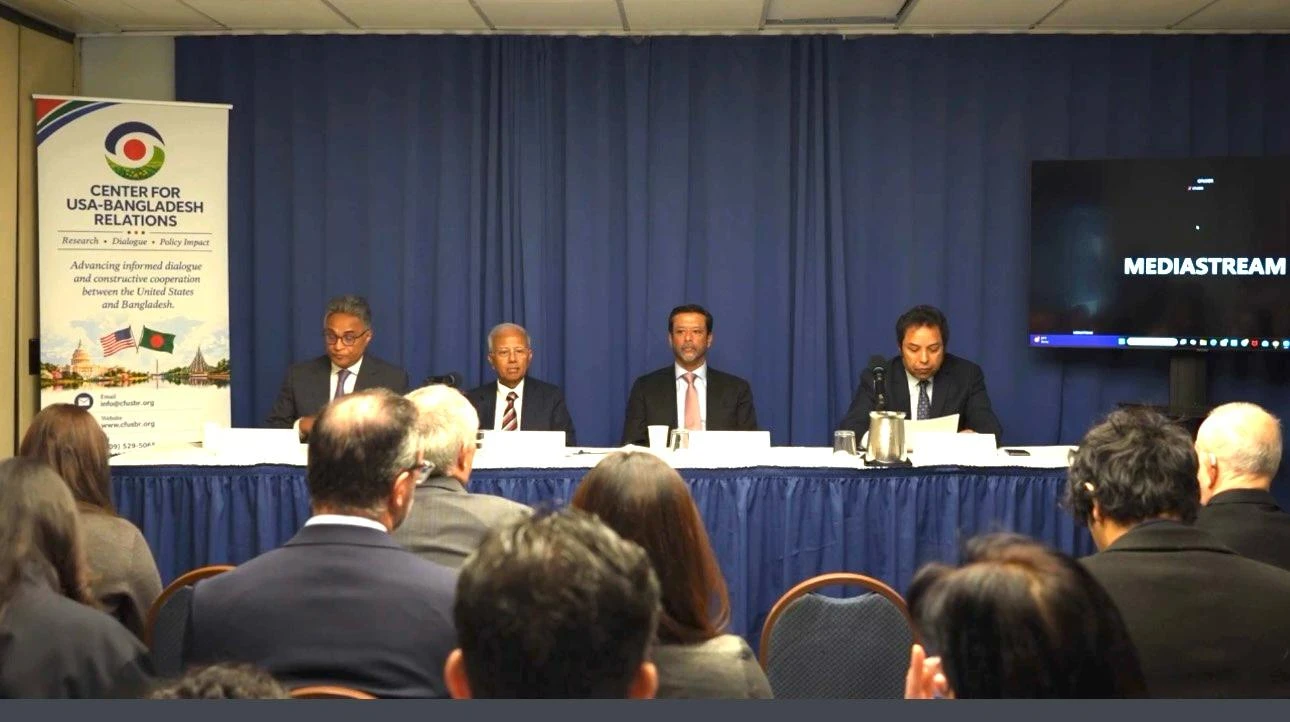
Hasina made the remarks on October 19 while addressing an international press conference virtually as the Chief Guest at the National Press Club in Washington, D.C. The event was organized by the think tank Center for U.S.-Bangladesh Relations.
Sajeeb Wazed Joy, former ICT adviser to Prime Minister Sheikh Hasina, also addressed the event as a special guest.
Hasina said supporters of the Awami League and Bangladeshi citizens could not simply be erased from the country’s political landscape.
“Those who opposed my government are also citizens of Bangladesh, and their rights must be respected. The future of Bangladesh must be built not on retribution, but on reconciliation,” she said.
“I envision a Bangladesh where political opponents sit down for dialogue rather than confront each other in the streets; where voters, not violence, determine elections; where journalists can report without fear; and where young people can criticize freely,” she said.
Expressing concern that she could face arrest, torture or even death if she returned, Hasina said she nevertheless considered it her responsibility to return to her people.
“I will return to Bangladesh in December. I am not afraid,” she said.
The Awami League president said political disagreement was both normal and necessary in a democracy and that governments must remain accountable. But democracy could survive only when dissent was not used as a pretext to exclude political parties or silence millions of citizens, she said.
Addressing the U.S. administration directly, Hasina said:
“Given the current situation in Bangladesh, I seek your support. Not intervention, but support for how democracy and human rights can be restored in Bangladesh.”
She outlined several areas in which she said Washington could support Bangladesh:
- “I am not asking the United States to choose Sheikh Hasina or the Awami League. I am asking the United States to choose democracy.”
- “I am not asking for intervention; I am asking for support.”
- “I want Bangladeshis to determine their government through a free and inclusive political process.”
- “I urge the United States to support free elections, independent courts, freedom of the press, freedom of political organization, protection of minorities, due process, economic openness and peaceful political competition.”
Hasina said Washington was the capital of a country founded on the principles of democracy, freedom, human dignity and the rule of law. She thanked the American people, the international community and all those concerned about democracy, human rights, regional security and Bangladesh’s future for the opportunity to speak directly with them.
“I speak before you not only as a former Prime Minister of Bangladesh, but as a lifelong servant of my country’s development, security, independence and democratic future,” she said.
“I speak not from a position of power, but as a former Prime Minister, as the daughter of the Father of the Nation, Bangabandhu Sheikh Mujibur Rahman, and as a citizen who has devoted her life to the independence, development and prosperity of my country.”
Hasina said Bangladesh and the United States had developed a deepening partnership based on shared values and mutual interests.
“Democracy, economic growth, regional stability, counterterrorism, climate action, trade and human security are all foundations of our relationship. What happens in Bangladesh matters not only to its people, but also to the United States and the international community,” she said.
The former prime minister said she wanted to speak openly about three major issues: the events that had taken place in Bangladesh and what the international community needed to understand about them; the current state of democracy, human rights, the economy and the rule of law in Bangladesh; and her vision for the country’s future.
Hasina stressed that she did not want the United States to take sides in Bangladesh’s domestic politics.
“I simply want Bangladesh to be judged by the same universal democratic principles that are upheld around the world—free and fair elections, constitutional governance, due process, freedom of expression, political pluralism and equal protection under the law,” she said.
She said Bangladesh needed a political environment in which every citizen could participate peacefully in shaping the country’s future, regardless of political affiliation, religion, gender, social status or region.
According to Hasina, the international community has an important role to play in this regard. Given the United States’ considerable influence in South Asia, she said Washington had a responsibility not to determine who should govern Bangladesh, but to help ensure respect for democratic institutions, constitutional order, peaceful political competition and human rights.
She also highlighted Bangladesh’s strategic position at the crossroads of South and Southeast Asia, its role in the Bay of Bengal and the Indo-Pacific, the livelihoods of millions of people linked to the American market, and the dynamism of its economy.
“All of these factors make stability and prosperity a shared interest,” she said.
“Our bilateral relationship should rise above personal interests and be grounded in enduring national interests. I look forward to stronger Bangladesh-U.S. economic ties, increased American investment, expanded cooperation in education and technology, enhanced security cooperation and deeper people-to-people connections,” Hasina said.
At the same time, she said Bangladesh must remain a sovereign country capable of maintaining constructive relations with all its partners, including the United States, India, China, Japan, the Middle East, Africa and Europe.
“Bangladesh must not become a battleground for great-power rivalry. Rather, it should serve as a bridge between different regions,” she said.
Hasina acknowledged that difficult questions remained surrounding her government, the events of 2024 and the developments that followed.
“I am aware of the difficult questions surrounding my government, the events of 2024 and what followed. I welcome those questions and I am prepared to answer them,” she said.
Calling for transparent, credible and impartial trials, she said allegations against anyone, including herself, should be addressed through due legal process rather than political declarations.
“Allegations against me or anyone else should be resolved through fair legal proceedings, not political pronouncements,” she said.
The Awami League president also called for justice for families affected by violence, people who had been unlawfully detained and all those entitled to justice.
“There can be no lasting peace without justice, and there can be no justice without due process,” she said.
Hasina expressed gratitude to the people of Bangladesh for the trust they had placed in her over the years.
“History will judge my government. But history will also acknowledge the significant transformation Bangladesh has achieved—economic growth, infrastructure development, expanded access to electricity, digital connectivity, poverty reduction and a stronger position in the global community,” she said.
Addressing the American people, she highlighted the contribution of Bangladeshis living in the United States.
“Bangladeshis have enriched the United States as entrepreneurs, professionals, academics, workers and community leaders. The Bangladeshi-American community is an important bridge between our two nations,” she said.
The press conference was chaired by Dr. Nurun Nabi, chairman of the Center for U.S.-Bangladesh Relations.
Among others, Dr. Kaykaus Ahmad, former Alternate Executive Director of the World Bank and former Principal Secretary to Prime Minister Sheikh Hasina, addressed the event.
The programme was moderated by Engineer Rana Hasan Mahmud, executive director of the Center for U.S.-Bangladesh Relations.

COMMENTS