
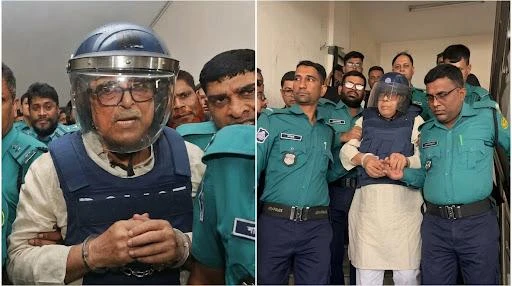
Justice loses its meaning when a court becomes a tool for political retaliation. Bangladesh’s International Crimes Tribunal (ICT), established to prosecute some of the gravest international crimes, now faces serious questions about its role in cases arising from the July 2024 movement. The trials of veteran politicians Rashed Khan Menon and Advocate Md Kamrul Islam raise concerns about the reliability of evidence, the fairness of proceedings, and the political forces that may influence the pursuit of accountability.
These concerns must be examined carefully. Those responsible for crimes must face justice, regardless of their political affiliation. But an accusation is not proof of guilt, and no political change can justify abandoning the principles of a fair trial.
Does the Tribunal Have a Legitimate Basis for These Trials?
The legitimacy of the ICT depends on its legal mandate, the quality of its evidence, and its independence from political pressure. The tribunal was established to prosecute genocide, crimes against humanity, war crimes, and other offences specified under its governing law. Its use in cases connected to the July movement must therefore satisfy the applicable legal requirements.
The deaths and injuries that occurred during the July movement deserve impartial investigation. Victims and their families have a right to truth and accountability. However, the demand for justice cannot justify placing responsibility on individuals without reliable evidence connecting them to the alleged crimes.
The cases against Rashed Khan Menon and Advocate Md Kamrul Islam raise a fundamental question: are the allegations supported by credible evidence, or are ordinary criminal allegations being presented in a way that does not adequately establish the tribunal’s jurisdiction?
The distinction matters. The seriousness of an allegation cannot substitute for proof of the elements of an offence within the tribunal’s jurisdiction. Nor should the ICT become a convenient forum for prosecuting political opponents simply because the accused once held positions of power.
The Obaidul Case: Questions That Demand Answers
Information provided in connection with the case raises particular questions about the death of a man identified as Obaidul, who is reportedly being presented as a victim of the July movement.
According to sources of different newspapers, Obaidul was injured in a motorcycle accident on 5 August 2024 and received treatment at Dhaka Medical College Hospital. He reportedly died on the night of 13 August. The account further alleges that he was returning after looting on 5 August when the accident occurred.
His sister has reportedly testified before the ICT, identifying her brother as a martyr of the July movement and giving evidence against Menon and Kamrul Islam.
If these details are accurate, they demand careful scrutiny. The date, circumstances, and medical cause of Obaidul’s death should be established through hospital records, medical evidence, contemporaneous news reports, and other admissible material. His sister’s testimony must also be assessed fairly, alongside any contradictory evidence.
A witness’s account should neither be accepted uncritically nor dismissed because of the witness’s relationship to the deceased. The court must examine what the evidence actually establishes.
If reliable records show that Obaidul died from injuries sustained in a motorcycle accident, the prosecution must explain how that death is legally connected to the alleged crimes and what evidence links the accused to those crimes. If the evidence contradicts the prosecution’s account, the contradiction must be addressed openly.
The defence must have a meaningful opportunity to challenge the testimony, question witnesses, and present relevant evidence. If the prosecution’s case depends on a materially inaccurate account of the circumstances of death, that is a serious issue for the court to resolve.
These questions cannot be settled through political statements or social media claims. They require documentary evidence and judicial scrutiny.
Fair Trial Is Not Optional: Justice Must Be Seen to Be Fair
Menon and Kamrul Islam are entitled to the same legal protections as any other accused person. Reports that Kamrul Islam has cancer and that Menon is over 80 also raise concerns about access to appropriate medical care and humane treatment in custody, where applicable.
Age, illness, and political history do not automatically exempt anyone from prosecution. Equally, they cannot be ignored when determining detention conditions, access to treatment, and the practical ability to participate in a trial.
A fair trial requires an independent and impartial court, adequate time and facilities for the defence, the opportunity to challenge prosecution evidence, and a reasoned judgment based on the evidence and applicable law. The prosecution must establish guilt according to the governing standard of proof.
The presumption of innocence is not a technical obstacle to justice. It is one of the safeguards that separates a court of law from a political tribunal.
When Accountability Becomes Retaliation
Both Rashed Khan Menon and Kamrul Islam played important roles in Bangladesh’s political history, including, according to their public records, roles connected to the country’s earlier war-crimes proceedings. Their political positions and past involvement may help explain why their prosecutions have become politically contentious. Nevertheless, allegations of political retaliation deserve serious examination, especially when prosecutions appear to rely on disputed facts or when the accused’s right to defend themselves is compromised.
Islamist and anti-Liberation War forces must not be allowed to turn the criminal justice system into an instrument for settling ideological scores. But the answer is not to presume that every prosecution is politically motivated. The answer is to demand transparent proceedings, verifiable evidence, and equal treatment under the law.
If a prosecution is built on unreliable evidence, if material contradictions are ignored, or if the tribunal is used to punish political opponents, its legitimacy will suffer. That conclusion must follow from the evidence, not from political allegiance.
Justice Must Never Become Revenge
Bangladesh needs accountability for deaths and abuses. Victims deserve justice, and those responsible for serious crimes must be held accountable. But justice cannot be measured by the number of political opponents convicted, nor can allegations be treated as established facts before the evidence is properly tested.
The proceedings against Rashed Khan Menon and Advocate Md. Kamrul Islam should therefore be judged on the evidence, the legality of the charges, the tribunal’s independence, and the fairness of the trial. Questions surrounding Obaidul’s death, if supported by credible evidence, must be addressed. If the evidence fails to establish guilt, the court must act accordingly. If it establishes criminal responsibility, the law must take its course.
A tribunal established to deliver accountability must not become a vehicle for political revenge. Justice must be impartial, evidence-based, and fair to every accused person. Otherwise, the pursuit of justice risks becoming another form of injustice.
Author Parvez Hashem, Lawyer and Human Rights Defender


COMMENTS