
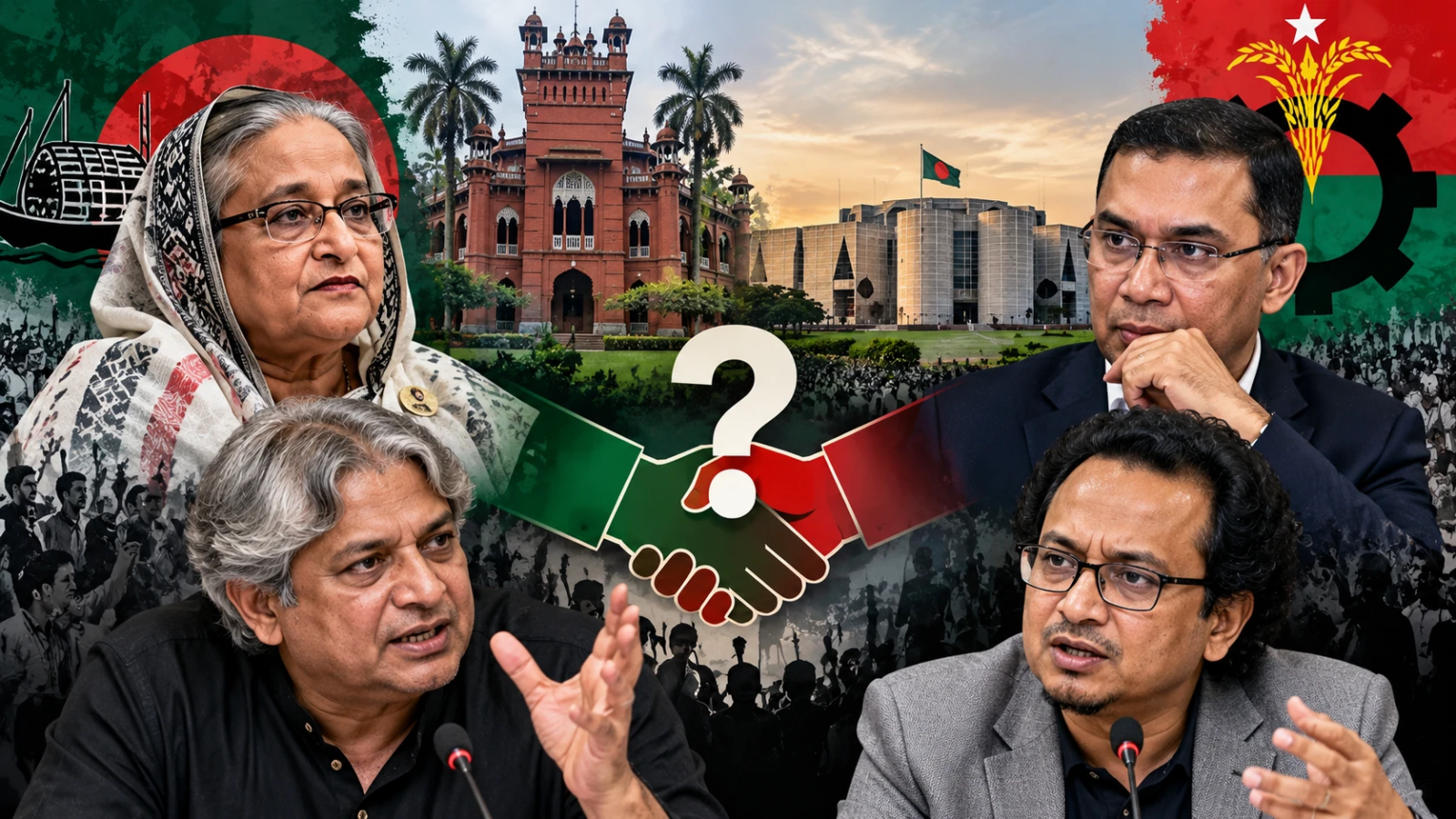
Is political reconciliation between the Bangladesh Nationalist Party (BNP) government and the Awami League, whose political activities are currently banned, possible in the near future, or is the idea merely political rhetoric? The question has triggered intense debate across Bangladesh’s political landscape following contrasting statements by senior government figures and representatives of the Awami League.
The debate came to the fore after Dr Zahed Ur Rahman, Information Adviser to Prime Minister Tarique Rahman, said at an event in Dhaka on October 6 that political reconciliation with the Awami League was not impossible.
“Many people in the country still support the Awami League. They are citizens of Bangladesh. Initiating reconciliation with active Awami League members and supporters is not a bad idea; in fact, such an initiative would be welcome,” he said. However, he stressed that the fundamental basis for reconciliation would have to be established before any meaningful process could begin.
Zahed said that anyone interested in facilitating reconciliation should contact the Awami League and engage its senior leadership to establish the basic conditions for dialogue. If those conditions could be agreed upon, he said, further discussions would be possible.
He cautioned that merely opening discussions would not be enough. The parties would need to clarify the essential conditions for reconciliation and their respective positions. If the Awami League demonstrated a willingness to address these issues, a dialogue could follow.
“For reconciliation to succeed, the Awami League must take the initiative first. The party must acknowledge its responsibility,” he added.
However, Mohammad Ali Arafat, a former state minister for information in the previous Awami League government, directly rejected the proposal.
Describing the idea of reconciliation as a possible tactic by those he characterised as conspirators, Arafat argued that it ran counter to both the democratic rights of the people and the pursuit of justice.
In a post on X, formerly Twitter, he wrote: “Who told them that the Awami League wants reconciliation? The Awami League does not want any kind of reconciliation. We only want democracy restored to the people so that they can exercise their voting rights and choose their own government, rather than leaving the country’s administration in the hands of individuals who seized power illegally and subsequently held unilateral and manipulated elections.”
He also called for an independent judiciary capable of ensuring justice for everyone, regardless of political affiliation or involvement. The party’s objective, he said, was to restore the democratic rights of the people, enabling Bangladesh to return to a path of peace, stability and development.
“Under the present circumstances, both democracy and justice have been taken hostage, and the state has fallen under the control of a group of individuals,” Arafat added.
The debate has also revealed contrasting positions within the government. On October 5, Deputy Speaker of the Jatiya Sangsad Kayser Kamal expressed a position directly opposed to Zahed’s more conciliatory remarks, declaring that there was no scope for political reconciliation with the banned Awami League.
Speaking at the closing-day session of the Bay of Bengal Conversation 2026, organised by the Centre for Governance Studies at the Pan Pacific Sonargaon Hotel in Dhaka, Kamal said that the political future of Awami League leaders was a separate matter from the question of accountability for violence allegedly committed through the use of state institutions.
He argued that the Awami League had used state institutions and affiliated organisations to perpetrate violence against the people. Those involved, he said, must be brought to justice.
According to Kamal, the purpose of accountability should extend beyond punishment. It should also establish a precedent strong enough to deter any future attempt to restore authoritarian rule in Bangladesh.
Referring to Awami League leaders living abroad, he said that many had yet to express remorse. They, too, should face justice, and political reconciliation must not provide a means of granting them immunity from accountability.
Yet, during the same session, most of the participating academics and researchers from Bangladesh, South Africa, Cambodia, India and Nepal emphasised the importance of justice, accountability and reconciliation.
They argued that while prosecuting crimes was essential, reconciliation was equally necessary to prevent society from remaining deeply divided. In Bangladesh, they said, accountability was important for crimes committed during the Liberation War, violence in the Chittagong Hill Tracts and offences committed during the July Mass Uprising. At the same time, a broader process of reconciliation was needed to address divisions and rebuild social trust.
Pramod Jaiswal, research director at the Nepal Institute for International Cooperation and Engagement, argued that justice was indispensable but warned that, without reconciliation, society could remain deeply polarised.
Jaiswal stressed that accountability must be distinguished from revenge. Across much of South Asia, he observed, the two concepts are often conflated. Reconciliation does not mean reaching complete agreement about the past, nor does it require forgetting or forgiving serious injustices and crimes.
Rather, he explained, reconciliation involves creating an environment in which individuals and communities can coexist with dignity, acknowledge historical grievances and rebuild mutual trust in public institutions.
Madalitso Zililo Phiri, a researcher at South Africa’s University of the Witwatersrand, referred to his country’s Truth and Reconciliation Commission as an important part of the effort to envision a new society. Although the initiative attracted substantial criticism, particularly because liberal institutions and democratic arrangements failed to fulfil every promise of equality, it nevertheless formed part of South Africa’s attempt to confront its past and establish a new political order.
Nikki Singer, executive director of Cambodia’s Centre for Peace and Conflict Studies, highlighted the experience of Cambodia, a country devastated by civil war. She noted that reconciliation efforts had begun before 1991 and that, in 1998, a national reconciliation initiative included the reintegration and disarmament of Khmer Rouge fighters.
These international experiences illustrate that reconciliation is rarely a simple or immediate process. It requires sustained engagement, a willingness to confront past abuses and credible mechanisms for accountability. They also demonstrate that the relationship between justice and reconciliation remains complex, particularly in societies emerging from periods of political violence and deep division.
Against this backdrop, reconciliation between the BNP government and the Awami League may appear difficult under current circumstances. Nevertheless, many politically aware citizens believe that a credible process of reconciliation is important in the broader interests of the country and its people. In their view, the sooner the two sides can establish a lawful and constructive framework for addressing their differences, the better the prospects for political stability and democratic consolidation.
Those advocating reconciliation argue that the government should take the initiative with an open mind. They point out that the Awami League is one of Bangladesh’s oldest and historically largest political parties and has governed the country on six occasions. They therefore call for the lifting of the ban on its political activities and the organisation of a free, fair, impartial and credible election in which all eligible political parties can participate.
They also emphasise that former Prime Minister and Awami League President Sheikh Hasina should be guaranteed a fair trial in accordance with the law if she returns to Bangladesh. Similarly, they call for an end to arbitrary arrests, attacks and politically motivated legal cases against Awami League leaders, activists and supporters, alongside the establishment of a level playing field for all political parties.
Another demand is the immediate release of political detainees held without a lawful basis and the protection of due process for everyone facing criminal proceedings.
However, such proposals remain contentious. The government’s emphasis on acknowledgment of wrongdoing and accountability contrasts with the Awami League’s stated demand for the restoration of democratic rights and its rejection of the current reconciliation proposal. Meanwhile, the continuing ban on the party’s political activities raises fundamental questions about political inclusion, legal accountability and the conditions under which competitive democracy can function.
Any meaningful reconciliation process would therefore require more than statements of goodwill. It would need clearly defined principles, credible dialogue, respect for judicial independence, accountability for proven crimes and safeguards against future abuses of state power. It would also need to distinguish individual criminal responsibility from the political rights of citizens who support a particular party.
The central question is whether the BNP government and the Awami League can move beyond their sharply conflicting positions to identify common ground on these issues.
For now, the prospect of an early breakthrough remains uncertain. Whether reconciliation becomes a substantive political process or remains an aspiration will depend on the willingness of both sides to engage in credible dialogue, respect the rule of law and address the unresolved questions of justice, accountability and political participation that continue to divide Bangladesh.


COMMENTS