
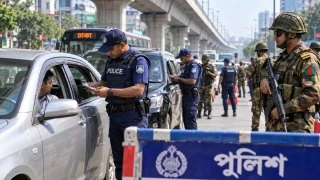
Bangladesh has stepped up nationwide security operations ahead of December, when former prime minister and Awami League president Sheikh Hasina has said she plans to return to the country.
Police officials say the heightened operations are aimed at preventing possible political violence and disorder. According to police headquarters, around 53,000 people were arrested across the country over the past month, with a large proportion allegedly linked to the Awami League and its affiliated organisations.
Nearly 10,000 people were arrested during the first six days of the current month, police said. In Dhaka, authorities are taking an average of around 500 people into custody each day. On Wednesday, the Dhaka Metropolitan Police (DMP) reported 465 arrests.
Police sources said the authorities have prepared lists of people suspected of conducting political activities while in hiding and plan to arrest them before December. Cyber police units are also monitoring social media for what authorities describe as rumours and inflammatory content.
Several Awami League leaders and activists have recently been arrested in different parts of the country, including leaders from Manikganj, Panchagarh, Bhola, Sirajganj, Kishoreganj, Rajshahi and Dhaka.
Hasina’s return sparks political debate
Sheikh Hasina announced in August and again in September that she intended to return to Bangladesh by December. Her statements have triggered differing interpretations among political analysts.
Some analysts believe the announcement could be intended primarily to boost the morale of Awami League supporters, given the legal and arrest risks she could face upon returning. They also argue that any return could depend on diplomatic engagement involving India and the international community.
Others believe India may be seeking a new political arrangement that would allow Hasina to return under guarantees concerning her security and legal status, including possible assurances relating to the enforcement of a death sentence.
Journalist and political analyst Masud Kamal said Hasina’s announcement should not be viewed merely as a psychological tactic. He said the desire for political rehabilitation and the possibility of returning to Bangladesh permanently could also be driving the former prime minister.
At the same time, he warned that if leaders currently in hiding suddenly mobilise supporters at a critical moment, a large-scale security operation alone may not be sufficient to contain the situation.
The scale of the arrests has also raised concerns about pressure on Bangladesh’s already overcrowded prison system.
People familiar with the situation say the country’s prisons have a combined capacity of around 45,000, while the average number of inmates is close to 100,000.
Crime expert Dr Touhidul Haque warned that a return by Hasina without a political settlement, followed by attempts to forcibly prevent her from returning, could trigger political violence.
He said the authorities should rely on specific intelligence to identify and prosecute key instigators rather than resorting to indiscriminate mass arrests.
Dhaka police warn against unrest
A senior additional inspector general at police headquarters said authorities had identified people allegedly running party activities from hiding and planned to arrest them before December.
DMP Commissioner Mosleh Uddin Ahmed said no attempt to create disorder or disrupt public life in the capital around December would be tolerated.
At a press conference at the DMP Media Centre on Wednesday, Dhaka Metropolitan Detective Branch chief and Additional Police Commissioner Md Shafiqul Islam said law enforcement agencies were on maximum alert to prevent any untoward incident.
He said authorities would not allow any political party whose activities have been banned to regain momentum.




COMMENTS