
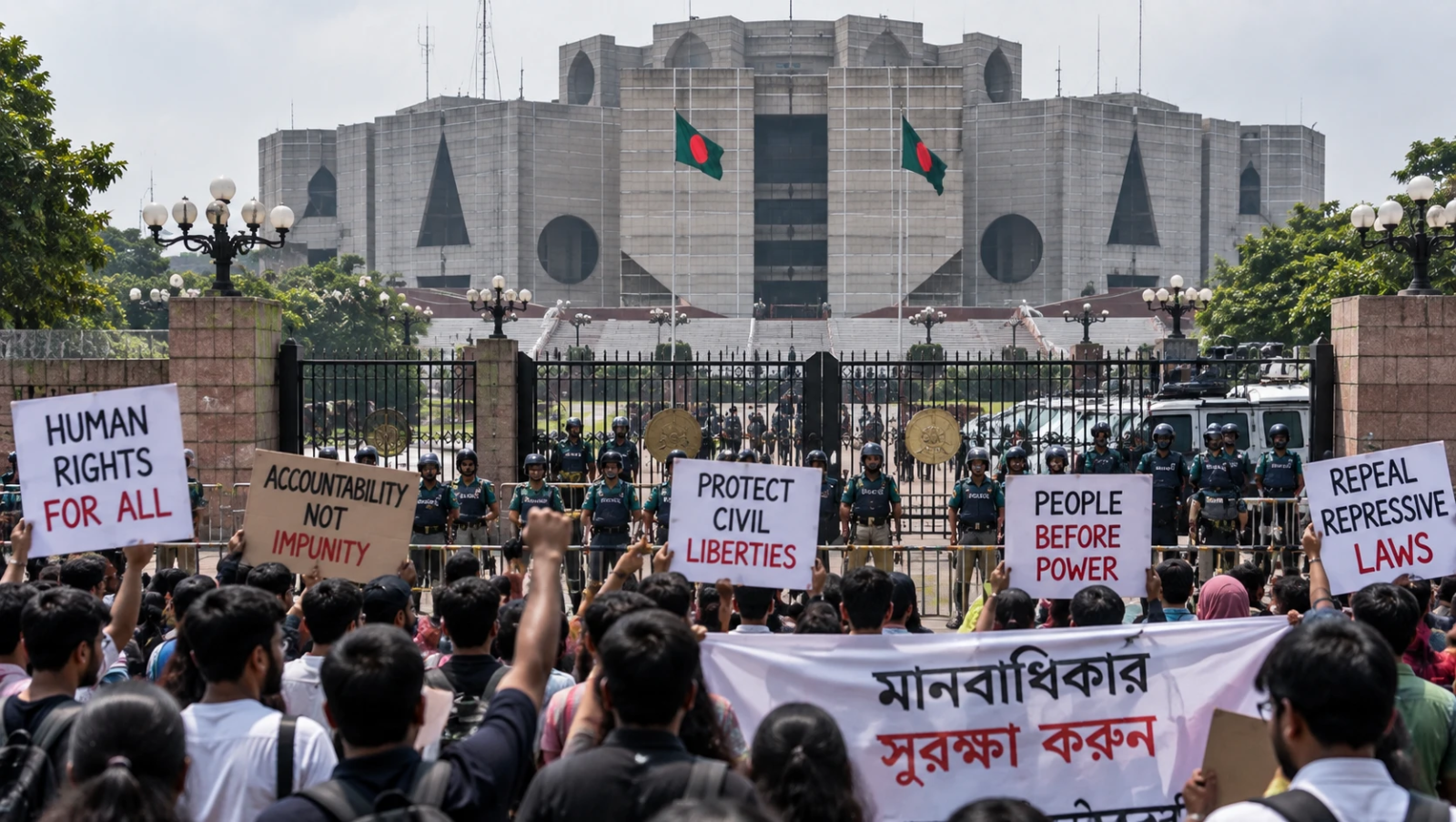
DHAKA — Three laws passed by Bangladesh’s parliament in September have weakened human rights protections and reversed reform measures introduced by the interim government, Human Rights Watch (HRW) said in a statement.
The international rights organisation said the legislation has reduced safeguards intended to prevent a return to abuses including enforced disappearances and extrajudicial killings.
According to HRW, the interim government, which governed Bangladesh from August 2024 to February 2026, had introduced ordinances aimed at strengthening the National Human Rights Commission (NHRC) and improving mechanisms to prevent and investigate enforced disappearances.
After the election of the Bangladesh Nationalist Party (BNP)-led government under Prime Minister Tarique Rahman, parliament instead passed legislation that HRW says has curtailed the NHRC’s independence and investigative authority.
A new NHRC law, passed on September 6 following a walkout by opposition lawmakers, does not explicitly give the commission authority to directly investigate alleged human rights violations by security forces. Under the legislation, the commission generally has to seek a report from the agency concerned, although HRW noted that a provision could allow an inquiry if the response is inadequate or not provided.
HRW also said the new law restores greater government influence over the appointment of commissioners and reduces the commission’s administrative and financial independence.
Another law, the Enforced Disappearance Prevention and Redress Act, passed on September 6, also reverses several safeguards contained in an earlier interim-government ordinance. Under the new framework, allegations of enforced disappearance are to be investigated by a security agency other than the one implicated, while powers previously given to the NHRC to inspect and investigate detention facilities have been removed.
The third measure, the Special Response Battalion Act, was passed on September 10. The law replaces the Rapid Action Battalion (RAB) with the Special Response Battalion (SRB).
HRW said the new force retains RAB personnel, powers and property, including records, and began operating on September 16. The organisation said the law does not provide adequate safeguards concerning training, independent oversight or accountability.
Elaine Pearson, HRW’s Asia director, said Bangladesh needs genuine security-sector reform and an independent human rights body capable of investigating allegations of abuse.
HRW has also urged Bangladesh’s international partners, including the United States, European Union and United Kingdom, to raise concerns over the government’s human rights policies. It called on Washington to maintain sanctions against the renamed security force until adequate safeguards and accountability mechanisms are established.
HRW said widespread abuses—including enforced disappearances, extrajudicial killings, arbitrary arrests and excessive use of force against protesters—occurred during Sheikh Hasina’s rule from 2009 to 2024. The organisation acknowledged that killings and disappearances have declined under the current government but alleged that hundreds of perceived political opponents remain in arbitrary detention.
The government’s legislation and HRW’s assessment reflect an ongoing dispute over how Bangladesh should structure its human rights institutions and security forces following the political transition of 2024–26.

COMMENTS