
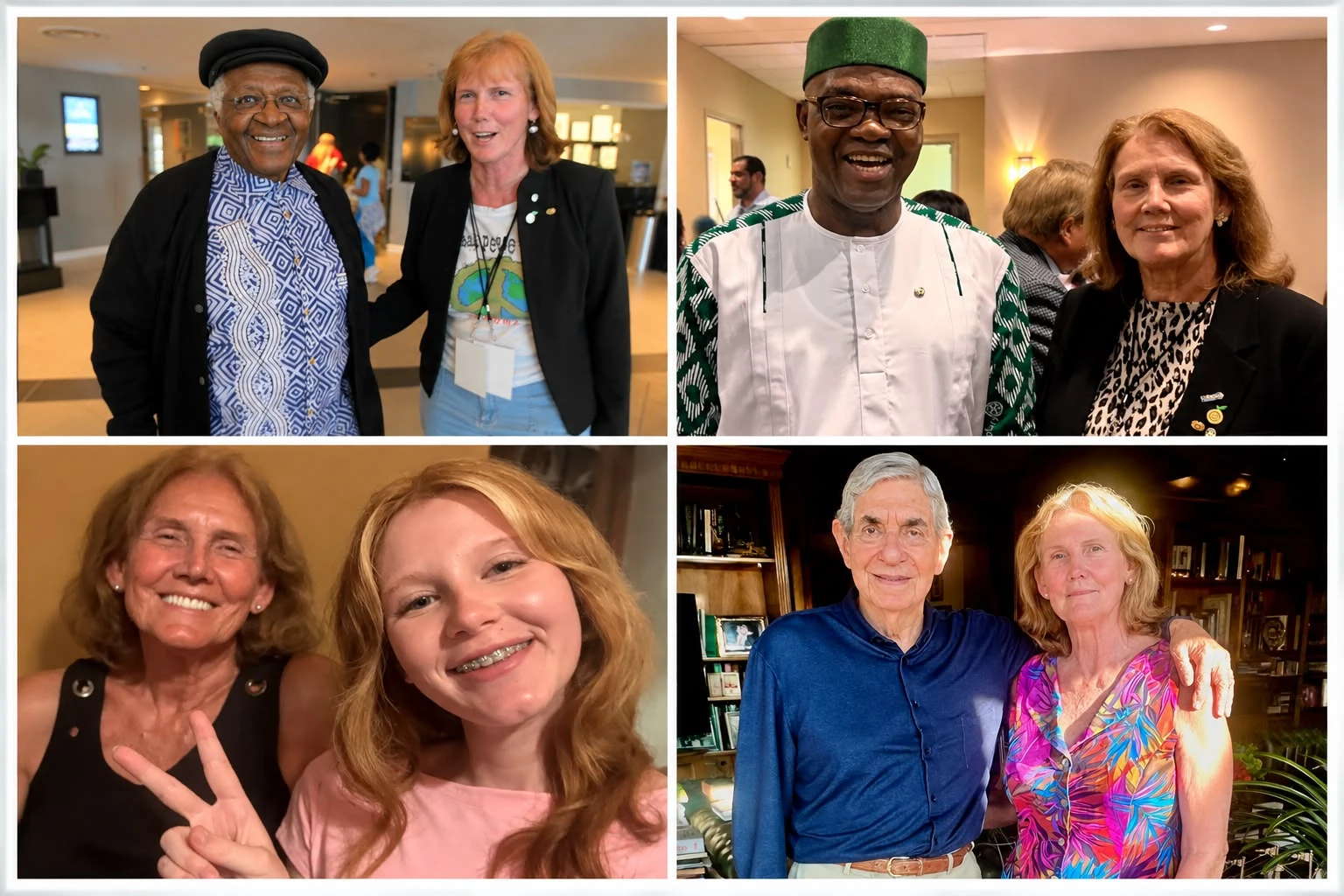
Sue Thompson, an American humanitarian, photographer, fine artist and peace advocate based in Orlando, Florida, has devoted much of her life to advancing peace, human rights, human dignity and dialogue across cultures and communities. She is the Founder and Chairperson of the Global Peace Network and the Charter President of the Rotary IMPACT Club of Orlando. Through photography, art, humanitarian initiatives and international peace-building efforts, she has sought to create connections among people who might otherwise never meet, with a particular emphasis on children and the belief that ordinary citizens can play a meaningful role in building a more peaceful world.
Her work has taken her to more than 40 countries and into some of the world’s most difficult environments, including conflict zones, refugee camps and communities affected by poverty and political violence. Yet, as she explains in this conversation, what has stayed with her most deeply are not the places themselves, but the people she encountered there—their faces, their stories, their resilience and, above all, their children.
Parvez Hashem, on behalf of The Voice, spoke with Sue Thompson at the Peace Farm in Orlando, Florida, on September 21, 2026, the United Nations International Day of Peace.
Parvez Hashem: Sue, tell us a little about yourself and the journey that brought you to this work.
Sue Thompson: I am an Orlando girl, born and raised here, but somehow the world gradually became my backyard. I grew up in a migrant farmworker family, and when I was young I certainly did not imagine that I would one day travel around the world, become a humanitarian photographer or work on issues of peace and human rights. Life simply took me in that direction. Photography initially gave me a reason to travel and to enter places and communities that were unfamiliar to me, but it was the people I met who ultimately gave me a reason to stay engaged.
Over the years, I have photographed and worked in more than 40 countries. I have been in Tunisia during the Arab Spring, in the West Bank and Bethlehem, in the Zaatari Syrian refugee camp in Jordan, at Standing Rock, in Selma, in Haiti and inside Saddam Hussein’s former secret prison in Iraq. These experiences exposed me to very different cultures and circumstances, including conflict, displacement, poverty and political struggle. But when I look back now, I do not remember the places as much as I remember the faces. I remember the children, their expressions, their curiosity and their hopes. I have often said that Orlando may be my birthplace, but the rest of the world is my backyard—and all the children are mine. That feeling has become an important part of the way I understand both humanitarian work and peace.
Parvez: How has photography shaped the way you see people and the world?
Sue Thompson: A camera can create a wall between you and another person, but it can also become a bridge, and for me it became a bridge. When you photograph someone, particularly someone whose life circumstances are very different from your own, you have a responsibility to really see that person. You cannot simply see a refugee, a Muslim, a Christian, a Jew, someone who is rich or poor, or someone who comes from another country. Before all of those descriptions, there is a human being with a life, a family, a history, fears, hopes and dreams.
There were many occasions when I did not speak the same language as the person I was photographing. Yet communication does not always begin with words. You can smile, look someone in the eye, sit beside them and listen. Sometimes those simple gestures are enough to establish the beginning of a relationship. Photography taught me that seeing another person with genuine attention can be an act of respect, and that lesson has influenced almost everything I believe about peace. When people are given the opportunity to see one another as human beings rather than as categories or labels, the distance between them can begin to disappear.
Parvez: What does peace mean to you personally?
Sue Thompson: Peace is a very big word, but I think we sometimes make it unnecessarily complicated. Of course, peace means stopping wars and ending violence and hatred, but peace also begins much closer to home. It can begin with something as simple as an act of human kindness or even a smile. It means listening to someone with whom you disagree rather than immediately trying to silence them. It means sitting down with another person instead of shouting across a room. It means teaching children that someone who looks different, worships differently or comes from another country is not automatically their enemy.
I believe we need to develop what I would call a vocabulary of peace. We need to use the words, teach the words and, most importantly, practise them in our everyday lives. Peace is not something that belongs exclusively to presidents, diplomats or international organisations. Those institutions have important responsibilities, particularly when it comes to resolving conflicts between states, but ordinary people also create peace every day through the choices they make, the relationships they build and the way they treat people who are different from themselves. In that sense, peace is not only an international objective; it is also a daily human practice.
Parvez: You founded the Rotary IMPACT Club of Orlando and have made peace central to its work. Why Rotary?
Sue Thompson: Rotary gave me a vehicle through which ideas could become action. It is an international organisation that connects people across cultures, religions, nationalities and political boundaries, and promoting peace is one of Rotary’s major areas of focus. That international character makes it particularly meaningful to me because the challenges facing humanity rarely stop at national borders. Our Rotary IMPACT Club of Orlando works around a simple philosophy: “Local Hands ~ Global Reach.” The idea is that something we do with a child in Orlando today can create a connection with another child halfway around the world tomorrow.
Our Peace Fans project is a good example. We invite children to think about what peace means to them and then express their ideas by writing or drawing on a fan. Adults spend an enormous amount of time telling children what the world is, what they should fear and what divides people. Sometimes I think we should stop and ask children what kind of world they want. Their answers can be surprisingly simple and remarkably universal. They want to feel safe, they want to be loved, they want their families to be well and they want to have the freedom to imagine a future. Those basic aspirations can become a powerful foundation for conversations about peace.
Parvez: Tell us about “Coming Together for PEACE” and the 24 Hours for PEACE initiative.
Sue Thompson: This was our first year, so in many ways we were beginning something rather than presenting a finished model. The idea behind “24 Hours for PEACE” was very simple: on the United Nations International Day of Peace, could we connect people around the world in one continuous conversation about peace? We invited Rotary clubs, families, children, peace advocates and friends from different countries to join us through Zoom. They did not have to prepare a speech or make a formal presentation. They could simply come online and say, “Hello. We are here. We stand for peace.” It could be ten minutes, five minutes or even one minute. What mattered most was the connection.
Here at our Peace Farm gathering in Central Florida, children created Peace Fans and Peace Rocks, families made art, there was music and a range of activities, and people were able to come together physically while the online programme connected them with people around the world. For me, the success of the initiative was never going to be measured simply by the number of famous people who participated. The children would make it successful for me. If one child in Orlando comes to understand that somewhere in Nepal, Ethiopia, England, Jordan or another part of the world there is another child who wants exactly the same fundamental things—to be safe, to be loved and to be able to dream—then we have achieved something meaningful. That recognition of our shared humanity is where a culture of peace can begin.
Parvez: You recently met Nobel Peace Laureate and former Costa Rican President Óscar Arias. What did that experience mean to you?
Sue Thompson: Meeting President Óscar Arias was a very special experience for me. Here is a man who received the Nobel Peace Prize because he was willing to continue working for peace at a time when Central America was surrounded by conflict. I had the opportunity to sit with him in Costa Rica, speak with him and photograph him, and he later agreed to serve as our Guest of Honor for “Coming Together for PEACE.”
What impressed me most was that peace was not an abstract word in his life. There were decisions behind it, courage behind it and persistence behind it. That is something I think we sometimes forget. Peace does not mean passivity, nor does it mean simply wishing that conflict would disappear. Working for peace can require tremendous courage, persistence and a willingness to continue talking when dialogue is difficult. The people who work for peace often have to confront very complicated realities, and that requires more than good intentions.
Parvez: You have witnessed poverty, conflict, refugees, injustice and human suffering in many parts of the world. How do human rights fit into your understanding of peace?
Sue Thompson: I do not believe you can separate peace from human dignity. You cannot tell someone to live peacefully while denying that person food, education, safety, freedom or basic human rights. Peace cannot simply mean the absence of open violence while people continue to live without dignity or opportunity. If we want sustainable peace, we have to address the conditions that allow people to feel excluded, dehumanised or permanently vulnerable.
I have photographed people in circumstances where it would have been very easy to see only their suffering. But people are always more than what has happened to them. A refugee is a mother, a father, a child, a teacher, a farmer or a professional whose life has been disrupted. A child living in poverty is still a child with imagination, curiosity and dreams. Someone on the other side of a conflict has a family, a personal history and a story that deserves to be heard. That is why photography and storytelling matter so much to me. When we genuinely see one another, it becomes much harder to dehumanise one another, and dehumanisation is where so much violence begins.
Parvez: After everything you have seen, what still gives you hope?
Sue Thompson: Children. Absolutely children. I have seen terrible things, but I have also witnessed extraordinary acts of kindness. I have watched complete strangers help one another, and I have seen people who had almost nothing share what little they possessed with someone else. I have watched children from completely different backgrounds sit down together and start drawing. They do not begin by asking each other about politics, religion, nationality or ideology. They begin by playing, creating and discovering one another. That gives me hope.
I am 74 years old now, and I do not think my responsibility is to solve every problem in the world. My responsibility is to do whatever I can with the time I have. That may mean making a connection, taking a photograph, telling a story, bringing together two people who might otherwise never have met, or giving a child a Peace Fan and asking, “What does peace look like to you?” These may seem like small things in comparison with the enormous conflicts confronting the world, but meaningful change often begins with small human connections. If we can remind people that peace does not necessarily have to begin somewhere far away, with governments or international institutions, perhaps we can also remind ourselves that peace can begin right here, with us.
COMMENTS