
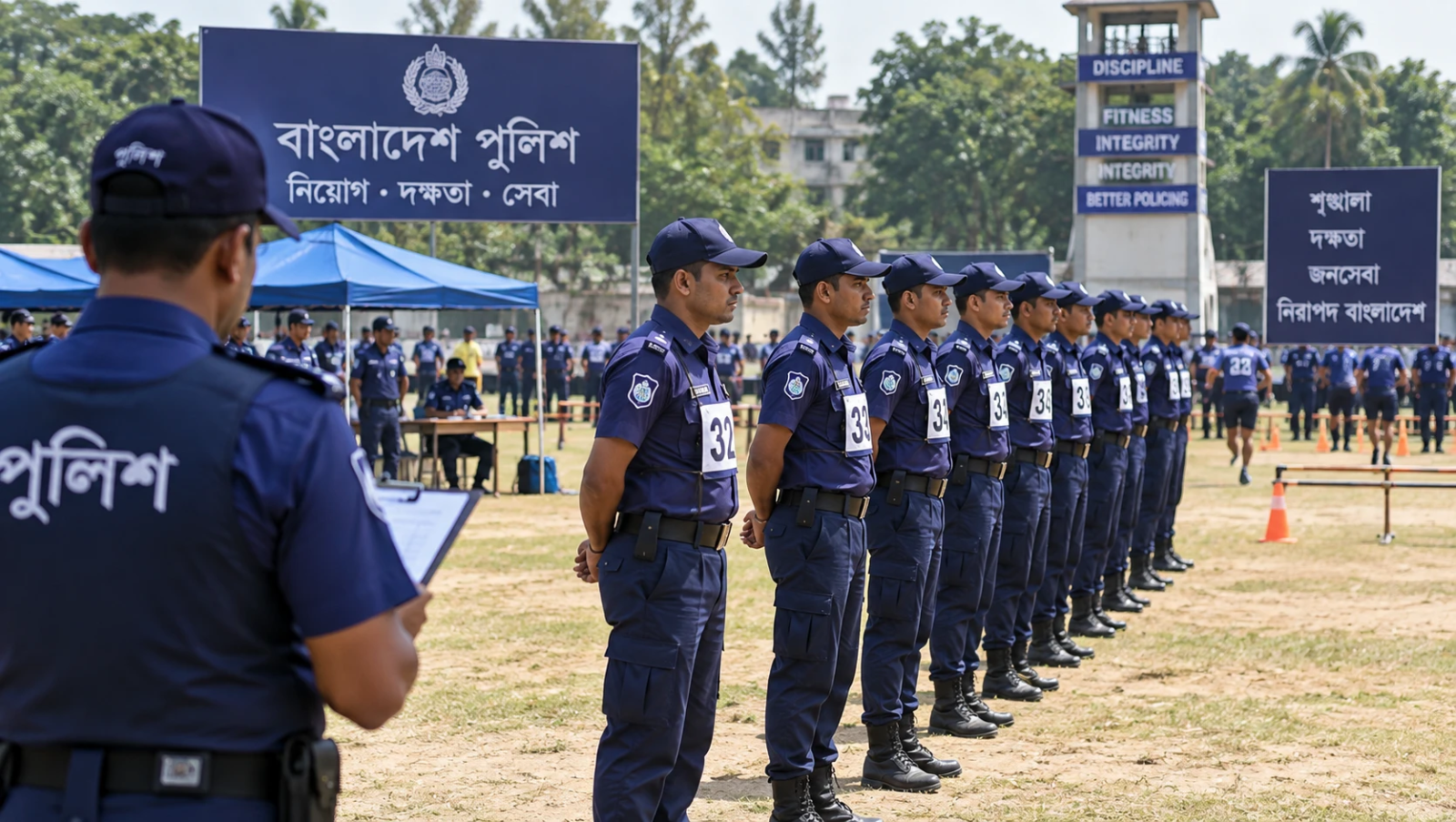
Allegations of opaque examination procedures and demands for Tk 15–18 lakh from candidates have raised questions over the recruitment of 4,000 Assistant Sub-Inspectors, while serving constables question the future of departmental promotion.
The recruitment of thousands of Assistant Sub-Inspectors (ASIs) in Bangladesh Police has come under scrutiny amid allegations of irregularities in the selection process and concerns among more than 200,000 serving constables over their prospects for departmental promotion.
The government approved the creation of 4,000 temporary unarmed ASI posts as part of an effort to strengthen the operational capacity of Bangladesh Police. Official statements indicate that the positions were to be filled through a combination of direct recruitment and promotion from within the force, with 2,000 posts allocated for direct recruitment and the remaining 2,000 for departmental promotion.
However, the recruitment process has generated concern among serving constables who traditionally regard departmental examinations and promotion as an established pathway to the ASI rank.
For years, constables have formed the largest field-level workforce of Bangladesh Police. Their career progression can include promotion to ASI and subsequently to Sub-Inspector and, in some cases, Inspector and Officer-in-Charge positions, subject to applicable rules, qualifications and performance.
The current recruitment exercise has therefore raised a broader question inside the force: how will direct recruitment be balanced with the career progression of personnel who have already spent years serving in the police?
Allegations over recruitment process
According to allegations made in connection with the recruitment process, candidates initially went through document verification and physical fitness tests under recruitment boards headed by district police superintendents.
Candidates who passed those stages were subsequently allowed to sit for written examinations conducted through the country’s eight police ranges.
The allegations claim that, after the written examinations, candidates were asked to sign blank portions of result sheets before the results were announced.
Candidates were reportedly also told that the written examination results and subsequent viva voce process would be handled at Police Headquarters.
If verified, such a procedure could raise significant questions regarding the chain of custody of examination records, result preparation and accountability in the selection process.
The claims, however, have not been independently established through publicly available official records.
Alleged financial transactions
The most serious allegation concerns claims that candidates are being asked to pay between Tk 15 lakh and Tk 18 lakh to secure appointments as ASIs.
Those making the allegations claim that certain officials are attempting to exercise control over the recruitment process and facilitate appointments through financial transactions.
The allegations have not been independently verified, and no evidence establishing the involvement of specific senior government or police officials in such transactions has been established.
The claims therefore warrant scrutiny by the appropriate authorities rather than being treated as established facts.
If such payments were allegedly sought from candidates for all 4,000 positions, the theoretical amount would range from Tk 600 crore to Tk 720 crore. However, official plans indicate that only 2,000 of the 4,000 positions were designated for direct recruitment, meaning any calculation based on all 4,000 posts would require qualification.
Why constables are concerned
For serving constables, however, the issue extends beyond the current recruitment process.
More than 200,000 constables have spent years performing frontline policing duties, often under demanding conditions. Many expect to progress through departmental examinations based on their experience, discipline, performance and qualifications.
The expansion of direct recruitment has consequently created anxiety among some personnel who fear that their established pathway to promotion could become increasingly limited.
The concern is not necessarily over the recruitment of new personnel itself, but over whether serving members of the force are being given a fair and meaningful opportunity to advance through departmental promotion.
A recruitment system that combines direct entry with internal promotion therefore requires clear rules, transparent selection criteria and equal accountability at every stage.
Transparency becomes the central question
The central issue is now whether the ASI recruitment process can demonstrate that every appointment is being made through a transparent, merit-based and verifiable procedure.
Several measures could help address the concerns: publication of written examination results, preservation and disclosure of relevant recruitment-board records, clear documentation of selection criteria and an auditable procedure for the viva voce examination.
Any formal allegation of bribery or financial transactions should also be investigated independently, with evidence examined by the competent authorities.
The issue is particularly sensitive because Bangladesh Police is a critical state institution whose effectiveness depends not only on manpower but also on internal discipline, professional confidence and public trust.
For serving constables, the question is equally personal and institutional: after years of field service, what role will departmental experience and performance play in determining their career progression?
And for the public, the larger question is whether the recruitment of thousands of police officers can be conducted in a manner that is demonstrably transparent, accountable and free from financial influence.
An independent review of the allegations, together with transparent publication of examination results and recruitment records, would provide a clearer basis for determining whether the concerns surrounding the ASI recruitment process are justified.



COMMENTS