
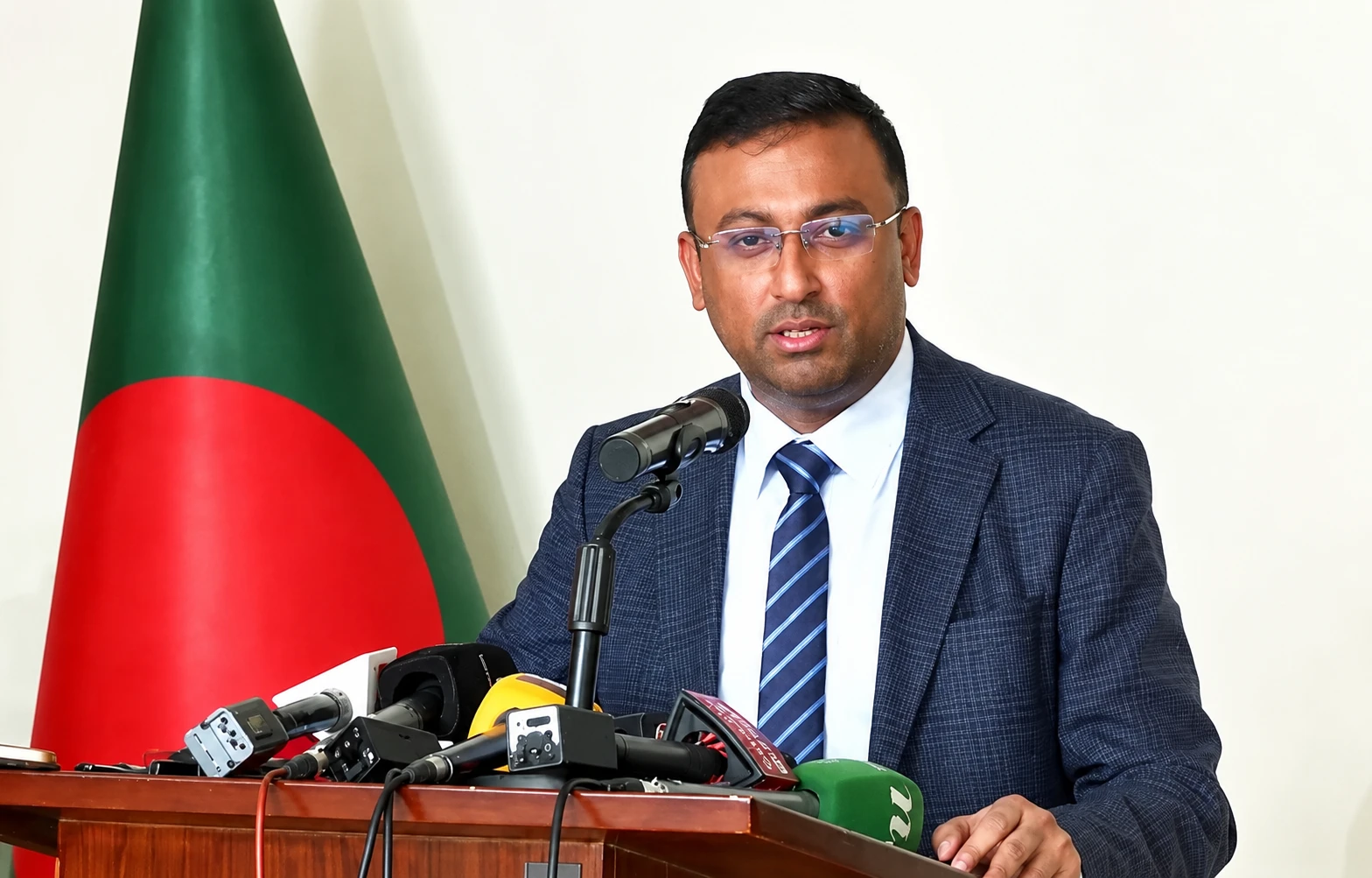
After nearly two years of strained relations following Sheikh Hasina’s ouster on August 5, 2024, Dhaka now signals a renewed push to rebuild ties with New Delhi through direct bilateral engagement.
Bangladesh is signalling a significant shift in its approach towards India, with State Minister for Foreign Affairs Humaiyun Kabir saying Dhaka wants to “reset” and rebuild the bilateral relationship after a period of sharp deterioration following Sheikh Hasina’s fall from power on August 5, 2024.
The change is noteworthy because Bangladesh-India relations had, in fact, strengthened considerably during the previous 15 years under the Awami League government led by Sheikh Hasina. Despite disagreements over issues such as water sharing, border management and trade, the two countries developed extensive political, economic and security cooperation during that period.
The relationship began to change dramatically after August 5, 2024, when Sheikh Hasina left Bangladesh following the political upheaval that brought an end to her government. Since then, diplomatic ties between Dhaka and New Delhi have become increasingly strained, with political disagreements, border incidents and other bilateral disputes contributing to growing mistrust.
It is against this backdrop that the new government is now openly talking about a “reset” with India.
The development raises an obvious question: what has suddenly changed in Dhaka’s calculations that has prompted the government to place renewed emphasis on improving relations with New Delhi?
Kabir made clear that the shift is specifically directed towards India. He said Bangladesh wants to develop a “good working bilateral relationship” with its neighbour and believes the process should begin through direct bilateral engagement rather than meetings on the sidelines of multilateral forums.
“We want to move towards a new relationship, which should be done through bilateral discussions, not through a multilateral forum,” Kabir said while responding to questions at the Ministry of Foreign Affairs.
He clarified that his earlier remarks were specifically about India and the need to rebuild bilateral relations through direct engagement.
“What I said was mainly applicable to India. We want to build a good working bilateral relationship with India,” he said.
Kabir explained that Bangladesh’s first engagement with a country with which it wants to develop better relations should ideally take place through a bilateral visit rather than through a meeting on the sidelines of an international conference.
“That was said only in the case of India. I never said that whenever we attend a multilateral event, we will not meet anyone,” he said.
He also clarified that Bangladesh would not avoid meeting other countries during international forums.
The renewed emphasis on bilateral engagement with India comes at a time when Dhaka appears to be attempting to establish a more pragmatic foreign-policy approach.
Rather than allowing political disagreements to dominate the relationship, the government now says it wants to address contentious issues directly through diplomatic channels.
Asked about recent incidents along the Bangladesh-India border, Kabir said the government would raise the issues with New Delhi through diplomatic discussions.
“We will resolve these issues through diplomatic discussions,” he said.
He added that Bangladesh would raise its concerns with India at every appropriate level while adhering to international law, existing border protocols and agreements between the two countries.
The government’s approach also appears to involve reassessing some of the arrangements established during the previous period of close cooperation.
Asked about the reported review of 101 memorandums of understanding, Kabir said the agreements were being scrutinised and reviewed through the parliamentary process.
This suggests that the proposed “reset” does not necessarily mean returning to the exact framework of Bangladesh-India relations before August 5, 2024. Instead, Dhaka appears to be seeking a relationship in which existing agreements can be reviewed while bilateral cooperation is simultaneously restored.
The timing of the shift is particularly significant.
For almost two years, Bangladesh-India relations have been affected by political uncertainty and mutual distrust. India’s continued relationship with Sheikh Hasina after her departure from Bangladesh has also remained a sensitive issue for Dhaka, while New Delhi has had its own concerns about developments inside Bangladesh.
The new government’s decision to publicly emphasise a “good working bilateral relationship” may therefore represent an attempt to move beyond the post-August 5 confrontation and establish a more functional relationship based on Bangladesh’s current interests.
At the same time, Bangladesh has strong practical reasons to maintain stable relations with India. The two countries share a long border and have deep economic, geographical and security interdependence. Issues ranging from border management and trade to water sharing, connectivity and regional security require sustained bilateral engagement.
The proposed reset, therefore, could be less about returning to the political relationship of the Hasina era and more about recognising the necessity of a functioning relationship between two neighbouring states.
The issue will also be relevant as Prime Minister Tarique Rahman prepares to travel to New York on September 21 to attend the 81st session of the United Nations General Assembly. He is scheduled to remain there until September 26.
The prime minister is expected to address the UN General Assembly, where he will present Bangladesh’s new vision and highlight the country’s democratic transition and aspirations for the future.
“He will share his thoughts and vision for the future of Bangladesh with world leaders,” Kabir told reporters.
“He will have a very busy schedule in New York,” he said, adding that the prime minister would hold meetings with world leaders on the sidelines of the UN General Assembly.
Asked whether there could be a meeting between Prime Minister Tarique Rahman and Indian leaders during the UNGA, Kabir’s broader explanation was that Bangladesh prefers direct bilateral engagement with countries where it wants to strengthen relations.
He did not, however, suggest that Bangladesh would avoid meeting countries at multilateral events.
The Rohingya crisis will also remain a major priority during the New York visit. Bangladesh plans to organise a high-level discussion or meeting on the crisis as part of the prime minister’s programme.
“There will be a high-level discussion or meeting on the Rohingya crisis as part of the visit. It is a major priority for us,” Kabir said.
Asked about the possibility of a sideline meeting between Prime Minister Tarique Rahman and US President Donald Trump, the state minister said such meetings at major international conferences are often decided at the last moment.
“The primary focus of the prime minister’s visit is to address the UN General Assembly,” he said, adding that details of the sideline meetings would be known in due course.
The renewed focus on India, however, remains one of the more notable signals emerging from Dhaka’s current foreign-policy direction.
After a period in which Bangladesh-India relations moved sharply away from the close cooperation seen during much of the previous 15 years, the new government is now openly talking about rebuilding the relationship.
The unanswered question is whether this is simply a diplomatic necessity—or whether Dhaka has concluded that the political and strategic costs of allowing relations with New Delhi to remain strained have become too high.
Either way, the call for an India “reset” marks a notable change in tone.
The coming months will show whether Dhaka’s new approach leads to a genuinely new Bangladesh-India relationship—or a return to the practical cooperation that existed before August 5, 2024, but on terms defined by the new political reality.
Dhaka, September 14



COMMENTS