
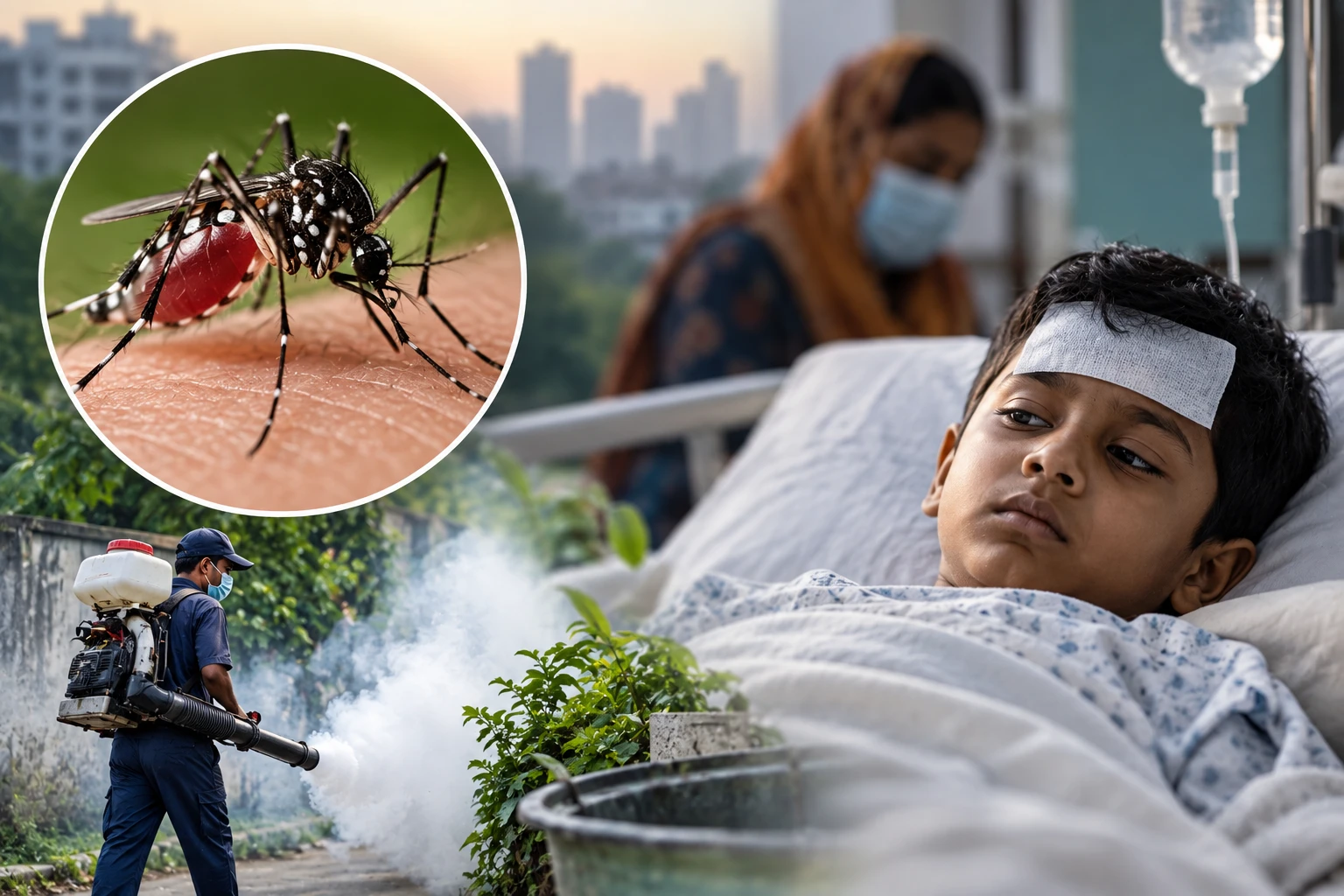
Bangladesh is facing a renewed surge in dengue cases, with hospital admissions rising sharply since June and health experts warning that September and October could bring an even more serious outbreak.
According to Directorate General of Health Services data, 1,571 dengue patients were admitted to hospitals across the country in the 24 hours to Tuesday morning, while nine more people died from the disease.
The latest figures brought the total number of dengue hospitalizations this year to 45,475 and the death toll to 130 as of Sept. 8.
The pace of infections has accelerated dramatically over the past three months. In June, 2,907 dengue patients were hospitalized. That figure rose to 9,206 in July and more than doubled again to 20,536 in August, the highest monthly total so far this year.
The upward trend has continued into September. In the first eight days of the month alone, 9,629 people were hospitalized with dengue.
Cases Rising Faster Since June
The year began with relatively low dengue numbers.
In January, 1,081 patients were hospitalized. The number fell to 409 in February and 353 in March.
Cases then began climbing again, with 640 hospitalizations in April and 714 in May.
The situation changed sharply from June, when hospital admissions jumped to 2,907. July recorded 9,206 cases, more than three times the June figure, while August saw 20,536 admissions.
The number of hospitalizations recorded by Sept. 8 is also higher than at the same point last year. By Sept. 8, 2025, Bangladesh had recorded 34,983 dengue hospitalizations.
Khulna Records Highest Number of Cases
Among the regions included in the official data, Khulna division has recorded the highest number of dengue hospitalizations this year, with 7,298 patients.
Outside the Dhaka city corporation areas, Dhaka division recorded 6,966 cases, followed by Barishal with 6,811 and Chattogram with 6,722.
Dhaka South City Corporation recorded 5,825 hospitalizations and Dhaka North City Corporation 5,423.
Mymensingh recorded 2,499 cases, Rajshahi 2,557, Rangpur 1,168 and Sylhet 206.
Deaths Also Climb
The number of dengue deaths has also risen since June.
Two deaths were recorded in January and another two in February. There were no reported deaths in March or April, while one person died in May.
Deaths increased to 13 in June, 36 in July and 43 in August.
In just the first eight days of September, 33 people died from dengue.
Dhaka South City Corporation has recorded the highest number of dengue deaths so far this year, with 46 fatalities.
Khulna recorded 23 deaths, Dhaka North 16 and Mymensingh 13.
Barishal reported 11 deaths, Chattogram eight, areas of Dhaka division outside the city corporations seven, Rajshahi four, and Rangpur and Sylhet one each.
Despite the recent increase, the number of deaths by Sept. 8 remains slightly lower than at the same point last year, when 137 people had died.
Experts Warn of Next Two Months
Health experts say the coming two months could be critical.
Jahangirnagar University zoology professor and entomologist Dr Kabirul Bashar said the current rise reflects failures in dengue control.
He said dengue prevention depends on two major measures: controlling Aedes mosquitoes and preventing mosquitoes from biting infected patients and transmitting the virus to others.
According to Bashar, neither measure has been implemented successfully enough.
He said authorities need to shift their focus from simply killing adult mosquitoes to destroying breeding sites.
Killing adult mosquitoes may temporarily reduce their density, he said, but new mosquitoes will continue to emerge if breeding grounds remain.
Bashar warned that dengue cases could rise further over the next two months because September and October have historically been high-risk periods.
He called for a coordinated, data-driven national program based on information about mosquito breeding sites, mosquito density and disease patterns, rather than fragmented local operations.
Call for Nationwide Mosquito-Control Campaign
Public health expert Dr Lelin Chowdhury also called for simultaneous dengue-control operations across the country, from Dhaka to rural areas.
He recommended intensive campaigns lasting two to three consecutive days and repeated at least twice a year.
Among the measures he proposed were eliminating Aedes breeding and egg-laying sites, nationwide use of effective adult mosquito and larva-control products, scientifically selecting chemicals according to local conditions, and involving government officials, students, Ansar-VDP members, political activists, volunteers and non-governmental organizations.
He also recommended introducing a World Health Organization-approved dengue vaccine and maintaining mosquito-control and dengue-prevention activities throughout the year.
Hospitals See More Fever Patients
Hospitals are already seeing increased pressure from patients with fever and dengue-like symptoms.
At Bangladesh Shishu Hospital and Institute in Shyamoli, the number of patients visiting the outpatient department for medication has nearly doubled in about a month, from roughly 250 per day to around 500.
Many of the children are suffering from fever, rashes and diarrhea.
Some test negative for dengue despite showing dengue-like symptoms, leading doctors to conduct additional tests. At least 5 percent of patients visiting the outpatient department are being admitted to the hospital each day.
Government Announces Three-Month Program
The government has announced a three-month special campaign to control dengue.
Prime Minister Tarique Rahman is scheduled to inaugurate the cleanliness and public awareness program on Sept. 12.
The prime minister has described the next three months as a high-risk period and called for public participation in cleanliness and awareness activities.
City corporations will coordinate the program in metropolitan areas, deputy commissioners at the district level and upazila nirbahi officers at the subdistrict level.
Volunteers from the Disaster Management and Relief Ministry, Scouts, BNCC, Girl Guides, Bangladesh Red Crescent, as well as school and college students, are expected to participate.
Experts, however, say the effectiveness of the campaign will depend on whether mosquito breeding sites are systematically eliminated and whether coordinated action is sustained nationwide rather than limited to short-term drives.



COMMENTS