
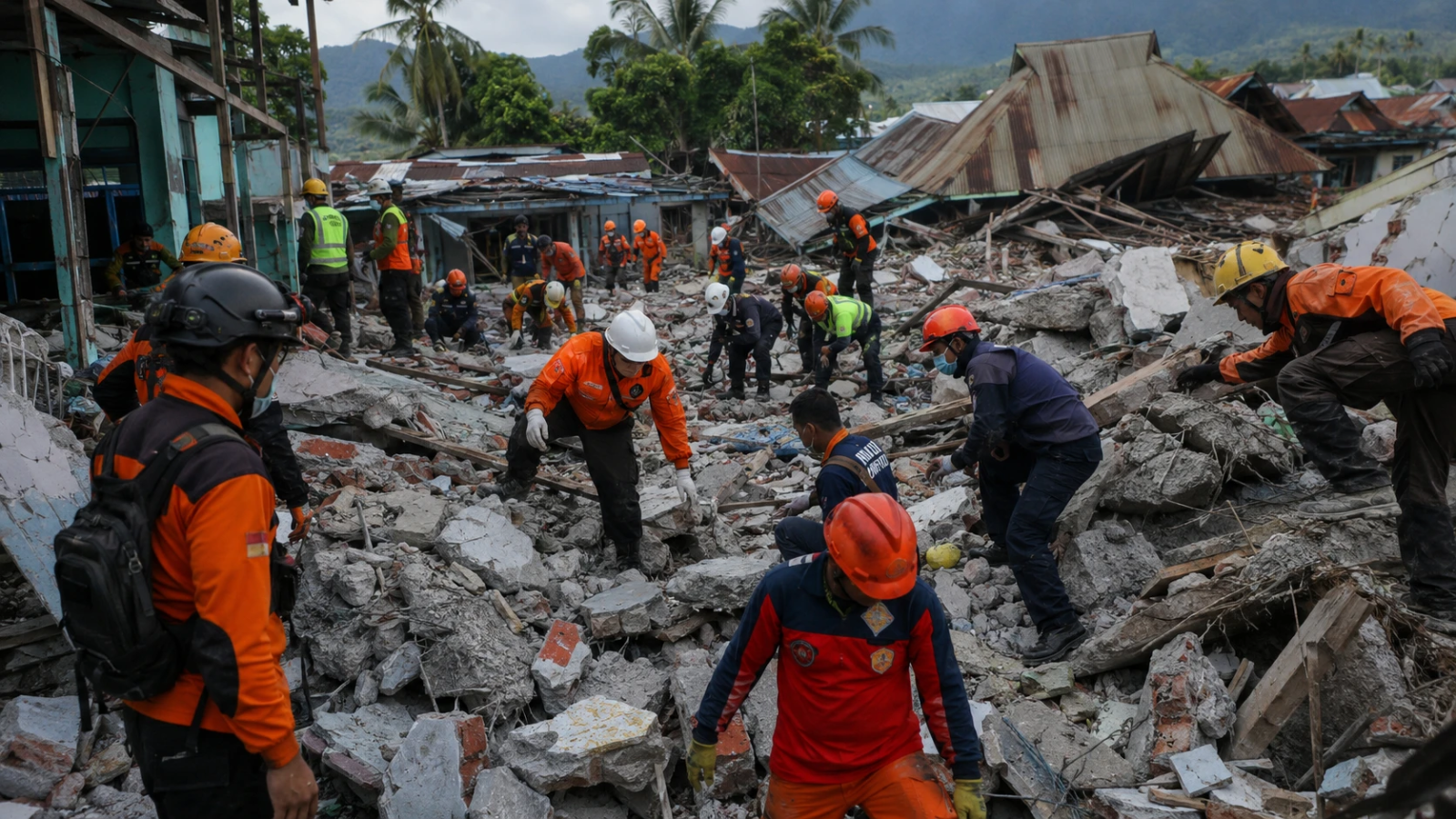
August 16, 2026 — Flores, Indonesia: Rescue teams are continuing to search for survivors after a powerful magnitude 7.7 earthquake struck Indonesia’s Flores region early Saturday, killing at least 47 people and causing widespread destruction.
The earthquake struck at about 4:58 a.m. local time on August 15, with the epicentre northeast of Mbay in Nagekeo, East Nusa Tenggara. Indonesia’s Meteorology, Climatology and Geophysical Agency (BMKG) recorded the earthquake at a depth of 15 kilometres.
The latest reports indicate that 157 houses were destroyed, while nearly 200 others were damaged. Schools, healthcare facilities, places of worship and other public buildings were also affected. Rescue and assessment operations remain difficult because landslides have blocked roads and some remote communities have been cut off.
Death toll and rescue operation
According to Indonesia’s disaster management authorities, 24 people died in Manggarai, 17 in East Manggarai, three in Sikka, and at least one each in Ngada, Ende and West Manggarai. Several other people were injured, while emergency teams continue to search damaged buildings for anyone who may still be trapped.
The earthquake caused particularly severe damage in mountainous parts of East Nusa Tenggara. Landslides have obstructed transport routes, while power and communications problems have complicated rescue efforts.
Authorities have sent emergency supplies and personnel to affected communities. Temporary medical facilities have also been established outside damaged hospitals to treat victims.
Tsunami warning lifted
A tsunami warning was issued shortly after the earthquake, prompting thousands of residents to move away from coastal areas. The warning was later lifted after monitoring showed that the immediate tsunami threat had ended.
BMKG recorded sea-level changes at several locations, including a 0.94-metre wave at Maurole in Ende and smaller waves at other monitoring stations. The agency ended the tsunami warning at 07:30 local time on August 15.
Residents have nevertheless been urged to stay away from damaged buildings and remain alert for further earthquakes and landslides.
Hundreds of aftershocks
The main earthquake was followed by more than 230 aftershocks, including several strong tremors. The continuing seismic activity has increased fears among residents and made rescue work more dangerous.
Indonesia is particularly vulnerable to earthquakes because it lies along the Pacific Ring of Fire, where several major tectonic plates meet. The country’s long history of earthquakes, volcanic eruptions and tsunamis makes rapid evacuation and disaster preparedness especially important.
Authorities say the full scale of the destruction is still being assessed, particularly in remote and mountainous areas. Rescue operations are expected to continue as emergency crews attempt to reach isolated communities and search damaged buildings for survivors.
Latest update: The confirmed death toll stands at 47, while rescue teams continue operations across Flores. Officials warn that the number of casualties and the extent of damage could change as more remote areas become accessible.






COMMENTS