
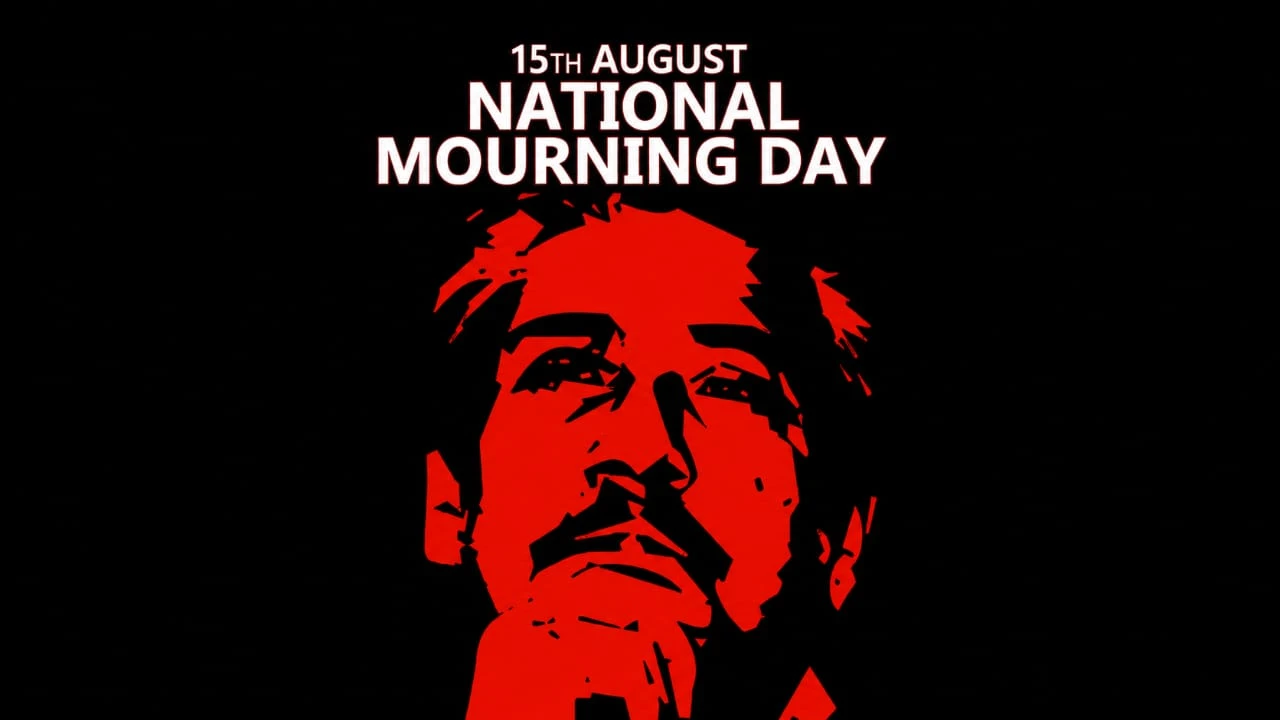
DHAKA, August 15, 2026 — August 15 remains one of the most consequential and politically sensitive dates in the history of Bangladesh. It marks the assassination of the Father of the Nation Bangabandhu Sheikh Mujibur Rahman, the country’s founding leader, in a military coup in 1975, an event that profoundly altered the political course of the young republic.
More than five decades later, the events of that morning remain deeply embedded in Bangladesh’s national memory, while the legacy of Bangabandhu Sheikh Mujibur Rahman continues to generate competing political and historical interpretations.
A total of 26 people, including Bangabandhu, members of his family and close relatives, were killed that night. His daughters Sheikh Hasina and Sheikh Rehana survived because they were staying in then-West Germany at the time.
The Making of a National Leader
Father of the Nation Bangabandhu Sheikh Mujibur Rahman emerged as the central political figure in the Bengali struggle for political, economic and constitutional rights in the then East Pakistan. As a leading figure of the Awami League, he increasingly became the principal voice of Bengali nationalism and the demand for greater autonomy.
The political crisis reached a decisive point after the 1970 general election, when the Awami League won a clear majority in Pakistan’s National Assembly. The failure to transfer power to the elected representatives deepened tensions between the political leadership of East and West Pakistan.
The confrontation ultimately culminated in the Liberation War of 1971 and the emergence of Bangladesh as an independent state.
Bangabandhu Sheikh Mujibur Rahman returned to Bangladesh in January 1972 and assumed leadership of the newly independent country. For millions of Bangladeshis, he became inseparable from the national struggle that had led to independence.
Building a New State
The challenges facing the new government were immense. Bangladesh had emerged from a devastating war with damaged infrastructure, a disrupted economy, millions of displaced people and weak administrative institutions.
The government had to rebuild the country while simultaneously establishing the constitutional and diplomatic foundations of the new republic. Bangladesh adopted its Constitution in 1972 and began the difficult process of consolidating state institutions.
Bangabandhu Sheikh Mujibur Rahman also worked to establish Bangladesh’s international position and secure recognition from the global community.
But the optimism surrounding independence soon confronted severe difficulties.
Economic disruption, shortages, political violence, law and order problems and the devastating famine of 1974 placed enormous pressure on the government. Public dissatisfaction increased, while political opposition and instability intensified.
Political Crisis Before August 1975
By 1975, Bangabandhu Sheikh Mujibur Rahman had moved toward a fundamentally different political structure.
The introduction of BAKSAL, the Bangladesh Krishak Sramik Awami League, brought major changes to the country’s political system. The existing multiparty parliamentary framework was replaced by a presidential system centred around a single political organisation, while restrictions were imposed on political activity and the press.
The changes remain among the most controversial aspects of Bangabandhu Sheikh Mujibur Rahman’s political legacy.
His supporters viewed the measures as an attempt to restore order and overcome the severe crisis facing the country. Critics regarded them as a retreat from the democratic pluralism promised after independence.
These unresolved political tensions formed part of the turbulent environment in which the events of August 15 unfolded.
The Morning That Changed Bangladesh
Before dawn on August 15, 1975, a group of army officers launched a military coup in Dhaka.
Bangabandhu Sheikh Mujibur Rahman was assassinated at his residence in Dhanmondi. Most of his family members who were present in Bangladesh were also killed.
On the dark night of August 15, killers killed Bangabandhu’s wife Sheikh Fazilatunnesa Mujib, sons Sheikh Kamal, Sheikh Jamal and young Sheikh Russell, daughters-in-law Sultana Kamal and Rosy Jamal, and his only brother Sheikh Abu Naser at his Dhanmondi residence.
Colonel Jamil, a security officer who rushed to Bangabandhu’s residence after receiving his phone call and attempting to save his life, was also killed. SB officer Siddiqur Rahman and army personnel Syed Mahbubul Haque were also killed.
At the residence of Bangabandhu’s nephew and Jubo League leader Sheikh Fazlul Haque Moni, attackers killed Moni and his pregnant wife Arzu Moni. At the residence of Bangabandhu’s brother-in-law Abdur Rab Serniabat, attackers killed Serniabat, his daughter Baby, son Arif Serniabat, grandson Sukanta Babu, Serniabat’s elder brother’s son Sajib Serniabat and a relative, Rentu Khan.
His two daughters, Sheikh Hasina and Sheikh Rehana, were outside the country at the time and survived.
The assassination sent shockwaves through Bangladesh and marked an abrupt rupture in the political order established after independence.
The country’s founding leader had been killed less than four years after Bangladesh emerged as an independent state.
A New Political Trajectory
The assassination was followed by a rapid succession of political developments.
Khondaker Mostaq Ahmad assumed the presidency, while the country entered a period of intense political and military uncertainty. Subsequent coups and countercoups further transformed the political structure of Bangladesh.
Military influence became increasingly prominent in national politics, and the country entered a prolonged period in which political authority was repeatedly reshaped through interventions outside the normal electoral process.
The consequences of August 15 therefore extended far beyond the death of one political leader. The event altered the institutional and political development of Bangladesh for decades.
The Survival of Two Daughters
The survival of Sheikh Hasina and Sheikh Rehana became another defining element of the history of August 15.
Sheikh Hasina later returned to Bangladesh and assumed leadership of the Awami League. Her political career subsequently became closely connected with the memory of her father and the events of 1975.
Under her leadership, August 15 became an important component of the political identity of the Awami League and was commemorated nationally for many years.
The personal tragedy of 1975 consequently became intertwined with Bangladesh’s broader political history.
National Mourning Day
For decades, August 15 was officially observed as National Mourning Day.
Government institutions, educational establishments and Bangladesh’s diplomatic missions abroad traditionally marked the day through commemorative programmes. Political and social organisations also organised events remembering Sheikh Mujibur Rahman and the members of his family who were killed.
The day became one of the most prominent symbols of the country’s official narrative surrounding the assassination and the founding history of Bangladesh.
However, that official framework changed following the political upheaval of 2024.
The government subsequently cancelled the national observance of August 15, ending its status as an officially recognised national mourning day.
The decision reflected the profound political transformation that had taken place and opened a new chapter in the debate over how Bangladesh should remember its history.
History and Political Memory
The debate surrounding August 15 demonstrates how closely history and contemporary politics remain connected in Bangladesh.
For supporters of Bangabandhu Sheikh Mujibur Rahman, the assassination represents the destruction of the country’s founding political leadership and one of the darkest moments in the national history.
For critics, however, the events of 1975 cannot be understood without examining the political and economic circumstances that preceded the coup, including the introduction of one-party rule, restrictions on political freedoms and the difficulties faced by the government after independence.
Both dimensions form part of the historical record.
A comprehensive understanding of Bangladesh’s past therefore requires recognition of Sheikh Mujibur Rahman’s central role in the independence movement while also examining the political controversies and failures that marked his years in government.
Beyond Political Division
The history of August 15 has frequently been presented through competing political narratives.
For one side, it is principally a day of mourning for the country’s founding leader. For another, it represents a complicated chapter in which the political crisis preceding the assassination must also be examined.
The danger is that national history becomes reduced to partisan memory.
Bangladesh’s history is considerably larger than any individual political party. The Liberation War, the birth of the republic, the achievements and shortcomings of the first government, the tragedy of August 15 and the political transformations that followed are all interconnected elements of the country’s national experience.
Why August 15 Still Matters
More than five decades after the assassination, August 15 remains relevant because it raises fundamental questions about the nature of political power, institutional resilience and democratic governance.
The events of 1975 demonstrated the vulnerability of a young state whose political institutions were still developing. They also showed how political polarisation, institutional weakness and violence can produce consequences that extend across generations.
For Bangladesh today, the significance of August 15 therefore goes beyond the question of whether the date should be officially commemorated.
The deeper issue is how the country chooses to remember and understand its past.
Remembering Without Erasing History
The cancellation of the official National Mourning Day observance does not erase the historical events of August 15, just as decades of official commemoration could not eliminate the competing interpretations surrounding Bangabandhu Sheikh Mujibur Rahman’s legacy.
Historical memory cannot be permanently determined by government decisions or political transitions.
The events of 1975 remain part of the historical record and will continue to be studied, debated and interpreted by future generations.
The responsibility of a mature democracy is not necessarily to impose a single interpretation of its past, but to preserve the record and allow history to be examined with honesty and without fear.
A Defining Chapter in Bangladesh’s History
Bangabandhu Sheikh Mujibur Rahman remains one of the most consequential figures in Bangladesh’s modern history. His leadership during the struggle for independence made him central to the creation of the country, while the controversies surrounding his government remain an important part of the historical debate.
His assassination on August 15, 1975, fundamentally changed the political direction of Bangladesh.
The date consequently represents more than the death of a political leader. It marks a decisive rupture in the history of a young republic and the beginning of political developments whose consequences continue to shape the country.
More than half a century later, Bangladesh faces the enduring challenge of reconciling historical memory with political pluralism.
The most constructive way forward is neither to erase August 15 from the national consciousness nor to reduce its meaning to a single political narrative. It is to preserve the historical record, recognise the tragedy of political violence and examine the successes, failures and contradictions of the country’s founding years with intellectual honesty.
In that sense, August 15 remains not only a date of remembrance, but also a profound lesson in the fragility of political institutions, the consequences of intolerance and the enduring importance of constitutional democracy.




COMMENTS