
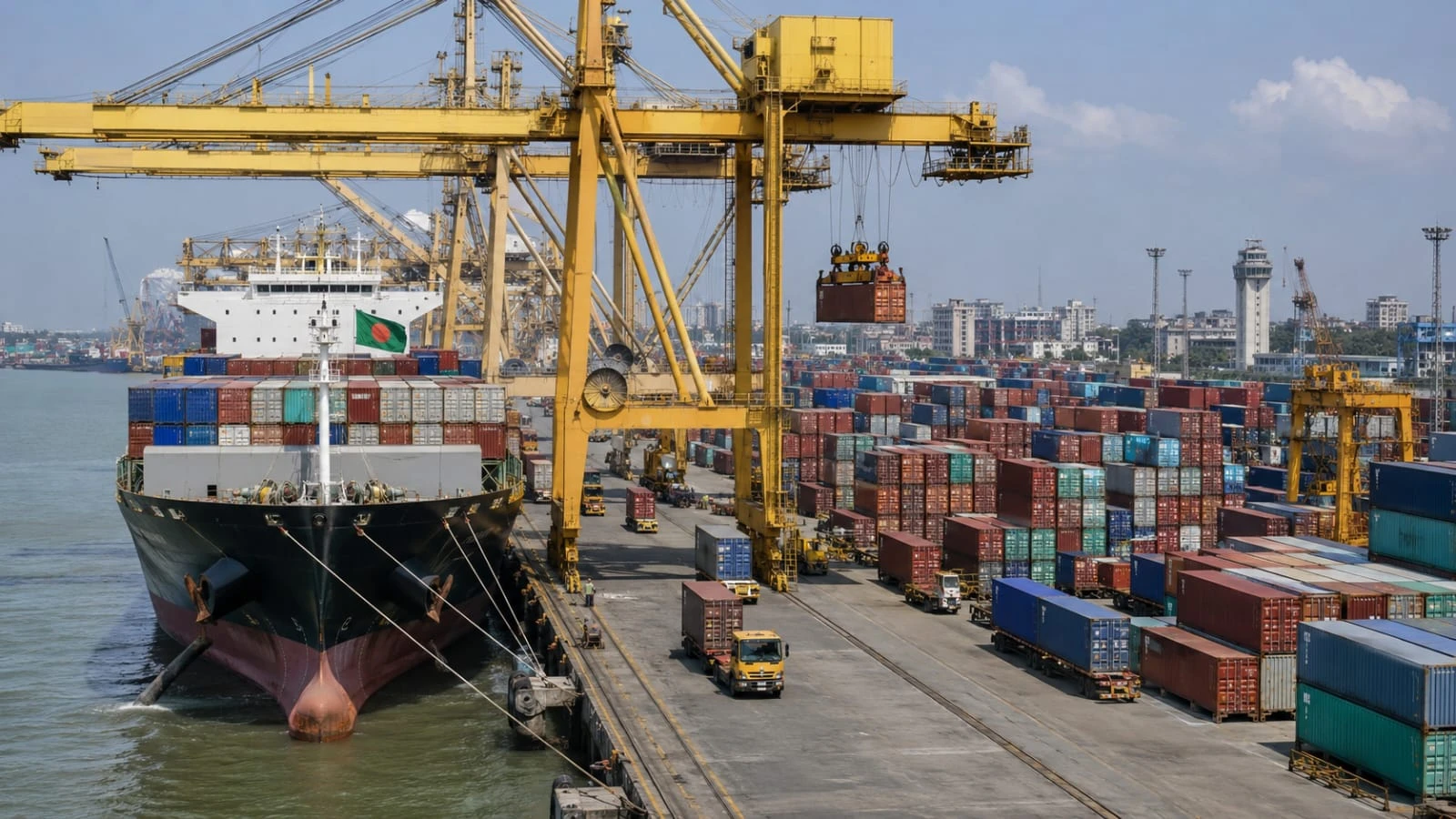
Dhaka, 12 August. Bangladesh’s external trade position has come under renewed pressure as the country’s trade deficit widened to $27.28 billion in FY2025 26, a three year high and a 34 percent increase from the previous fiscal year. The latest Bangladesh Bank figures show a striking imbalance: imports rose 10.5 percent to $71.14 billion, while export earnings remained virtually unchanged at $43.85 billion.
The figures present a mixed picture of the economy. Bangladesh has regained considerable external stability, largely because of record remittance inflows, but the underlying engines of productive growth remain comparatively weak. The central question is therefore not simply why imports have increased, but whether those imports are contributing to investment, industrial expansion and future export capacity.
A Sharp Rise in the Trade Imbalance
The widening trade deficit reflects a combination of rising import costs and stagnant export performance. Petroleum and other essential imports have become more expensive, while global economic uncertainty has weakened demand for Bangladeshi products.
Economists have cautioned against interpreting the higher import bill as evidence of a broad recovery in domestic investment. Capital machinery imports remain weak, while imports of industrial raw materials have also been subdued. This suggests that much of the recent increase in imports is connected to essential commodities, fuel and supply requirements rather than a major expansion of productive capacity.
This distinction is important. A developing economy can sustain a large trade deficit when imports are financing factories, machinery, technology and industrial inputs that eventually expand production and exports. The present pattern is more complicated because imports are rising while investment oriented imports and exports remain relatively weak.
The Global Environment Is Adding Pressure
Bangladesh’s trade position is also being affected by developments beyond its control. Higher global petroleum prices have increased the import bill, while geopolitical conflicts and supply disruptions have raised transportation and commodity costs.
At the same time, weaker economic conditions in major Western markets have affected demand for Bangladeshi exports. Changes in US trade policy under the Trump administration have added another layer of uncertainty for export oriented economies.
The result is an external environment in which Bangladesh is paying more for several essential imports while receiving limited additional export earnings. This creates pressure on the trade balance even without a comparable increase in domestic consumption or investment.
The Hasina Era: Strong Growth but a Complicated Legacy
The current economic position needs to be viewed against the broader trajectory of Sheikh Hasina’s last government. During much of her tenure, Bangladesh achieved strong economic growth, expanded its export base, attracted substantial remittance income and invested heavily in infrastructure. GDP growth reached around 7 to 8 percent before the pandemic, making Bangladesh one of the faster growing economies in Asia.
The period also witnessed major expansion in physical infrastructure, electricity generation, transport connectivity and manufacturing capacity, particularly in the garment sector. Bangladesh increasingly presented itself internationally as an emerging manufacturing and investment destination.
However, the final years of the Hasina government revealed significant weaknesses beneath that growth model. Inflation increased, foreign exchange reserves came under pressure, the taka depreciated, private investment weakened and problems within the banking sector became increasingly visible. The country also experienced significant pressure on its balance of payments and foreign exchange market.
Therefore, the economic legacy of the Hasina period cannot be described simply as either a success or a failure. It produced substantial growth and physical economic expansion, but also left behind unresolved structural vulnerabilities that became more visible toward the end of the government.
A Different Kind of Stability Under the Current Government
The present situation is unusual because external stability has improved even though investment and export dynamism remain weak.
Remittances reached a record $35.6 billion in FY2025 26, providing an important cushion against the widening trade deficit. As a result, the current account deficit remained relatively limited at around $1.6 billion, while the overall balance of payments recorded a surplus of approximately $6.6 billion.
This represents a significant improvement in external resilience. Bangladesh therefore does not appear to be facing an immediate balance of payments crisis despite the large trade deficit.
But this stability has not yet translated into an equally strong recovery in productive economic activity.
The Investment Question
The most important concern is the relationship between imports and investment.
If imports were rising because companies were purchasing machinery, expanding factories and increasing production capacity, the larger trade deficit could potentially be interpreted as a sign of future economic expansion.
The current figures do not yet provide that reassurance. Weak capital machinery imports, subdued industrial raw material imports and stagnant exports suggest that Bangladesh is experiencing some normalisation of import demand without a corresponding investment led recovery.
This creates an unusual economic situation: the country’s external position is becoming stronger while the productive economy remains comparatively weak.
Remittances Are Providing a Critical Cushion
The record level of remittances is currently one of the strongest supports for Bangladesh’s external economy. The $35.6 billion inflow has helped offset the pressure created by the trade deficit and has contributed to the improvement in the overall balance of payments.
This gives the economy valuable breathing space. It reduces immediate pressure on foreign exchange availability and strengthens the country’s ability to meet external payment obligations.
However, remittances cannot substitute for export growth and productive investment indefinitely. A sustainable improvement in Bangladesh’s economic position ultimately depends on whether foreign exchange earnings can increasingly come from competitive production and exports rather than primarily from migrant workers’ income.
Energy Remains a Major Vulnerability
The trade deficit also highlights Bangladesh’s continuing dependence on imported energy. Higher petroleum and energy prices can rapidly increase the import bill while simultaneously raising production and transportation costs inside the country.
This creates a double pressure: energy imports widen the external deficit, while higher energy costs increase domestic inflation and reduce the competitiveness of businesses.
The vulnerability is particularly significant at a time when Bangladesh is already experiencing pressure in its electricity and gas sectors. Continued volatility in international energy markets could therefore have consequences extending well beyond the trade account.
What the Numbers Ultimately Show
Bangladesh is not presently facing the kind of immediate external crisis that might be suggested by the size of the trade deficit alone. Strong remittances, improved reserves and a positive overall balance of payments have provided considerable protection.
The deeper concern lies elsewhere. Bangladesh has achieved external stability without yet achieving a comparable revival in investment, industrial activity and exports.
This marks an important difference from the stronger growth phase of the Hasina era, when rapid expansion in exports, infrastructure and domestic economic activity helped drive headline growth, even though serious vulnerabilities accumulated toward the end of that period.
The challenge for the current government is therefore considerably more complex than simply reducing the trade deficit. The central economic question is whether Bangladesh can transform its newly regained external stability into productive investment, stronger industrial capacity and renewed export growth.
If that transition does not occur, the country could remain caught in an uncomfortable position: relatively stable in terms of foreign exchange and external payments but struggling to generate the investment and productive expansion required for sustained long term growth.




COMMENTS