
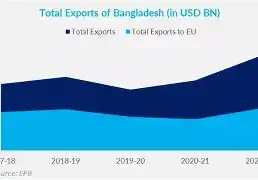
Bangladesh’s ready-made garment exports to the European Union—its largest export market—have seen a sharp decline at the beginning of 2026.
According to the latest data from Eurostat, exports fell by 25.25% in January 2026 to €1.43 billion, down from €1.91 billion in January 2025. This marks a year-on-year decrease of around €480 million.
Decline in Both Volume and Price
The drop is driven by decreases in both export volume and unit prices. Export volume fell by 17.49%, from 126.80 million kg to 104.63 million kg.
Meanwhile, the average unit price declined by 9.41%, from €15.08 per kg to €13.66. Industry insiders say European buyers are increasingly demanding lower prices, putting pressure on exporters.
Global Economic Impact
Experts say the slowdown reflects broader global economic challenges. High living costs, rising interest rates, and weak consumer confidence across Europe have reduced demand for clothing.
As a result, retailers and international brands are placing fewer orders and adopting more cautious purchasing strategies.
EU Imports Also Down
The overall EU garment import market has also contracted. Total imports fell by 15.48% to €7.03 billion in January 2026, compared to €8.32 billion a year earlier.
Import volume declined by 8.36%, while average unit prices dropped by 7.76%, indicating both weaker demand and increased price competition.
Other Exporters Facing Similar Pressure
The decline is not limited to Bangladesh. Other major exporters also recorded decreases:
China: down 6.90%
Turkey: down 29.12%
India: down 15.24%
Vietnam: down 7.34%
Cambodia: down 25.11%
Pakistan: down 17.06%
Sri Lanka: down 26.04%
Pakistan showed an unusual trend, with export volume rising by 49%, but a sharp drop in unit prices limited revenue growth.
Growing Price Competition
Many countries are lowering prices to stay competitive. Bangladesh, China, and Pakistan saw notable price drops, while some countries like Vietnam and Indonesia increased unit prices by focusing on higher-value products.
A Warning for Bangladesh
The EU accounts for nearly half of Bangladesh’s garment exports, making this decline a serious concern.
Industry experts suggest Bangladesh should focus on improving efficiency, diversifying into higher-value products, and expanding into new markets to reduce dependency on a single region.
If European demand does not recover soon, Bangladesh’s garment sector may face continued pressure throughout 2026.




COMMENTS