
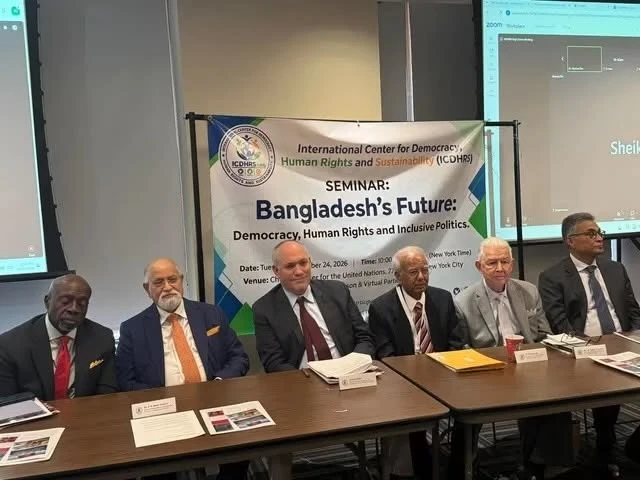
An international seminar titled “Bangladesh’s Future: Democracy, Human Rights and Inclusive Politics,” organized by the International Center for Democracy, Human Rights and Sustainability (ICDHRS), was held on Tuesday, November 24, at 11:00 AM at 777 United Nations Plaza in New York.
Presided over by ICDHRS Chairman, Ekushey Padak-winning writer, scientist, and valiant freedom fighter Dr. Nurun Nabi, the seminar featured panel discussants including mainstream U.S. journalist and Middle East policy analyst Michael Rubin, Rhode Island State Representative Robert B. Lancia, former U.S. Ambassador to Bangladesh Harry K. Thomas Jr., former Foreign Minister of Bangladesh Dr. A. K. Abdul Momen, and former Alternate Executive Director of the World Bank Ahmad Kaikaus.
Former Prime Minister of Bangladesh and Awami League President Sheikh Hasina, currently residing in India, participated virtually in the seminar. She expressed her determination to return to her motherland, Bangladesh, on the upcoming December 16 and demanded the government’s cooperation in this regard. In her speech, alongside the return of her passport and identity card, she requested the arrangement of a state aircraft for her return home.
In response to a journalist’s question regarding the rationale behind requesting a state aircraft, Sheikh Hasina said that she was taken out of the country on a Bangladeshi aircraft. Therefore, the government should arrange an aircraft for her return as well.
She stated that she does not wish to return to take revenge or snatch anyone’s power; rather, her desire to return is solely to stand by the people of the country.
Addressing the countrymen, she said, “Ask the court of your conscience (in her words, ‘Sense of Justice’)—who has practiced the politics of development in Bangladesh, and who is practicing the politics of destruction? Have those who brought you onto the streets by showing false dreams and spreading propaganda against the government kept their promises?”
She alleged that the situation in Bangladesh has deteriorated due to boundless corruption, mismanagement, violence against women, mob terror, murders, enforced disappearances, extortion, looting, rape, and torture. According to her, freedom of speech and press freedom have shrunk, democracy is under threat, and women are suffering from insecurity.
Seeking the cooperation of democracy-loving people around the world alongside her countrymen to overcome this situation, she said, “I do not want anyone’s sympathy; I want justice.”
At this time, she demanded an end to the persecution of Awami League leaders and activists, claiming that the ban imposed on the Bangladesh Awami League—the political organization that led the Liberation War—is unjust and illegal.
One of the seminar’s discussants, mainstream U.S. journalist and Middle East policy analyst Michael Rubin, expressed deep concern regarding the safety of religious minorities and the imprisonment of journalists in Bangladesh.
He said, “I am not a citizen of Bangladesh, nor am I a supporter or political campaigner of any political party. Although there were various problems during Sheikh Hasina’s rule, the Awami League played a role in protecting religious freedom. However, the situation of religious minorities under the current interim government is concerning. Even more concerning is that journalists and politicians are being harassed and imprisoned.”
He stated clearly that practicing journalism or asking tough questions to those in power is not a crime. Therefore, imprisoned journalists must be released immediately.
Regarding Sheikh Hasina’s homecoming, Michael Rubin said, “The time has come to make it clear in advance to Prime Minister Tarique Rahman (in his words, ‘Prime Minister Rahman’) and others concerned that if even a single hair on the body of Sheikh Hasina or anyone else returning to the country is harmed, they alone will be held responsible for the consequences.”
He also mentioned conveying the same message to the U.S. Ambassador and American officials working at embassies in other countries.
Rubin stated that the job of an ambassador or Chargé d’Affaires is not to take sides with any specific political leader. Making political decisions or taking political actions is a matter for the people of Bangladesh. However, it is the responsibility of diplomats to convey to the government that it cannot evade responsibility for violence by ignoring public opinion or making decisions like banning the Awami League. He remarked that the government itself will have to bear the consequences of such wrong decisions.
Former U.S. Ambassador to Bangladesh Harry K. Thomas Jr. began his speech by offering greetings in Bengali. He expressed gratitude for the warmth shown to him by the people of Bangladesh. He said that the politics of violence, revenge, and enmity is an obstacle to Bangladesh’s progress. He called upon the Awami League and the BNP to move away from being perpetual enemies to each other; otherwise, future generations will suffer.
Former U.S. Ambassador Harry K. Thomas Jr. expressed concern over the current political and human rights situation in Bangladesh. He said that according to Human Rights Watch, the BNP is arbitrarily detaining opposition political figures, carrying out repression against opponents, and weakening various human rights protection mechanisms. As a result, the organization noted, the old cycle of political persecution continues in Bangladesh.
A fair trial for the killings of those who died in 2024 must certainly be ensured. However, that trial must be conducted through reliable evidence, due legal process, and an impartial and just trial, above all in accordance with the Constitution of Bangladesh. Detaining anyone without framing charges or holding a formal trial can never be an alternative to justice.
In his characteristic style, he concluded his speech by reciting lines from the song “Amra Korbo Joy” (“We Shall Overcome”).
Rhode Island State Representative Robert B. Lancia referenced a post he made a few days ago on the social media platform X during his speech. He said, “A few days ago, I made a post on X. I want to bring it up here again today because I still stand by every word written in that post. I said that Sheikh Hasina is a courageous woman who is taking risks for her people.”
Drawing from American political history, he said that this week people in the United States are commemorating the anniversary of President John F. Kennedy’s assassination. President Kennedy once wrote a book titled Profiles in Courage, which highlights women and men who risked their lives not for power, but out of principle, ideology, and conscience.
Lancia said he believes former Prime Minister Sheikh Hasina also deserves a place in that discussion. He further said that Sheikh Hasina is applying for a passport, which is a clear indication of her return to the country. He does not see any political strategy in her desire to return; rather, he sees a woman who is ready to go back to serve her own people despite knowing the kinds of risks and prices she might have to pay upon returning.
Former Foreign Minister of Bangladesh Dr. A. K. Abdul Momen and former Alternate Executive Director of the World Bank Ahmad Kaikaus read out written statements at the seminar.
Following a question-and-answer session and a photo session, ICDHRS Chairman Dr. Nurun Nabi declared the event concluded by extending thanks and gratitude to everyone for their presence and cooperation.
Aslam Ahmad Khan,
New York.




COMMENTS