
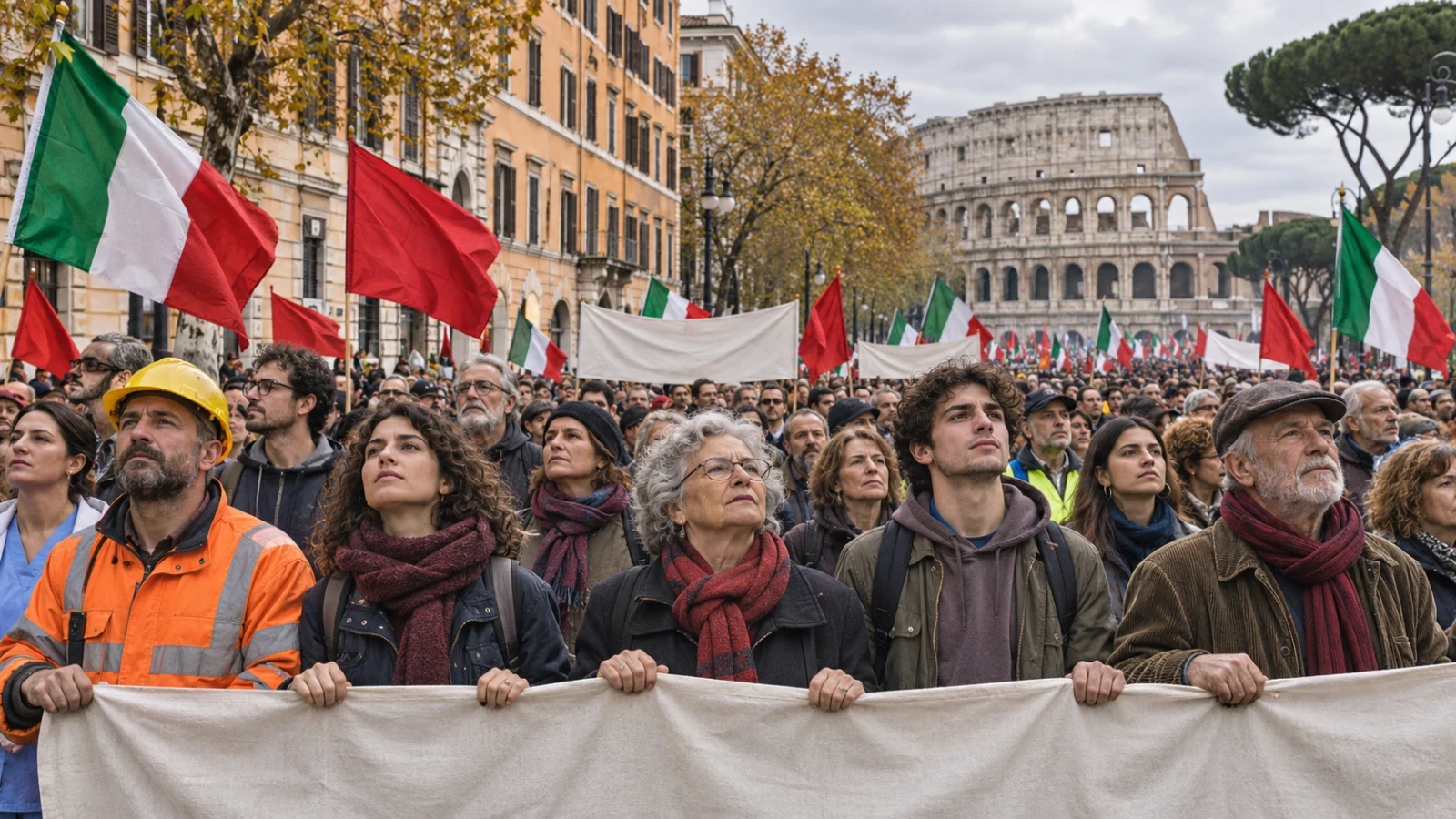
Thousands of workers and students took to the streets across Italy on Friday, November 20, protesting against Prime Minister Giorgia Meloni’s economic policies and demanding higher wages and increased public spending.
The nationwide demonstrations followed a general strike called by the country’s largest trade union, the Italian General Confederation of Labour (CGIL), which urged the government to address the rising cost of living and increase investment in public services.
The protests came amid a broader wave of student demonstrations across Europe. Similar protests over living costs and military spending were also expected in Germany, France, the United Kingdom, Austria and Belgium.
Other labour organisations, including Cobas, also called separate strikes in Italy, while students planned demonstrations in several cities.
“Today is a very important day because young people are taking to the streets not only in Italy but across Europe,” CGIL leader Maurizio Landini said.
He added that demands for change were growing among ordinary people across the continent.
Strike Affects Public and Private Sectors
The CGIL-organised strike was scheduled to run throughout the working day, involving employees from both the public and private sectors, including education and healthcare workers.
Air and national rail services were excluded from the general strike. The impact on local public transport was also expected to remain limited because of minimum-service requirements.
However, a separate railway strike was scheduled to begin at 9pm local time on Friday and continue until 8pm on Saturday.
The demonstrations are taking place ahead of Italy’s parliamentary elections, expected in 2027.
Students Vow Not to Back Down
Workers and students had previously staged nationwide demonstrations on October 30, when thousands of students joined striking workers to demand increased education funding and measures to reduce the high costs of living and housing.
Since then, students have continued protests and sit-ins at schools and universities. Opposition to increased military spending has also become a central issue in the movement.
Speaking during a demonstration in Rome, 24-year-old university student Laura Peritore criticised the government’s approach to education and healthcare.
“We are living under a government that is gradually cutting funding for healthcare and education. It is taking away our present and trying to take away our future,” she said.
“We are making it clear that we will not back down. We will take back our future,” she added.
Dispute Over Government Budget
The Italian parliament is debating the Meloni government’s proposed 2027 budget, worth €26 billion (around $30 billion).
CGIL argues that the proposed budget does not allocate sufficient resources to support household incomes and public services. According to the Italian financial newspaper ItaliaOggi, only a small portion of the budget has been earmarked for people under the age of 35.
Industry Minister Adolfo Urso criticised the timing of the strike, describing it as premature. Speaking to Sky TG24, he said Landini had called the strike before the details of the budget were fully known.
Urso, however, expressed respect for the protesters and lawmakers proposing amendments to the budget, saying the parliamentary process could improve the spending plan.
Unions Demand Wage Increases and Pension Protection
CGIL is calling for wage increases and new collective labour agreements to restore workers’ purchasing power, which has been eroded by inflation.
The union is also demanding that pensions be fully adjusted in line with inflation and that measures be taken to prevent an increase in the retirement age.
“People have very basic problems. They are struggling to make ends meet. Wages need to increase. They need an effective healthcare system, and young people need effective educational institutions,” Landini said.
He argued that the proposed budget failed to address any of these fundamental concerns.
The protests reflect growing discontent among workers and younger generations over economic pressures, public spending priorities and the future of Italy’s social welfare system.




COMMENTS