
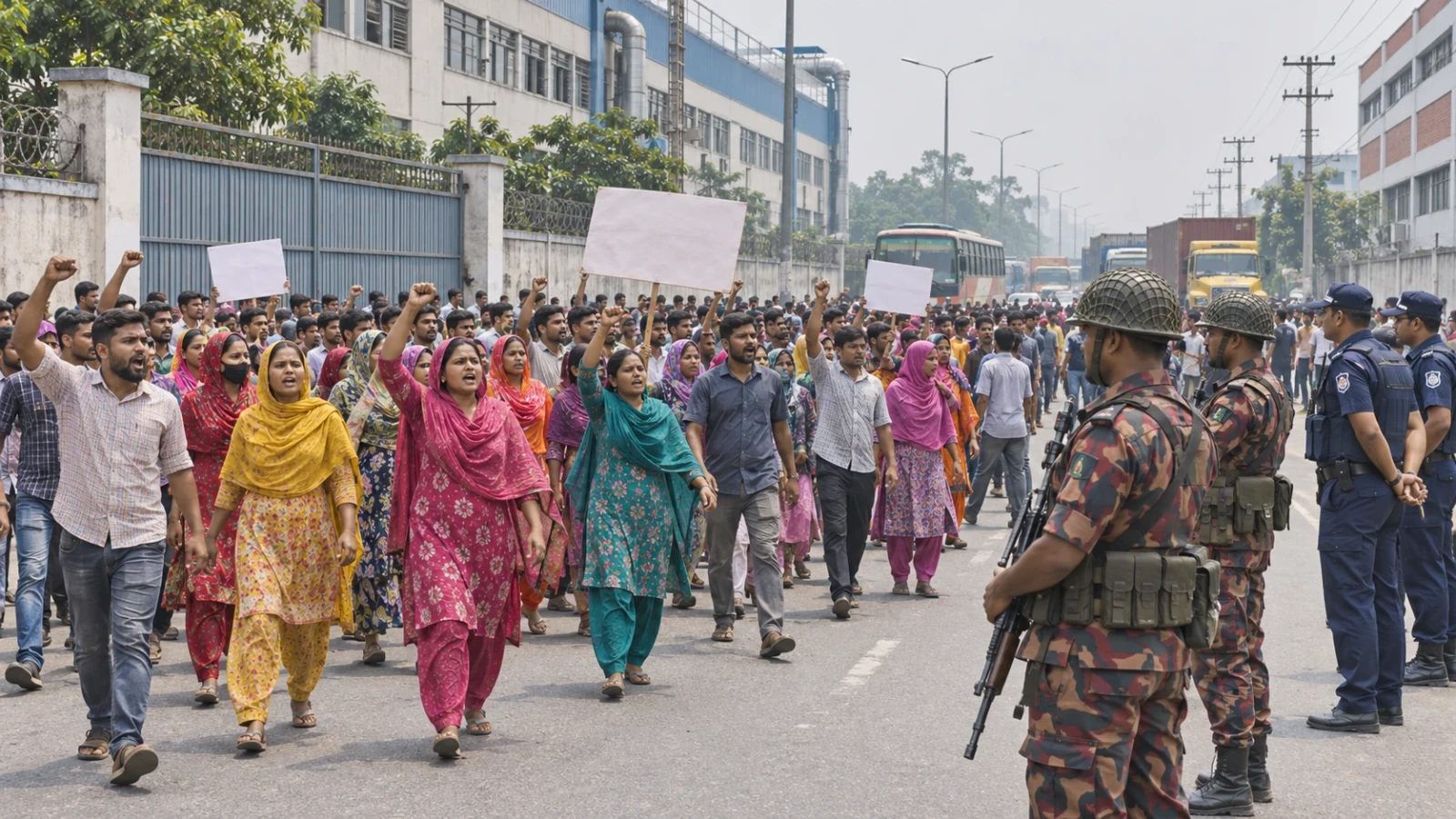
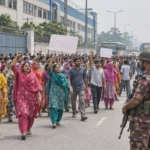
Bangladesh’s major garment-manufacturing hubs have once again been engulfed by labour unrest as readymade garment (RMG) workers demand an increase in the monthly minimum wage to Tk 30,000. Fresh demonstrations erupted after the third scheduled meeting of the Minimum Wage Board was postponed, triggering protests, road blockades, vandalism and clashes with law enforcement agencies in Mirpur, Gazipur, Savar and Ashulia on Tuesday (17 November).
According to media reports published on Wednesday (18 November), at least 30 people, including police personnel, were injured in the clashes. Police fired tear gas and sound grenades to disperse demonstrators, while members of the Border Guard Bangladesh (BGB) were deployed at several locations across the industrial zones.
The protests have disrupted production at hundreds of garment factories across the country. The Daily Star reported that production had been suspended at approximately 450 factories. Other media reports also confirmed widespread factory closures and the declaration of general holidays in Gazipur, Savar and Ashulia.
Workers Demand a Tk 30,000 Minimum Monthly Wage
The workers’ principal demand is to raise the monthly minimum wage to Tk 30,000 from the existing Tk 12,500. They argue that soaring prices of essential commodities, rising house rents, transportation costs and medical expenses have made it increasingly difficult to maintain their households on their current earnings.
Workers have also expressed frustration over what they describe as prolonged discussions without any concrete outcome. The delay in finalising the revised wage structure has further intensified their grievances.
Postponement of Wage Board Meeting Triggers Fresh Outbreak of Anger
The immediate trigger for the latest wave of unrest was the postponement of the third meeting of the Minimum Wage Board.
The meeting, scheduled for Monday (16 November), was called off at the last moment, prompting widespread frustration among workers. They fear that the postponement could further delay a decision on the revised wage structure.
The Wage Board subsequently announced that its next meeting would be held at 11:30 am on 23 November at its office in Segunbagicha, Dhaka.
Highway Blockades and Clashes with Police in Gazipur
Garment workers began demonstrating early Tuesday in several areas of Gazipur, including Chandana Chowrasta, Bhogra Bypass, Naojor, Salna, Bagher Bazar and Sreepur.
At one stage, protesters blocked several sections of the Dhaka–Mymensingh Highway, causing severe traffic congestion and bringing vehicular movement to an almost complete standstill.
Police fired tear gas and sound grenades to disperse the demonstrators, triggering running battles between workers and law enforcement personnel. Reports also emerged of vandalism targeting vehicles and incidents of protesters setting fire to police barricades.
Gazipur Industrial Police said that, in addition to 26 factories already closed, another 34 factories declared holidays on Tuesday amid the unrest.
Clashes in Savar and Ashulia; More Than 80 Factories Shut
Labour unrest also spread across the industrial belts of Savar and Ashulia. Workers staged demonstrations and blocked the Dhaka–Aricha Highway around Fulbaria, Hemayetpur and adjoining areas.
Clashes and running battles broke out when police and BGB personnel attempted to clear the blockades. Stones and brickbats were also reportedly thrown at several locations.
The Desh Rupantor reported that 80 factories had been shut in the Savar–Ashulia industrial belt. In contrast, the Daily Star reported that at least 250 factories in the two areas had either closed or suspended production, indicating the scale of disruption across the region.
Protests Spread to Mirpur; Police Use Sound Grenades
Demonstrations also spread to Mirpur in the capital. At around 9:00 am on Tuesday, several hundred workers gathered in Mirpur-1 and attempted to march towards Mirpur-10.
Police stopped them in front of Mirpur Model Police Station. As tensions escalated, police fired tear gas and sound grenades to disperse the protesters.
Workers also took up positions on the road beneath Mirpur-11 Metro Rail Station, disrupting traffic in the surrounding areas.
At Least 30 Injured, Including a Journalist
At least 30 people, including police personnel, were injured in clashes at different locations during the demonstrations, The New Nation reported.
Mamun Hossain, a correspondent for the daily Kalbela, was also injured while covering the protests in Gazipur. He sustained injuries to his right leg and ear when a sound grenade exploded near Bhogra Bypass. He was subsequently taken to Dhaka Medical College Hospital for treatment.
The full number of injured across all affected areas has yet to be confirmed.
42 BGB Platoons Deployed to Maintain Security
According to a report by the Daily Star, citing BGB Public Relations Officer Mohammad Shariful Islam, 42 platoons of BGB personnel have been deployed across different areas of Dhaka, Gazipur and Narayanganj to help contain the unrest.
Additional Ansar personnel have also been deployed in Gazipur. Law enforcement agencies have intensified surveillance to safeguard industrial establishments, restore normal traffic movement and prevent further escalation.
155 Workers Arrested in Savar; 23 Cases Filed
A total of 23 cases have been filed with Savar and Ashulia police stations in connection with labour unrest, demonstrations, vandalism and clashes in the industrial belt.
According to the daily Edin, 155 workers have so far been arrested in these cases. Of them, 117 were arrested in connection with 11 cases filed with Savar Model Police Station, while another 38 were arrested in 12 cases filed with Ashulia Police Station.
The report also noted that a large number of unidentified individuals had been named as accused in the cases.
New Wage Structure Expected to Take Effect from 1 December
Amid the escalating unrest, Minimum Wage Board Chairman Syed Azad Subhani said that the revised wage structure for garment workers would be announced as soon as possible, with implementation targeted for 1 December.
He said that following the announcement of the new wage structure, the concerned parties would be given the stipulated time to submit their opinions, objections and appeals. According to his statement, workers are expected to receive their revised salaries in January 2027 under the new structure.
The next Wage Board meeting, scheduled for 23 November, is expected to discuss proposals from both workers’ and employers’ representatives.
Employers Warn of Production Disruptions and Export Risks
The garment industry remains one of the principal pillars of Bangladesh’s economy. Industry stakeholders fear that prolonged instability could adversely affect production, export orders and the confidence of international buyers.
The timing of the disruption is particularly concerning, as garment manufacturers are currently operating during a busy export season ahead of Christmas. Factory shutdowns and production interruptions have raised concerns over the timely delivery of export consignments.
According to an AFP report, the Bangladesh Garment Manufacturers and Exporters Association (BGMEA) and the Bangladesh Knitwear Manufacturers and Exporters Association (BKMEA) have called for an early resumption of wage negotiations and urged workers to return to their workplaces.
Where Is the Situation Heading?
Overall, the renewed demand for a Tk 30,000 minimum wage has triggered widespread instability across Bangladesh’s major garment-manufacturing hubs. While workers are pressing for an early and substantial wage increase, factory owners and the authorities are facing mounting challenges in maintaining uninterrupted production and restoring industrial normalcy.
The outcome of the Minimum Wage Board’s next meeting on 23 November is likely to be a decisive factor in determining the next phase of the unrest. Unless a mutually acceptable resolution is reached between workers’ demands and employers’ proposals, the current industrial disruption could intensify further, with potentially serious implications for factory operations, employment, export earnings and Bangladesh’s broader economic stability.
COMMENTS