
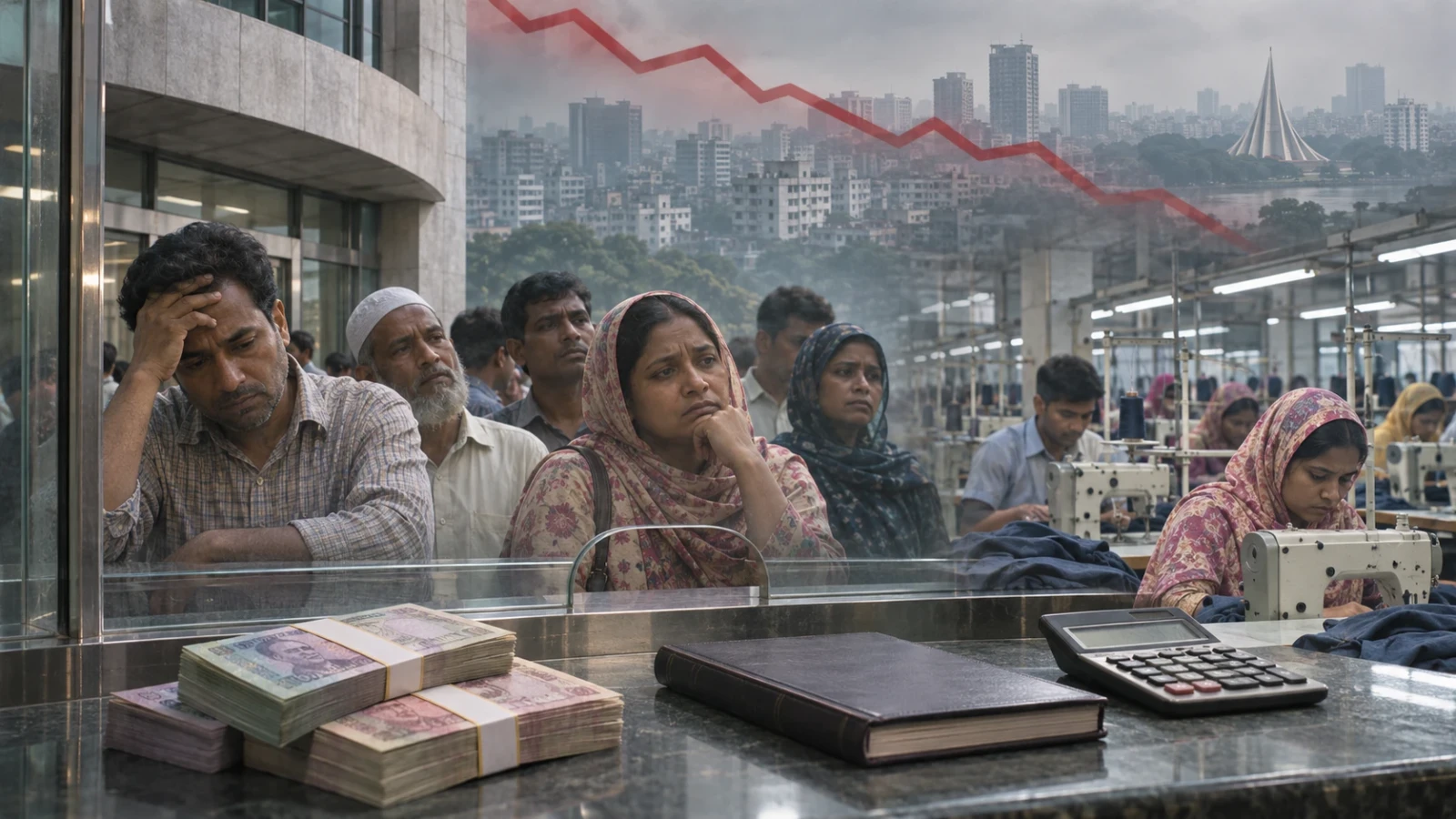
Bangladesh, once widely celebrated for its rapid economic growth and remarkable success in poverty reduction, is facing mounting economic challenges, with banking sector weaknesses, political uncertainty and declining investment threatening its development achievements, according to a recent report by British magazine The Economist.
The report questions whether Bangladesh has lost its reputation as a global development role model after decades of economic progress.
The country’s banking sector has come under severe pressure amid allegations of irregularities, loan fraud and financial misconduct. Ordinary depositors are struggling to withdraw their savings, with some reportedly waiting months or even years to access their money.
The magazine cited the experience of Ekanto, a Dhaka-based café owner who has been unable to withdraw his bank deposits for the past year. Despite repeated visits to the bank, he has been told that the institution is facing a liquidity shortage.
At least six depositors reportedly described similar difficulties, including people unable to access savings intended for their children’s weddings or funeral expenses for their parents.
The banking sector’s non-performing loan ratio has reportedly reached around 33 per cent, significantly higher than India’s 1.7 per cent and Pakistan’s 5 per cent. The combined capital shortfall of Bangladeshi banks stands at 3.8 per cent, raising concerns about the financial viability of a substantial portion of the sector.
From development success to economic uncertainty
After gaining independence in 1971, Bangladesh began its journey amid widespread poverty, natural disasters and limited export capacity. At the time, some US officials famously described the country as a “bottomless basket”.
However, the country gradually transformed its economy through the expansion of the ready-made garment industry, rising exports, poverty reduction and improvements in healthcare and education.
That progress is now facing significant challenges.
The country, home to nearly 180 million people, is struggling with institutional weaknesses and financial sector instability. Since taking office in February, the BNP-led government has faced mounting pressure over the banking crisis, labour unrest in the garment industry and law and order concerns.
Political uncertainty has also intensified following former prime minister Sheikh Hasina’s announcement that she intends to return to Bangladesh in December. The report said her possible return could further complicate the political situation and trigger fresh anti-government protests. Hasina has been sentenced to death in absentia by a court.
Banking crisis threatens investment
The report highlighted the concentration of bad loans in Islamic and state-owned banks, with Islami Bank Bangladesh emerging as a particularly significant case.
The country’s one of largest private banks was previously associated with political controversy over its links to Jamaat-e-Islami. The S Alam Group later took control of the bank, citing allegations of terrorist financing.
The banking crisis is also affecting business activity and private investment. Private sector credit growth, which stood at around 10 per cent in 2025, has fallen to 4.5 per cent this year — its lowest level in 33 years.
Bangladesh’s economic growth is projected to slow to 3.7 per cent this year, compared with approximately 6.5 per cent towards the end of Hasina’s administration, according to the report.
Energy shortages and industrial disruptions have further weakened economic activity. Production at several factories has been affected by inadequate energy supplies, while labour unrest and strikes in the garment sector have added to the difficulties.
The World Bank has warned that poverty in Bangladesh could rise for the third consecutive year in 2026, potentially reversing decades of progress in poverty reduction.
Massive financial support, but little room for recovery
To keep struggling banks operational, Bangladesh Bank has provided around $6.2 billion in emergency liquidity assistance, equivalent to approximately 1.2 per cent of the country’s gross domestic product (GDP).
However, the support is insufficient to address the banking sector’s overall capital shortfall.
According to an assessment by international credit rating agency Moody’s, Bangladesh may need financial resources equivalent to around 10 per cent of GDP over the next few years to address the sector’s capital deficiencies.
The government’s ability to mobilise such resources remains limited. Tax evasion and weak revenue administration have kept Bangladesh’s tax revenue at around 7 per cent of GDP, compared with approximately 10 per cent in Pakistan.
Meanwhile, government spending on food and energy subsidies has contributed to a budget deficit of 3.3 per cent of GDP. The government has increasingly relied on borrowing from relatively stronger private commercial banks to finance its expenditure.
Additional liquidity support from the central bank could also increase money supply and create further inflationary pressure.
Questions over banking reforms
The new government’s approach to restructuring the banking sector has also drawn criticism.
In June, the government introduced provisions allowing financially distressed borrowers additional time to pay interest on their loans. It also imposed a ceiling on bank lending rates.
Economists have warned that fixing interest rates could limit banks’ ability to assess borrowers’ risks and set lending rates accordingly, potentially weakening credit risk management.
When Law Enforcers Open Fire: A Fisherman’s Death Demands Justice
Finance Minister Amir Khasru Mahmud Chowdhury has defended the government’s approach, saying the administration is not postponing the problems. He said initiatives were underway to clean up banks’ financial statements and that viable businesses facing temporary difficulties could be considered for additional time to repay their loans.
Nevertheless, questions remain over whether the change in political leadership will bring meaningful reforms to the banking sector’s governance structure.
The report also cited concerns raised by an economist that influential business groups associated with the BNP, some of whom remained outside power for 15 years, could seek economic advantages of their own.
This has raised questions about whether banking reforms could ultimately benefit a new group of politically connected business interests rather than ensure transparency and accountability.
A former government official, quoted in the report, suggested that although political power had changed hands, the fundamental system remained largely unchanged.
A critical test for the new government
Bangladesh’s economic difficulties now extend beyond the banking sector. Rising bad loans, capital shortages, weak revenue collection, declining private investment, energy constraints and political instability are collectively undermining the country’s economic prospects.
The challenge for the BNP-led government will be to restore confidence in the financial system, strengthen institutional accountability, recover defaulted loans and ensure that banks operate independently of political and business influence.
The country’s ability to address these structural weaknesses will determine whether Bangladesh can regain the economic momentum that once established it as one of the world’s most widely recognised development success stories.





COMMENTS